- Animals
- ›Chordates
- ›Vertebrates
- ›Reptiles
- ›Snakes and Lizards
- ›Lizards
- ›Skinks and allies
- ›Skinks
- ›Eugongyline skinks
- ›Oligosoma
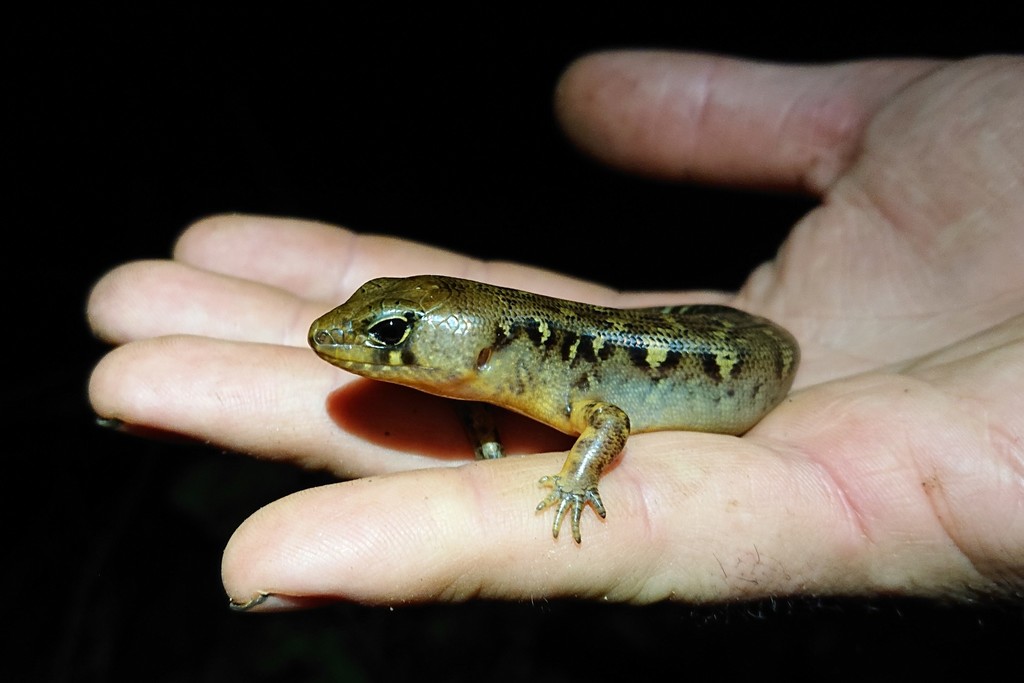
Robust Skink
Oligosoma alani
Oligosoma alani, (formerly Cyclodina alani), also known as the robust skink, is the largest endemic skink to New Zealand. The robust skink is in the family Scincidae and found in the protected nature reserves of the Mercury Islands in the North Island of New Zealand. The robust skink has an at risk - recovering conservation status.
From the article Robust skink on Wikipedia (CC BY-SA), quoted section by section
Description
The New Zealand skink fauna is incredibly diverse, coming from a monophyletic lineage to many species with varying morphologies. The robust skink is the largest in New Zealand with a maximum recorded snout-vent length of 150mm2, length of up to 33 cm and weight of 105 grams. These skinks are large with short limbs and toes, with a thickset body. Characterising points of these skinks are large body, and mid-dark brown dorsal colouring, often broken up with large cream/pale blotches. Some individuals are seen to have black and white markings above shoulders with ventral areas of the body showing vivid reddish pink colouring. Below each dark eye, a black-edged teardrop shape can be seen. The snouts are round and blunt. Tails are thick and quickly taper off. Given their large shape and clear markings the robust skink is unlikely to be confused with other types of skinks. Robust skinks lack common reptile predator avoidance features such as body armour. Hence the evolution of camouflage patterning features allowing this species to be cryptic and avoid identification as food by predators. Robust skinks can show extreme longevity in adulthood, with recorded ages of 33 and 55 years in captivity.
Range & habitat
Members of the North New Zealand herpetofauna have faced range declines due to mammalian predation and colonisation. Following the first wave of mainland reptilian extinctions the robust skink is only found on rodent free islands off the North Island of New Zealand. Subfossils have been recorded from areas such as Motutapu Island (Auckland), Waitomo and Martinborough. The robust skink is strictly nocturnal to maximise benefits and reduce costs of feeding. They are a forest-dwelling species, occupying seabird burrows, rocky areas and deep forest litter. Like other Oligosoma skinks, the robust skink is physiologically restricted to moist microenvironments, as they are susceptible to water loss through their skin. Thus, they prefer areas of high humidity. To avoid water loss and maximise survival chances the skinks, spend the day in thick leaf litter, hide under rocks and find refuge in seabird burrows, such behaviour is both innate and learned.
Wikipedia: “Distribution and habitat”
What it does
As seen in other lizard species, the mating behaviour in Oligosoma is rather violent. The male often repeatedly bites the female around the neck and head area causing scarring. This behaviour is common among skink species as a mate selection strategy, to assess the relative quality of the female.
Wikipedia: “Courtship behaviour”
In human culture
The specific epithet, alani, was given by the describer Joan Robb in honour of her nephew, Alan Robb.
Wikipedia: “Etymology”
Where it lives
Recorded sightings
—
geo-referenced records in GBIF, from museums, herbaria and field observers.
Drag the globe to turn it. Dots are where records exist, not a range map; darker means more records.
In the stacks
Searching the stacks…
Every page naming Oligosoma alani in the Biodiversity Heritage Library →
This page is assembled live from iNaturalist, GBIF, Wikipedia, the Source Library and the Internet Archive. It is not yet part of the hand-edited codex. iNaturalist taxon 37027.