- Animals
- ›Chordates
- ›Vertebrates
- ›Reptiles
- ›Snakes and Lizards
- ›Lizards
- ›Skinks and allies
- ›Skinks
- ›Social skinks
- ›Cyclodomorphus
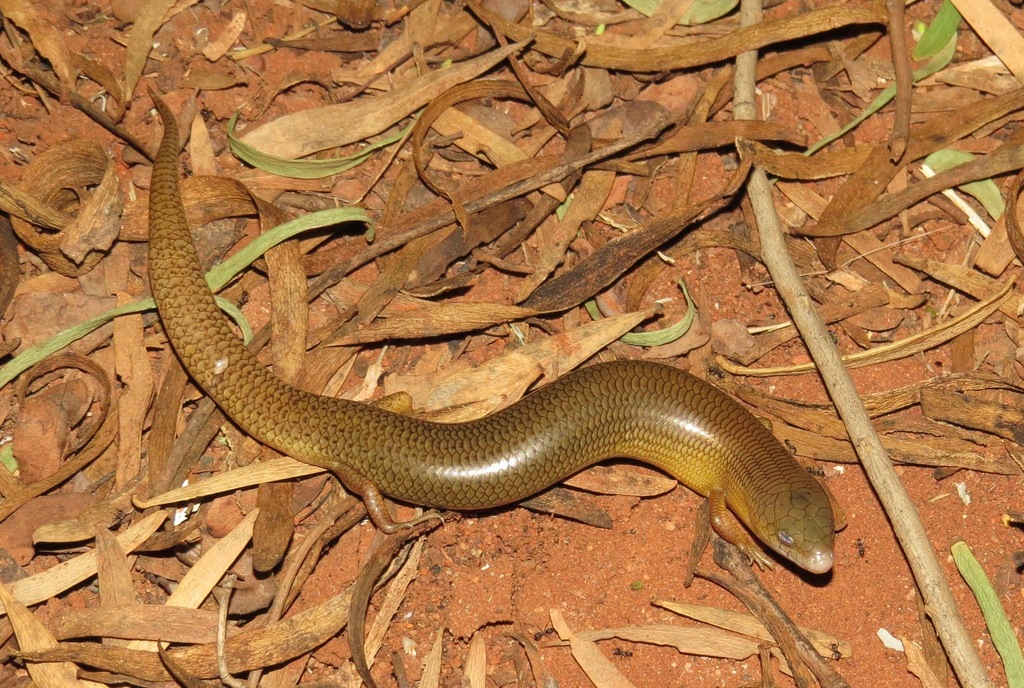
Spinifex Slender Bluetongue
Cyclodomorphus melanops
The Spinifex slender blue-tongue or Samphire slender bluetongue (Cyclodomorphus melanops) is an endemic species of skink that inhabits the arid areas of central Australia. The Spinifex slender blue-tongue is closely related to the large blue-tongue skinks (Tiliqua Gray, 1825). However is individually categorised under the Genus Cyclodomorphus and species Cyclodomorphus melanops (C. melanops).
From the article Spinifex slender blue-tongue on Wikipedia (CC BY-SA), quoted section by section
Description
The group of the Spinifex slender blue-tongue (Cyclodomorphus melanops) consists of small to medium-sized skinks that are primarily categorised by their slender body type. These species can measure around 12-13 centimetres from their snout to pelvis. With the tail of the animal spanning just shorter or equal to the length of its body. As stated by the name, each of the subspecies have a dark blue tongue colour with a pale upper lip.
Cyclodomorphus melanops melanops (Stirling & Zietz, 1893). This subspecies is typically a grey-brown, yellow-brown or orange-brown dorsal colouration with minimal body patterning. The underside is typically the same colour as the dorsal side, just paler. Having dorsal colours with minimal patterning allows for this species to camouflage into its surrounding habitat of light coloured sands. In turn reducing the likelihood of being spotted by predators such as foxes. The limbs for this species are short with small claws except for one longer toe on the hind legs. This aids them in the manoeuvring through the sandy surfaces and climbing up the branches of trees.
Cyclodomorphus melanops elongatus (Werner, 1910). The characteristics for this species is similar to that of the one above. However, the body for this subspecies is typically has a slightly darker brown dorsal surface colour with an even darker head. …
Wikipedia: “Characteristics”
Range & habitat
The C. melanops species are well adapted to the harsh environments of Australia. In turn meaning they are primarily distributed within
arid inland areas across Australia, within a range that extends from Western Australia (WA) to western NSW and Queensland (QLD). While they predominantly favour inland regions, it can also inhabit areas along the north coast of WA. The species is found to be most prominent within the southern end of South Australia (SA), midland Australia, and the western side of NSW. This distribution closely correlates with dryer desert environments, characterised by the presence of spinifex grasses. The adaptability of the C. melanops to arid conditions and Spinifex-rich landscapes contributes to its presence across the diverse regions of the Australian continent.
Wikipedia: “Distribution”
What it does
Each of the C. melanops have a solitary, nocturnal behaviour pattern and is typically most active within the late evenings and into the night. These skinks can have a tendency to be spotted within open environments such as roads and walking tracks when hunting for prey. However, they can also have a habit of hiding under rocks or low vegetation such as spinifex grasses where it is able to evade predators and wait for oncoming prey.
Wikipedia: “Behaviour”
Where it lives
Recorded sightings
—
geo-referenced records in GBIF, from museums, herbaria and field observers.
Drag the globe to turn it. Dots are where records exist, not a range map; darker means more records.
In the stacks
Searching the stacks…
Every page naming Cyclodomorphus melanops in the Biodiversity Heritage Library →
This page is assembled live from iNaturalist, GBIF, Wikipedia, the Source Library and the Internet Archive. It is not yet part of the hand-edited codex. iNaturalist taxon 37016.