- Animals
- ›Chordates
- ›Vertebrates
- ›Ray-finned Fishes
- ›Spiny-rayed fishes
- ›Pipefishes and Allies
- ›Syngnathoidei
- ›Pipefishes, Seahorses, and Seadragons
- ›Tail-brooding Pipefishes
- ›Halicampus
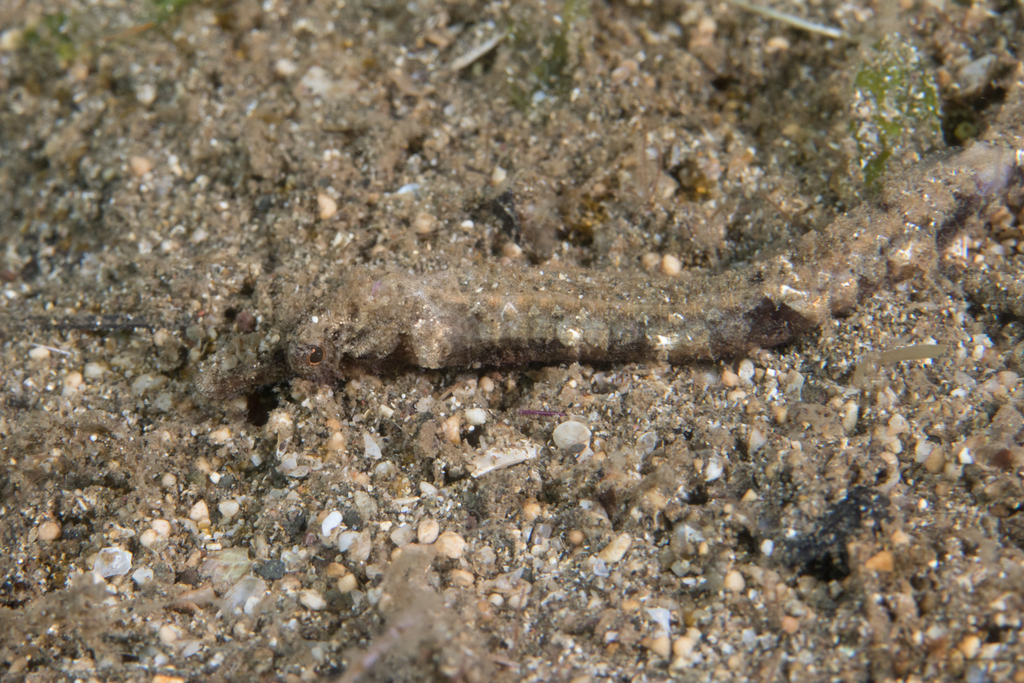
Mud Pipefish
Halicampus grayi
Halicampus grayi, Gray's pipefish, also known as the mud pipefish or spiny pipefish, is a species of marine fish of the family Syngnathidae. It is found in the Indo-Pacific in the Gulf of Aden, Sri Lanka, and from the Gulf of Thailand to Japan, the Marshall Islands, and the Great Barrier Reef. It lives to depth of 100 metres (330 ft), and planktonic juveniles have been found above depths of 3,000 metres (1.9 mi). It occurs in muddy habitats, in estuaries, and on coral reefs, where it likely feeds on small crustaceans. It can grow to lengths of 20 centimetres (7.9 in). This species is ovoviviparous, with males carrying eggs in a brood pouch before giving birth to live young.
From the article Halicampus grayi on Wikipedia (CC BY-SA), quoted section by section
Description
H. grayi is brownish with dark bars along the side of its body, and pale bars on the gill membrane. This colouring provides extremely good camouflage for muddy and silty habitats, where the species will cover itself to stay hidden.
== References ==
In human culture
The fish's patronym was not identified but it was certainly in honor of British zoologist John Edward Gray (1800-1875), who got Kaup's monograph on syngnathid fishes published under the auspices of the British Museum.
Wikipedia: “Etymology”
Where it lives
Recorded sightings
—
geo-referenced records in GBIF, from museums, herbaria and field observers.
Drag the globe to turn it. Dots are where records exist, not a range map; darker means more records.
In the stacks
Searching the stacks…
Every page naming Halicampus grayi in the Biodiversity Heritage Library →
This page is assembled live from iNaturalist, GBIF, Wikipedia, the Source Library and the Internet Archive. It is not yet part of the hand-edited codex. iNaturalist taxon 368806.