On eBird ↗
King Rail
Live sightings near you, the range map, bar charts of when it is seen, and Macaulay Library photos and recordings.
King Rail
Rallus elegans
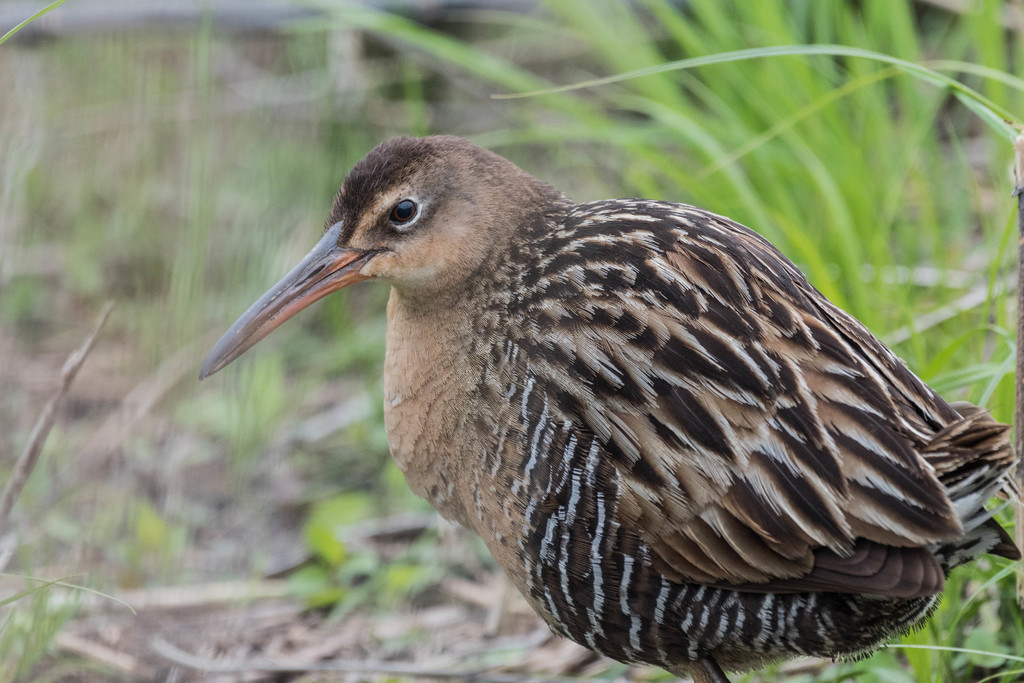
The king rail (Rallus elegans) is a large, mostly brown rail native to North America, where it breeds in marshes.
From the article King rail on Wikipedia (CC BY-SA), quoted section by section
Description
Distinct features are a long bill with a slight downward curve, with adults being brown on the back and rusty-brown on the face and breast with a dark brown cap. They also have a white throat and a light belly with barred flanks. Undertail coverts are white and are displayed by the male during courtship. Immature birds are covered in down, with light brown on the head and darker brown on the back and wings. The males are larger than females, the male weighing on average 369 g (13.0 oz) and the female weighing 309 g (10.9 oz). This bird's call is a low repeated grunt transcribed as kek-kek-kek.
Range & habitat
This bird breeds in marshes in eastern North America. Birds along the southeastern coasts of the United States are permanent residents. Other birds migrate to the southern United States and Mexico; in Canada, they are found in southern Ontario. An adult king rail will molt completely after nesting and it becomes flightless for almost a month.
Wikipedia: “Distribution and habitat”
What it does
This rail forages in shallow water near cover and eats mainly aquatic insects and crustaceans. It forages by probing the mud while moving around in shallow water. The chicks are fed small arthropod prey by their parents. The prey is transferred from one parent's beak to that of the chick. Males often give food to whomever they pursue during courtship.
Wikipedia: “Feeding”
Listen
Looking for field recordings…
Where it lives
Recorded sightings
—
geo-referenced records in GBIF, from museums, herbaria and field observers.
Drag the globe to turn it. Dots are where records exist, not a range map; darker means more records.
In the stacks
Searching the stacks…
Every page naming Rallus elegans in the Biodiversity Heritage Library →
This page is assembled live from iNaturalist, GBIF, Wikipedia, the Source Library and the Internet Archive. It is not yet part of the hand-edited codex. iNaturalist taxon 367715.