On eBird ↗
Plumbeous Seedeater
Live sightings near you, the range map, bar charts of when it is seen, and Macaulay Library photos and recordings.
Plumbeous Seedeater
Sporophila plumbea
The plumbeous seedeater (Sporophila plumbea) is a species of bird in the family Thraupidae. It is found in Argentina, Bolivia, Brazil, Colombia, French Guiana, Guyana, Paraguay, Peru, Suriname, and Venezuela. Its natural habitats are dry savanna and subtropical or tropical seasonally wet or flooded lowland grassland.
From the article Plumbeous seedeater on Wikipedia (CC BY-SA), quoted section by section
Description
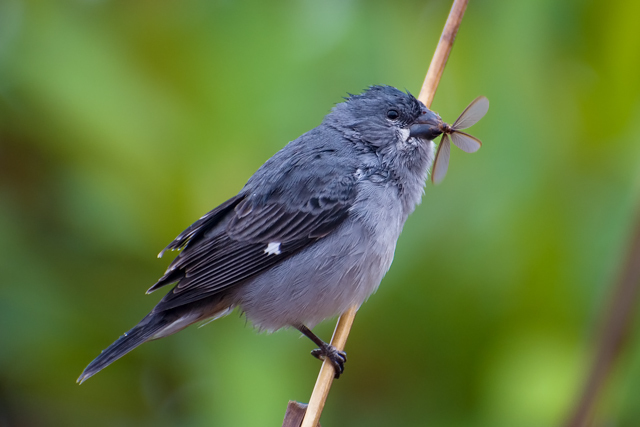
The plumbeous seedeater is 10.5 to 11 cm (4.1 to 4.3 in) long and weighs 8.8 to 12 g (0.31 to 0.42 oz). It has a thick bill with a rounded culmen. The species is sexually dimorphic. Adult males of the nominate subspecies S. p. plumbea have a lead-gray head with a pale arc under the eye and some faint darker streaks on the crown. Their upperparts are also lead-gray with faint darker streaks except on the rump. Their tail is blackish with very thin grayish olive edges and buffy tips on the feathers. Their wings' upper sides are blackish with olive-gray edges on the coverts, olive-brown edges on the tertials, and white bases on the primaries that show as a small square on the closed wing. Their chin and lower cheek are whitish, their throat and breast a paler gray than the upperparts, their belly and undertail coverts an even paler gray, and their vent almost whitish. Their wings' undersides are gray with white marginal coverts. Males of subspecies S. p. colombiana are overall a paler gray than the nominate with more white on the face and a white throat. Males of S. p. whiteleyana are like the nominate but for a more visible white arc under the eye and more white around the base of the bill. Adult females of all three subspecies have a brownish head, upperparts, tail, and wings without the male's white primaries. …
Range & habitat
The plumbeous seedeater has a disjunct distribution: No subspecies' range abuts another, and some subspecies have gaps within their ranges. The subspecies are found thus:
S. p. colombiana: northern Colombia disjunctly in southern Chocó Department, the lower valley of the Magdalena River, and the Sierra Nevada de Santa Marta S. p. whiteleyana: Colombia in a triangle from approximately western Meta Department northeast into Venezuela; Venezuela primarily in Amazonas and Bolívar states with scattered records in the Serranía del Perijá on the Colombian border and in Carabobo and possibly Aragua states; and extending east through the Guianas and extreme northern Brazil's Roraima and northeastern Amapá states to the Atlantic S. p. plumbea: Junín Department and extreme southeastern Madre de Dios Department in southeastern Peru east through northern Bolivia into much of southern Brazil and eastern Paraguay. In Brazil it is within a line from Rondonia east almost to the Atlantic in Bahia, south to the Atlantic in Sao Paulo state and across northern Rio Grande do Sul. Several sources include northeastern Argentina's Misiones Province in the subspecies' range but the South American Classification Committee has only unconfirmed records from that country. The plumbeous seedeater primarily inhabits wet savanna and grasslands, where it greatly favors tall grass and is usually near water. …
Wikipedia: “Distribution and habitat”
What it does
The plumbeous seedeater feeds mostly on grass seeds; those of genus Andropogon are known in its diet. It plucks seeds while clinging to stems and also feeds on the ground. It is typically in small flocks that include other seedeaters.
Wikipedia: “Feeding”
Listen
Looking for field recordings…
Where it lives
Recorded sightings
—
geo-referenced records in GBIF, from museums, herbaria and field observers.
Drag the globe to turn it. Dots are where records exist, not a range map; darker means more records.
In the stacks
Searching the stacks…
Every page naming Sporophila plumbea in the Biodiversity Heritage Library →
This page is assembled live from iNaturalist, GBIF, Wikipedia, the Source Library and the Internet Archive. It is not yet part of the hand-edited codex. iNaturalist taxon 367713.