On eBird ↗
Yellow-winged Cacique
Live sightings near you, the range map, bar charts of when it is seen, and Macaulay Library photos and recordings.
Yellow-winged Cacique
Cassiculus melanicterus
The Mexican cacique or yellow-winged cacique (Cassiculus melanicterus) is a species of cacique in the family Icteridae. It is found only on the west coast of Mexico and the northern-most edge of Guatemala. It is monotypic in its own genus.
From the article Mexican cacique on Wikipedia (CC BY-SA), quoted section by section
Description
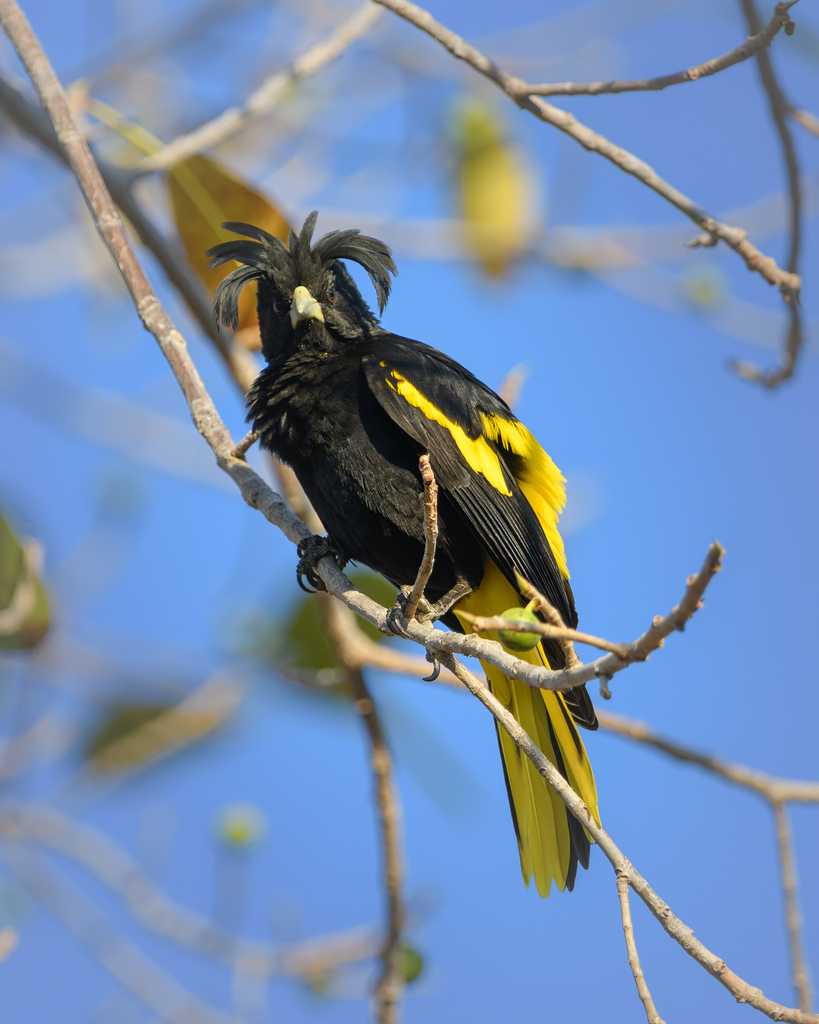
Mexican cacique males average about 32 cm (13 in) long and females about 28 cm (11 in). Males weigh an average of about 96 g (3.4 oz) and females 70 g (2.5 oz). Adult males are mostly glossy black and have a long crest on the nape. Their lower back and uppertail coverts, most upperwing coverts, and crissum are yellow. Their tail is mostly black with yellow outer feathers. Adult females have a shorter crest than males. They have almost the same pattern as males but are a duller slaty black and their yellow tail feathers have olive edges. Both sexes have a dark brown iris, an ivory-colored bill with variable darker tinges, and dark gray legs and feet. Juveniles have no crest, are dusky where the adults are black, and have a greenish tinge on the yellow parts.
Range & habitat
The Mexican cacique has a disjunct distribution. Its main range is along the Pacific lowlands of Mexico from central Sonora to western Chiapas. Many systems place it separately in western Guatemala. A 2016 field guide to northern Central American birds places it very locally in Guatemala and includes a sub-population in northern El Salvador. The Cornell Lab of Ornithology's Birds of the World also places it in El Salvador. In most of its range it inhabits clearings and edges of dry to moderately humid deciduous forest, thorn scrub, grassy areas such as savanna and large pastures if they have large trees, and also plantations. In El Salvador it primarily occurs in coastal mangroves and gallery forest. Overall it ranges from sea level to 1,500 m (4,900 ft) but reaches only about 200 m (700 ft) in Guatemala and El Salvador.
Wikipedia: “Distribution and habitat”
What it does
The Mexican cacique feeds primarily on insects and other invertebrates and also on fruits and nectar in lesser amounts. It is thought to also prey on small vertebrates. It sometimes joins mixed-species feeding flocks. It forages in small flocks mostly from the forest's mid-level to its canopy.
Wikipedia: “Feeding”
Listen
Looking for field recordings…
Where it lives
Recorded sightings
—
geo-referenced records in GBIF, from museums, herbaria and field observers.
Drag the globe to turn it. Dots are where records exist, not a range map; darker means more records.
In the stacks
Searching the stacks…
Every page naming Cassiculus melanicterus in the Biodiversity Heritage Library →
This page is assembled live from iNaturalist, GBIF, Wikipedia, the Source Library and the Internet Archive. It is not yet part of the hand-edited codex. iNaturalist taxon 367693.