On eBird ↗
Great-billed Seed-Finch
Live sightings near you, the range map, bar charts of when it is seen, and Macaulay Library photos and recordings.
Great-billed Seed-Finch
Sporophila maximiliani
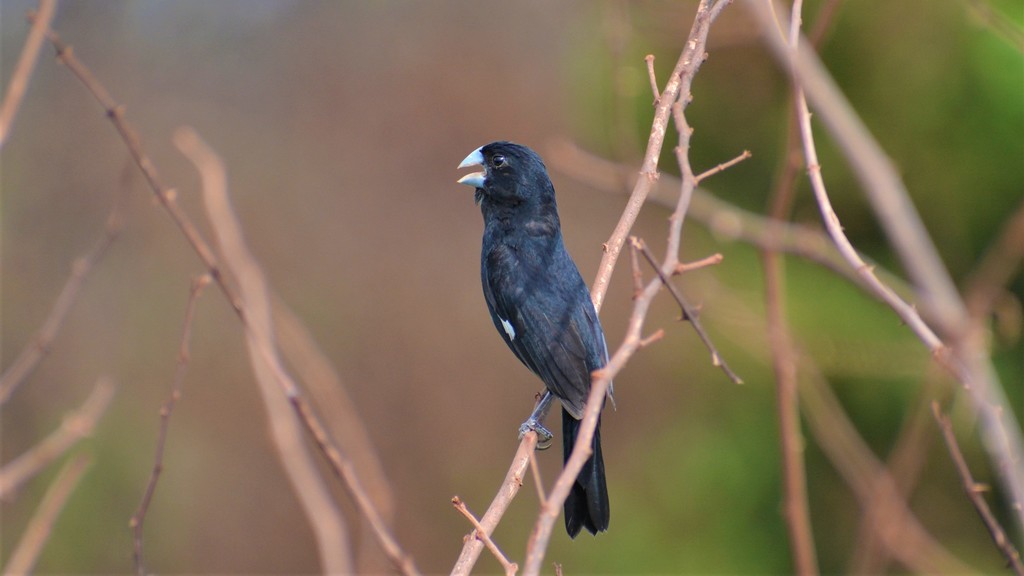
The great-billed seed finch (Sporophila maximiliani) is a species of bird in the family Thraupidae. Its natural habitats are subtropical or tropical moist shrubland, swamps, and heavily degraded former forest. They are found in two separate general populations, one in the northern Amazon rainforest and the other in the Cerrado. They live in flooded areas with nests low to the ground. The adults express strong sexual dimorphism. Males are black with white under wing-coverts and ivory white bills, and the females are generally light brown with white under wing-coverts and black bills. Both the male and female have very large, thick bills. The great-billed seed finch has a melodious call, which has made it a target for trapping.
Although the population is quickly declining due to trapping and loss of habitat, not much is known about its behavior and ecology.
From the article Great-billed seed finch on Wikipedia (CC BY-SA), quoted section by section
Description
The great-billed seed finch is sexually dimorphic. They have an extremely large and thick bill, that is chalky white in males and black in females. The beak volume is about 840mm³. The males are black with white or white and black under wing-coverts. The females have a warm brown back and a buffy brown belly with white under wing-coverts. The females are very similar to other adult females of the Sporophila genus. Both the male and female great-billed seed finch are very similar in appearance to the male and female large-billed seed finch. It is a medium-sized finch at around 14.5–16.5 cm (5.7–6.5 in) in length. The juvenile is similar in appearance to the female. Sexual dimorphism presents itself in males when they begin to sing. The male juvenile eventually moults its black feathers, having a patchy appearance for several months until it is fully black. Due to their similarity with other species, sexual dimorphism, and juvenile appearance, great-billed seed finches can be very difficult to identify morphologically. The eggs of the great-billed seed finch are grayish white with black blotches and light brown spots.
Range & habitat
The great-billed seed finch exists in two separate populations in South America. The southern population is found in the Cerrado and in the Cerrado enclaves into the transition zones in Atlantic Forest. The northern population is found in the northern Amazon rainforest. The great-billed seed finch is specialized to live in humid environments and is often associated with flooded areas and marshy borders.
Wikipedia: “Distribution and habitat”
What it does
The great-billed seed finch is predominantly granivorous and feeds mainly on seeds of many species in the Cyperaceae family. They are usually found in pairs. Not much more is known.
Wikipedia: “Feeding”
Listen
Looking for field recordings…
Where it lives
Recorded sightings
—
geo-referenced records in GBIF, from museums, herbaria and field observers.
Drag the globe to turn it. Dots are where records exist, not a range map; darker means more records.
In the stacks
Searching the stacks…
Every page naming Sporophila maximiliani in the Biodiversity Heritage Library →
This page is assembled live from iNaturalist, GBIF, Wikipedia, the Source Library and the Internet Archive. It is not yet part of the hand-edited codex. iNaturalist taxon 367684.