On eBird ↗
Marianne White-eye
Live sightings near you, the range map, bar charts of when it is seen, and Macaulay Library photos and recordings.
Marianne White-eye
Zosterops semiflavus
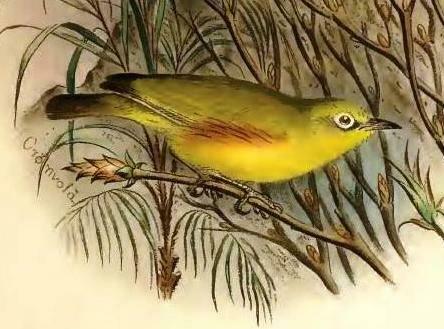
The Marianne white-eye (Zosterops semiflavus), also known as Seychelles chestnut-sided white-eye or Seychelles yellow white-eye, is an extinct species of small bird in the white-eye family.
From the article Marianne white-eye on Wikipedia (CC BY-SA), quoted section by section
Description
It reached a size of 10 cm (3.9 in), the wing length was 5.8 to 6.3 cm (2.3 to 2.5 in), the length of the tail was 3.8 cm (1.5 in) and the length of the culmen 1.1 to 1.2 cm (0.43 to 0.47 in). It was generally greenish yellow with chestnut-coloured flanks and a conspicuous white eye-ring. The forehead and a line above the eyes were yellow. The top of the head and the back were yellow olive. The wings and the tail were black and the underparts were pale yellow. It was similar in appearance to the Mayotte race of the Malagasy white-eye (Zosterops maderaspatanus mayottensis). Nothing is known of its ecology.
Range & habitat
It is known with certainty only from the small granitic islet of Marianne Island 0.962 mi2 (2.49 km2) in the Seychelles about 6 km (3.7 mi) east of La Digue. Reports that it also occurred on Praslin, La Digue, Silhouette Island and Mahé are unconfirmed. Due to the habitat destruction through agricultural development it apparently became extinct between 1870 and 1900 (according to IUCN around 1888). An expedition in 1940 led by Irish zoologist Desmond Vesey-Fitzgerald failed to find it. There is one specimen in the Natural History Museum in London.
Wikipedia: “Distribution and habitat”
Listen
Looking for field recordings…
Where it lives
Recorded sightings
—
geo-referenced records in GBIF, from museums, herbaria and field observers.
Drag the globe to turn it. Dots are where records exist, not a range map; darker means more records.
In the stacks
Searching the stacks…
Every page naming Zosterops semiflavus in the Biodiversity Heritage Library →
This page is assembled live from iNaturalist, GBIF, Wikipedia, the Source Library and the Internet Archive. It is not yet part of the hand-edited codex. iNaturalist taxon 367662.