On eBird ↗
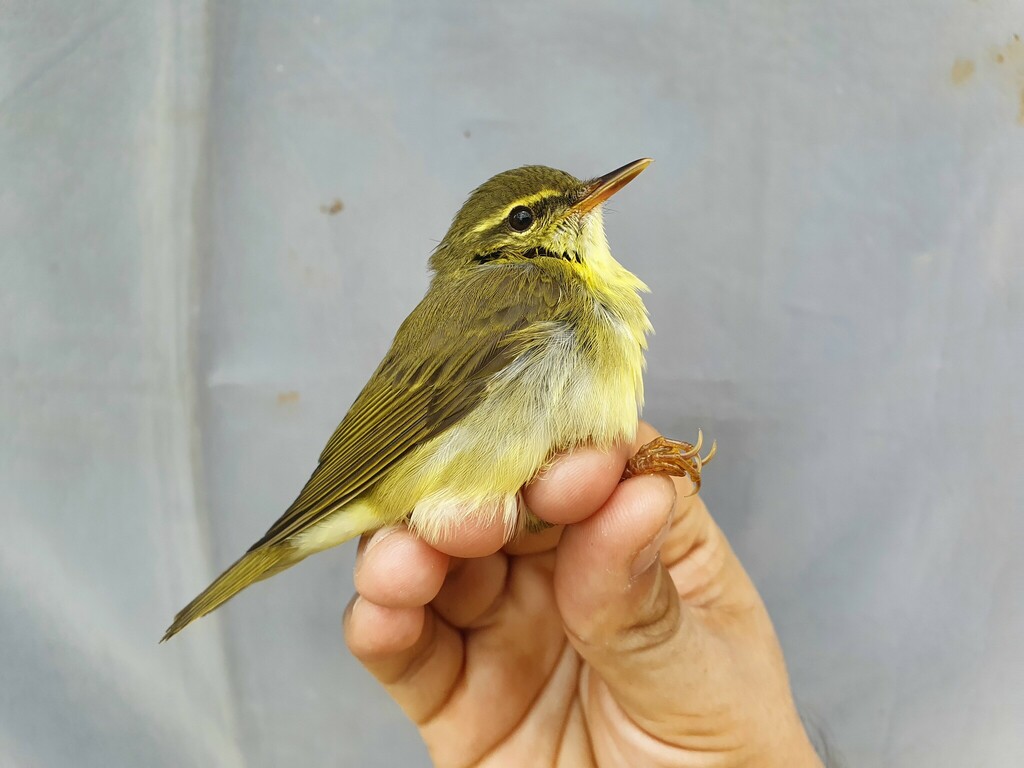
Japanese Leaf Warbler
Live sightings near you, the range map, bar charts of when it is seen, and Macaulay Library photos and recordings.
Japanese Leaf Warbler
Phylloscopus xanthodryas
The Japanese leaf warbler (Phylloscopus xanthodryas) is a leaf warbler (family Phylloscopidae). The species was first described by Robert Swinhoe in 1863. It was formerly included in the "Old World warbler" assemblage. It is closely related to the Arctic warbler and the Kamchatka leaf warbler, to which it was formerly considered conspecific.
It is found throughout Japan, except on Hokkaido; it winters to Southeast Asia.
From the article Japanese leaf warbler on Wikipedia (CC BY-SA), quoted section by section
Description
The Japanese Leaf-Warbler is sized between 12–13 cm in length. They typically have darker green upper body feathers, with an under body (or belly) with lighter green feathers. They have a very short and black (with a hint of yellow) beak, as well as extremely small legs that vary from pale yellow to orange-brown. The bird has a clear yellowish-white eyebrow stripe above the bird's dark eyes. Adults are bright olive-green (with a white wingbar and greenish tail). Both sexes look alike. Juveniles are roughly similar, yet duller in color (more grey-brown).
Range & habitat
This species lives in mixed and deciduous forests, as well as in coniferous woods and thickets. It is usually found between 1500 and 2500 meters in elevation, but most often below 2200 meters. It nests in thick undergrowth, rhododendron bushes, and scrub above the tree line. In winter, it is seen below 1800 meters in woodlands, rainforests, secondary growth, plantations, and gardens. It also occurs in shrublands, wetlands, and cultivated areas, as well as artificial terrestrial habitats. The species depends on thick vegetation for nesting and foraging.
Wikipedia: “General Habitat”
What it does
Its diet is made up mostly of insects and their larvae. Common food items include midges, ants, grasshoppers, caterpillars, beetles, spiders, and small snails. In autumn, it may also eat berries. The warbler usually forages alone or in pairs but can join mixed groups of birds outside of the breeding season. It searches for food in trees, shrubs, and on the ground, and it sometimes catches insects while flying.
Wikipedia: “Diet and Foraging”
Listen
Looking for field recordings…
Where it lives
Recorded sightings
—
geo-referenced records in GBIF, from museums, herbaria and field observers.
Drag the globe to turn it. Dots are where records exist, not a range map; darker means more records.
In the stacks
Searching the stacks…
Every page naming Phylloscopus xanthodryas in the Biodiversity Heritage Library →
This page is assembled live from iNaturalist, GBIF, Wikipedia, the Source Library and the Internet Archive. It is not yet part of the hand-edited codex. iNaturalist taxon 367657.