On eBird ↗
Dwarf Jay
Live sightings near you, the range map, bar charts of when it is seen, and Macaulay Library photos and recordings.
Dwarf Jay
Cyanolyca nanus
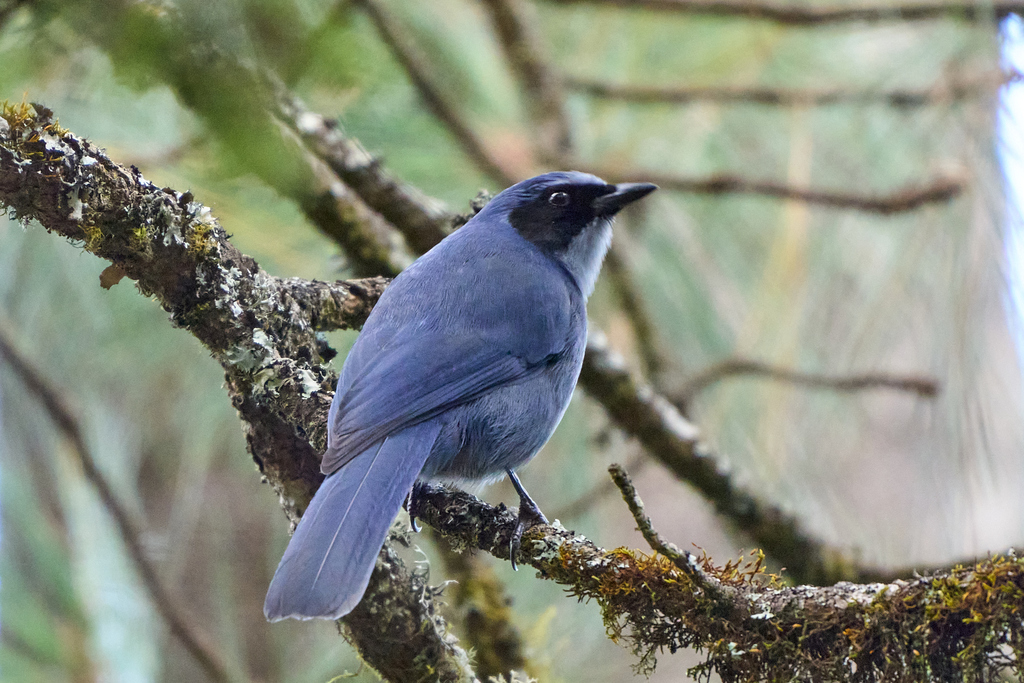
The dwarf jay (Cyanolyca nanus) is a species of bird in the family Corvidae. It is endemic to Mexico. Its natural habitat is subtropical or tropical moist montane forests. As its name would imply, this is the smallest member of the family Corvidae at 20–23 cm long and weighing 41 g. It is threatened by habitat loss.
From the article Dwarf jay on Wikipedia (CC BY-SA), quoted section by section
Description
The dwarf jay is the smallest jay in the Americas at 20 to 23 cm (7.9 to 9.1 in) long. Four individuals weighed 39 to 41.4 g (1.4 to 1.5 oz). The sexes have the same plumage though females tend to be duller than males. Adults have a black mask from the lores and chin to the cheeks and ear coverts. They have blue crown with a thin paler blue stripe separating it from the mask. Their upperparts are grayish or violet-blue that is brighter on the wings and tail. Their throat is pale purplish or whitish blue and the rest of their underparts grayish blue. The undersides of their wings and tail are grayish. They have a red brown iris, a black bill, and black legs and feet. Juveniles are duller overall than adults. They have no stripe between the crown and mask and their throat is grayish blue.
Range & habitat
The dwarf jay is found intermittently in southeastern Mexico in southwestern Veracruz, far eastern Puebla, and northern Oaxaca states. It primarily inhabits humid pine-oak forest in the upper subtropical and temperate zones. It is also often in forest dominated by fir trees and in secondary forest near its preferred habitat. It greatly favors forest with a dense understory and subcanopy. Sources differ on its elevation range with 1,600 to 3,200 m (5,200 to 10,500 ft), 1,500 to 3,000 m (4,900 to 9,800 ft), 1,600 to 3,000 m (5,200 to 9,800 ft), and 2,500 to 3,050 m (8,200 to 10,000 ft) all being listed.
Wikipedia: “Distribution and habitat”
What it does
The dwarf jay is believed to be primarily insectivorous though details are lacking. During the breeding season it typically forages in pairs but outside it is in mixed species feeding flocks of up to about 20 individuals. It forages mostly from the forest's mid-story to its lower canopy, agily seeking prey in vegetation, mosses, and in bark crevices, sometimes briefly hovering or hanging upside-down.
Wikipedia: “Feeding”
Listen
Looking for field recordings…
Where it lives
Recorded sightings
—
geo-referenced records in GBIF, from museums, herbaria and field observers.
Drag the globe to turn it. Dots are where records exist, not a range map; darker means more records.
In the stacks
Searching the stacks…
Every page naming Cyanolyca nanus in the Biodiversity Heritage Library →
This page is assembled live from iNaturalist, GBIF, Wikipedia, the Source Library and the Internet Archive. It is not yet part of the hand-edited codex. iNaturalist taxon 367648.