On eBird ↗
Bicolored Antbird
Live sightings near you, the range map, bar charts of when it is seen, and Macaulay Library photos and recordings.
Bicolored Antbird
Gymnopithys bicolor
The bicolored antbird (Gymnopithys bicolor) is a species of bird in subfamily Thamnophilinae of family Thamnophilidae, the "typical antbirds". It is found in Colombia, Costa Rica, Ecuador, Honduras, Nicaragua, and Panama.
From the article Bicolored antbird on Wikipedia (CC BY-SA), quoted section by section
Description
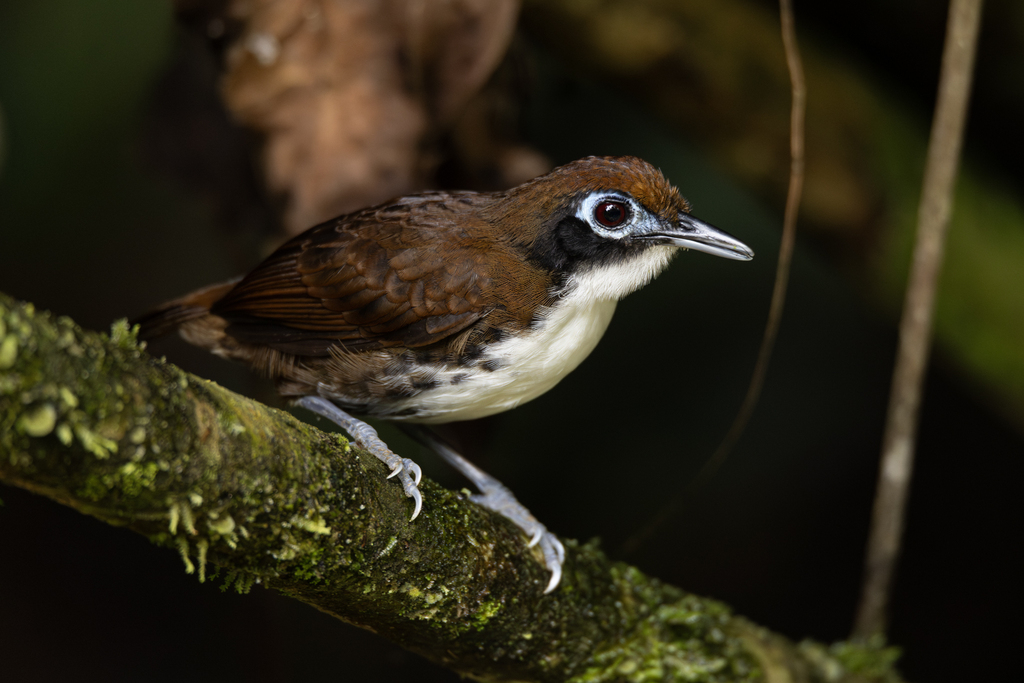
The bicolored antbird is 13.5 to 15 cm (5.3 to 5.9 in) long and weighs 28 to 37 g (0.99 to 1.3 oz). The sexes are the same. Adults of the nominate subspecies G. b. bicolor have a brownish chestnut crown and nape. They have bare blue-gray skin around the eye, a gray forehead, a broad gray band behind the eye, and black cheeks. Their back, rump, wings, and tail are brownish chestnut. Their throat and breast are white with a brown band from their cheek along their flanks. Subspecies G. b. olivascens of the bicolored antbird is much like the nominate but is dull brown behind the eye rather than gray. G. b. daguae is like a darker olivascens. G. b. aequatorialis is darker still, with a rufous forehead and blacker sides. G. b. ruficeps has a brighter rufous forehead and crown than aequatorialis, is blacker behind the eye, and has a darker reddish back and redder sides.
Range & habitat
The subspecies of the bicolored antbird are found thus:
G. b. olivascens: Caribbean slope of Honduras and Nicaragua through Costa Rica on the Caribbean and Pacific slopes into western Panama G. b. bicolor: central and eastern Panama into the Pacific slope of northwestern Colombia's Chocó Department G. b. daguae: Pacific slope of western Colombia from Chocó south to Cauca Department G. b. aequatorialis: Pacific slope of extreme southwestern Colombia into western Ecuador as far as Azuay Province G. b. ruficeps: Andes of northern Colombia between Antioquia and Cesar departments and south in the Magdalena Valley to Boyacá Department The bicolored antbird primarily inhabits lowland and foothill terra firme evergreen forest and nearby mature secondary forest. It almost entirely remains in the forest undergrowth. In elevation it reaches 1,750 m (5,700 ft) in parts of Central America though only 1,600 m (5,200 ft) in Costa Rica and 1,500 m (4,900 ft) in Panama. In Colombia it occurs below 1,000 m (3,300 ft) and in Ecuador below 750 m (2,500 ft).
Wikipedia: “Distribution and habitat”
What it does
The bicolored antbird is an obligate ant follower that feeds on a wide variety of arthropods that flee foraging army ant swarms. It typically forages individually, in pairs, and in family groups, perching within about 1 m (3 ft) of the ground though as high as 5 m (16 ft), and sallying or pouncing to the ground after prey. Up to a dozen birds have been noted at a swarm. It is dominant over smaller antbirds but subordinate to larger species of other families such as woodcreepers.
Wikipedia: “Feeding”
Listen
Looking for field recordings…
Where it lives
Recorded sightings
—
geo-referenced records in GBIF, from museums, herbaria and field observers.
Drag the globe to turn it. Dots are where records exist, not a range map; darker means more records.
In the stacks
Searching the stacks…
Every page naming Gymnopithys bicolor in the Biodiversity Heritage Library →
This page is assembled live from iNaturalist, GBIF, Wikipedia, the Source Library and the Internet Archive. It is not yet part of the hand-edited codex. iNaturalist taxon 367613.