On eBird ↗
Graceful Pitta
Live sightings near you, the range map, bar charts of when it is seen, and Macaulay Library photos and recordings.
Graceful Pitta
Erythropitta venusta
The graceful pitta (Erythropitta venusta), sometimes alternatively known as the black-crowned pitta (although another species is more regularly called black-crowned pitta (Erythropitta ussheri), is a species of bird in the family Pittidae which occurs in Sumatra, Indonesia. Its natural habitat is subtropical or tropical moist montane forests. It is threatened by habitat loss.
From the article Graceful pitta on Wikipedia (CC BY-SA), quoted section by section
Description
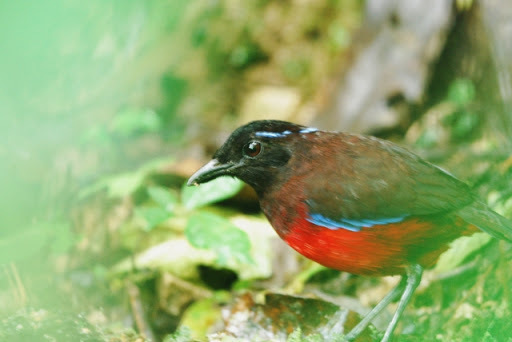
The graceful pitta is a petite bird that measures approximately 18 cm (7.1 in) in length. Its black coloring is enhanced with reddish undertones, and the bottom of its wings have vivid blue stripes running down them. The lower breast and abdomen are a dull crimson. The upper chest is dark brown with a purple hue. The legs can appear to be either a purple-blue or a pale blue, and its iris is a dark brown color. The bill is black. The extended tail has reddish-black hues. Males and females show little sexual dimorphism. Juveniles have an all dark brown exterior with less color variation throughout the body. They also have pinkish-grey feet, a red tipped bill, and grayish colored irises. Its call has been described as a high pitched train whistle which remains at a consistent pitch.
Range & habitat
The graceful pitta is a native of the Indonesian Sumatran highlands, which consist of thick tropical forests with various species of plants, animals, and insects. It inhabits dense, moist woods with a thick understory of plants, but its habitat has been decreasing rapidly due to deforestation owing to the demand for palm oil, which Indonesia is the largest producer of.
Wikipedia: “Distribution and habitat”
What it does
The graceful pitta flies close to the ground, primarily in residential levels through the trees.
Breeding. According to research, breeding can take place from May to July, and possibly as early as from February to October. But, only one nesting has been recorded for graceful pittas, which took place in May. The birds construct their nests that typically are placed around 60 centimetres (24 in) above the ground, using materials such as dead leaves, bamboo leaves, fine roots, degraded fibers, and moss. The graceful pitta typically can produce two to three eggs every breeding cycle. Each of the eggs has a distinctive look with a dull white tone and dark brown and gray lilac spots.
Wikipedia: “Behaviour”
Listen
Looking for field recordings…
Where it lives
Recorded sightings
—
geo-referenced records in GBIF, from museums, herbaria and field observers.
Drag the globe to turn it. Dots are where records exist, not a range map; darker means more records.
In the stacks
Searching the stacks…
Every page naming Erythropitta venusta in the Biodiversity Heritage Library →
This page is assembled live from iNaturalist, GBIF, Wikipedia, the Source Library and the Internet Archive. It is not yet part of the hand-edited codex. iNaturalist taxon 367594.