On eBird ↗
Gold-whiskered Barbet
Live sightings near you, the range map, bar charts of when it is seen, and Macaulay Library photos and recordings.
Gold-whiskered Barbet
Psilopogon chrysopogon
The golden-whiskered barbet (Psilopogon chrysopogon) is an Asian barbet species native to the western Malay Archipelago, where it inhabits foremost forests up to 1,500 m (4,900 ft) elevation. It has been listed as Least Concern on the IUCN Red List since 2004 because of its wide distribution.
From the article Golden-whiskered barbet on Wikipedia (CC BY-SA), quoted section by section
Description
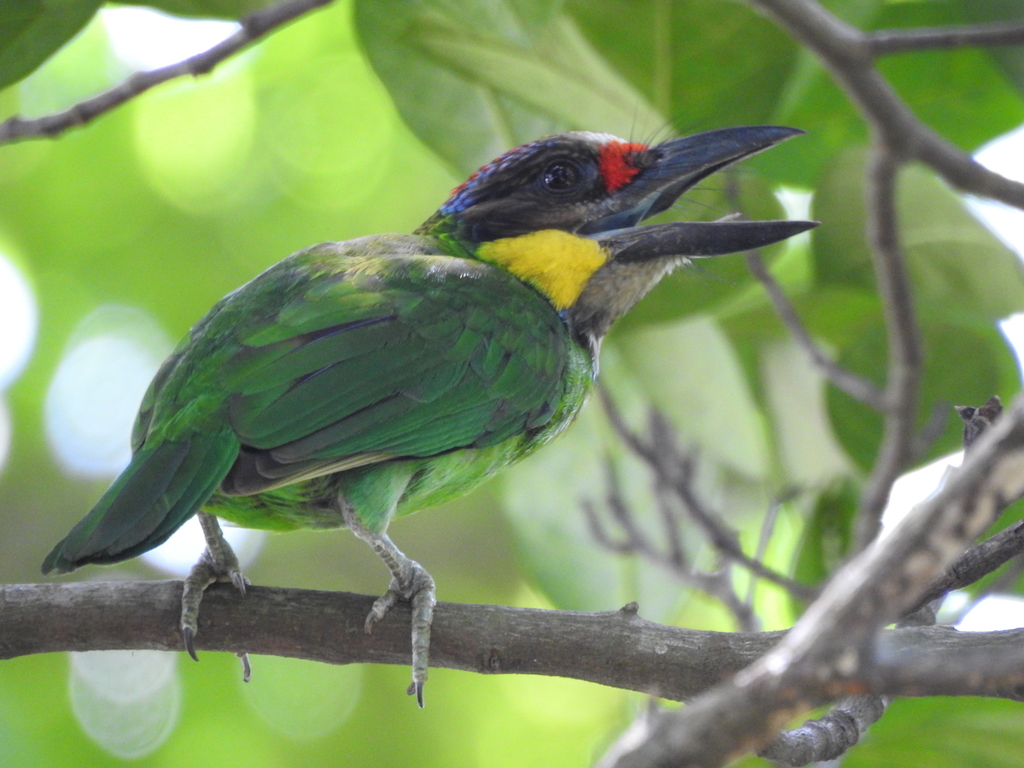
The golden-whiskered barbet has a green plumage of various hues. On both sides of the black beak it has a yellow moustache that extends to the ear canal. Its throat is blue, and it has small blue and red spots on the head. Its eyes are also surrounded by blue. Its forecrown is pale yellow, with red patches on both sides of the beak. It is 30 cm (12 in) long and weighs 110–215 g (3.9–7.6 oz). Female and male are similar in appearance but display a small degree of sexual dichromatism in that the beaks of the female appear paler with a dusky bluish color. Before reaching maturity birds of both sexes have duller overall plumage.
Range & habitat
The golden-whiskered barbet ranges from the Malay Peninsula to Sumatra and Borneo, where it inhabits tropical and subtropical moist broadleaf forests and montane forest. It has also been sighted in cacao plantation and second growth forests but is rare in evergreen and swamp forests.
Wikipedia: “Distribution and habitat”
What it does
The golden-whiskered barbet spends most of the day in the forest canopy. It forages mostly on figs and berries. As it has been observed picking on dead wood, it is assumed that it also looks for insects. It sings a series of 'too-tuk' notes, and when breeding also despite high temperatures during day. It breeds from February to August and lays two eggs per clutch.
Wikipedia: “Behaviour and ecology”
Listen
Looking for field recordings…
Where it lives
Recorded sightings
—
geo-referenced records in GBIF, from museums, herbaria and field observers.
Drag the globe to turn it. Dots are where records exist, not a range map; darker means more records.
In the stacks
Searching the stacks…
Every page naming Psilopogon chrysopogon in the Biodiversity Heritage Library →
This page is assembled live from iNaturalist, GBIF, Wikipedia, the Source Library and the Internet Archive. It is not yet part of the hand-edited codex. iNaturalist taxon 367541.