On eBird ↗
Himalayan Owl
Live sightings near you, the range map, bar charts of when it is seen, and Macaulay Library photos and recordings.
Himalayan Owl
Strix nivicolum
The Himalayan owl or Himalayan wood owl (Strix nivicolum) is a medium-sized owl native to the forests and mountain ranges of the Himalayas, Taiwan and Korea. Although populations are declining, this owl is not considered endangered and is currently listed as a species of Least Concern on the IUCN Red List due to its large range and slow decline. The Himalayan owl is nocturnal and is rarely seen in most areas of its range. Few studies have been done on its lifestyle and current population trends.
From the article Himalayan owl on Wikipedia (CC BY-SA), quoted section by section
Description
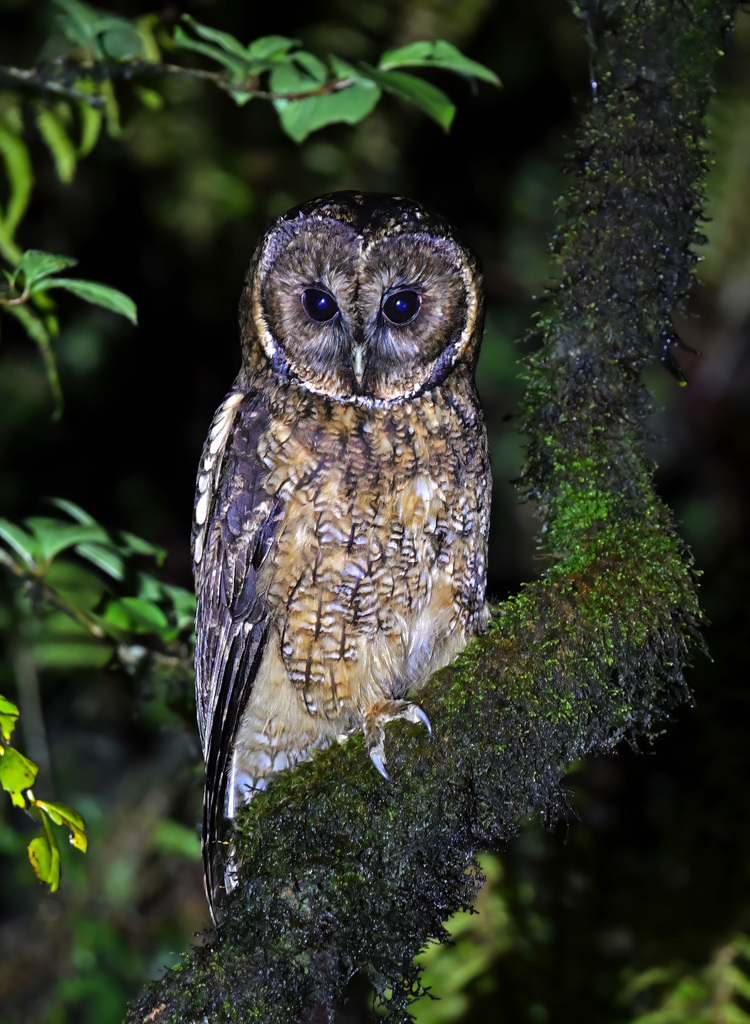
The Himalayan owl measures 35–40 cm and has a wingspan of approximately 270mm, classifying it as a medium-sized owl. The Himalayan Owl has warm-toned, tawny-coloured, plumage with light brown, dark brown and white colouring across its body. Its chest is light brown and white with vertical dark brown stripes, while its wings and tail feathers are darker with white horizontal bands and light patches towards the tips. Its head is round and without ear tufts and is a dark brown colour with lighter speckling, similar to its wings. The Himalayan owl has a small, hooked, yellow beak located around half an inch under its eyes in the center of its paler coloured face. Unlike many bird species, males and female Himalayan owls are morphologically similar, and cannot be differentiated by appearance. The juvenile Himalayan Owl appears similar to the adult yet is distinguished by slight white barring on the dark crown of its head.
Range & habitat
The Himalayan owl inhabits a widespread territory throughout East Asia and the Himalayas. Its distribution and habitat is quite stationary year round though it have been observed to descend to lower elevations in the winter months. While the Himalayan Owl is divided into three subspecies, all inhabiting different regions of Asia, its habitat is pretty consistent, consisting of coniferous and oak forests as well as rocky ravines in the Himalayan mountains. Although the species is not considered widely at risk, the owls habitat in certain regions, such as South Korea, is increasingly threatened by deforestation and artificial filling of tree cavities. These cavities are preferred breeding sites of the bird and are vital for their reproduction and survival. In areas where tree concentration and cavities are reduced, the Himalayan owl is also known to utilize man-made nest boxes.
Wikipedia: “Habitat and distribution”
What it does
The Himalayan owl is nocturnal, sleeping throughout the day and active at night. The owl begins hunting at dusk, perching in trees in its range until it locates its prey within its powerful hearing. Himalayan owls are generalist species eating insects, small birds and small mammals. Their primary prey are rodents, notably shrews and mice such as the Himalayan Field mouse.
Wikipedia: “Diet”
Listen
Looking for field recordings…
Where it lives
Recorded sightings
—
geo-referenced records in GBIF, from museums, herbaria and field observers.
Drag the globe to turn it. Dots are where records exist, not a range map; darker means more records.
In the stacks
Searching the stacks…
Every page naming Strix nivicolum in the Biodiversity Heritage Library →
This page is assembled live from iNaturalist, GBIF, Wikipedia, the Source Library and the Internet Archive. It is not yet part of the hand-edited codex. iNaturalist taxon 367501.