On eBird ↗
Great Cuckoo-Dove
Live sightings near you, the range map, bar charts of when it is seen, and Macaulay Library photos and recordings.
Great Cuckoo-Dove
Reinwardtoena reinwardti
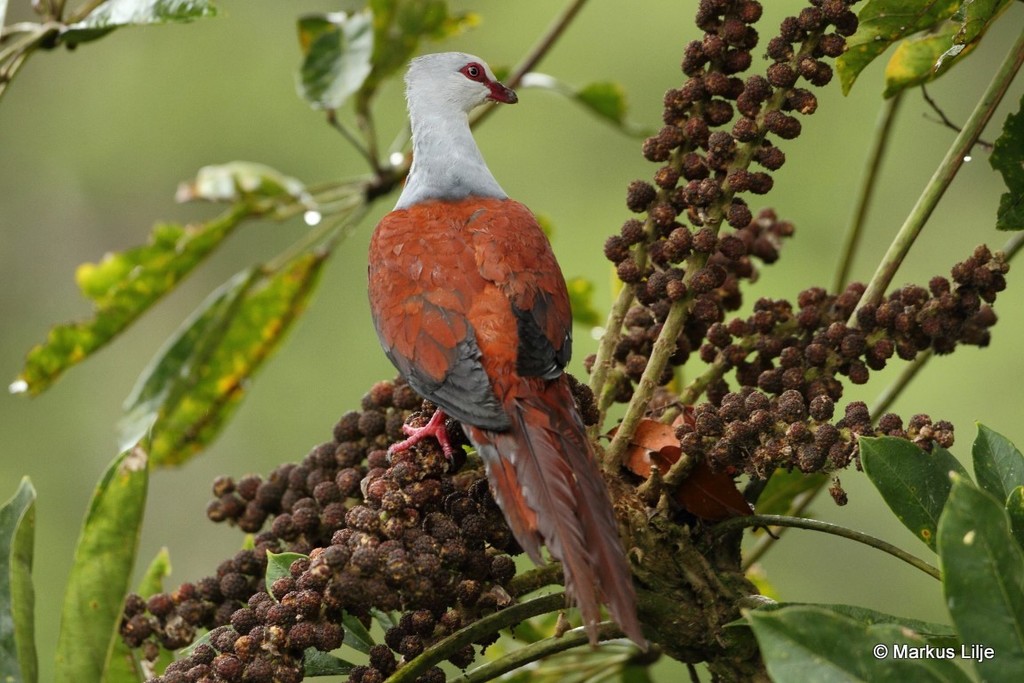
The great cuckoo-dove (Reinwardtoena reinwardti) is a species of bird in the pigeon family, Columbidae. First described by the Dutch zoologist Coenraad Jacob Temminck in 1824, it is found on New Guinea, several surrounding islands, and Wallacea, where it mainly inhabits primary forest and the forest edge. It is a large, distinctive pigeon, with a length of 47.5–52.5 cm (18.7–20.7 in) and a weight of 208–305 g (7.3–10.8 oz). In adults, the head, neck, and breast are whitish or blue-grey, the underparts are pale bluish-grey, the upperparts are chestnut-brown, and the outer wings are black. Females differ from males in having more yellowish irises and duller orbital skin. Juveniles are mainly dull grey-brown, with dirty-white throats and bellies.
The species feeds on fruit and seeds. It is usually seen alone or in pairs, but forms flocks with other frugivorous birds at fruit trees. It is known to defend fruiting shrubs it is feeding on, an uncommon foraging behaviour among birds. Breeding occurs throughout the year and varies in different parts of its range, seemingly peaking from October to December on New Guinea. Nests are flat or slightly concave platforms made of sticks, moss, roots, and ferns, and contain a single white egg. The species is classified as being of least concern by the International Union for Conservation of Nature due to its sufficiently large range and stable population.
From the article Great cuckoo-dove on Wikipedia (CC BY-SA), quoted section by section
Description
The great cuckoo-dove is a large and long-tailed pigeon, with a length of 47.5–52.5 cm (18.7–20.7 in) and a weight of 208–305 g (7.3–10.8 oz). A slight crest on the back of the head gives it a "big-headed" appearance. Birds of the nominate subspecies have the head, neck, and breast blue-grey or cream-white with a pale bluish-grey tinge, turning purplish grey on the back of the neck and upper back. The throat and belly are white, with the latter frequently having a pinkish tinge. The mantle, back, rump, and uppertail-coverts are chestnut-brown. The wings are darker chestnut-maroon, becoming blackish further from the body, and are black below. The underparts are pale bluish-grey. The outermost rectrices (tail feathers) are greyish-white with black bases and black stripes near the end, while the second-outermost are coloured similarly with black-and-chestnut stripes. The amount of chestnut increases moving inwards, with the central rectrices being almost entirely chestnut with only a small amount of black and grey near the base. Individuals of the nominate subspecies vary clinally (in a gradient across their geographic distribution) in appearance, being darkest in the north and palest in the southwest of their range. In males, the iris is yellowish-white with a red outer ring, and the orbital skin is reddish. Females have a more yellowish iris and duller orbital skin. …
Range & habitat
The great cuckoo-dove is native to Papuasia and Wallacea. In the Maluku Islands of Indonesia, it is found on Buru, Ambon, Seram, Obi, Bacan, Kasiruta, Kayoa, Halmahera, and Morotai. On New Guinea, it occurs across most of the mainland, excluding the Trans-Fly lowlands, as well as the satellite islands of Waigeo, Salawati, Misool, Yapen, Biak, Kumamba, Kairiru, Manam, Karkar, Goodenough, and Fergusson. The species mainly inhabits primary forest and forest edge; on Biak, it is also known from logged forest, secondary growth, and gallery forests. It is found at elevations of up to 3,380 m (11,090 ft) on mainland New Guinea and up to 1,190 m (3,900 ft) on Karkar Island. On the Maluku Islands, it is found from 115–1,400 m (380–4,600 ft), but is most common above 800 m (2,600 ft).
Wikipedia: “Distribution and habitat”
What it does
The great cuckoo-dove is usually seen either alone or in pairs in the midstorey or canopy of the forest, although it will form groups of up to ten birds at fruit trees, sometimes joining flocks of other frugivorous birds. It usually flies under the canopy and is fast, despite its slow, powerful, and graceful wingbeats.
Feeding. The great cuckoo-dove feeds on fruits and small seeds, preferring plants in the family Araliaceae and especially those in the genus Heptapleurum, such as Heptapleurum chaetorrhachis. Feeding usually takes place in the canopy, but occasionally occurs on the ground. It has been observed defending fruiting shrubs that it is feeding on by scaring off other birds that attempt to feed on the shrub, including birds-of-paradise, Ailuroedus catbirds, honeyeaters, and berrypeckers. The dove attacks other birds by "clapping" its wings together loudly, while trying to land on the intruding bird. Defending fruit sources is an uncommon foraging behaviour as it occurs only in certain conditions, requiring intermediate crop sizes and moderate rates of visitation by other birds. The species has also been observed eating soil and several individuals have been found to have stones in their stomachs.
Breeding. …
Wikipedia: “Behaviour and ecology”
Listen
Looking for field recordings…
Where it lives
Recorded sightings
—
geo-referenced records in GBIF, from museums, herbaria and field observers.
Drag the globe to turn it. Dots are where records exist, not a range map; darker means more records.
In the stacks
Searching the stacks…
Every page naming Reinwardtoena reinwardti in the Biodiversity Heritage Library →
This page is assembled live from iNaturalist, GBIF, Wikipedia, the Source Library and the Internet Archive. It is not yet part of the hand-edited codex. iNaturalist taxon 367479.