On eBird ↗
Black-billed Capercaillie
Live sightings near you, the range map, bar charts of when it is seen, and Macaulay Library photos and recordings.
Black-billed Capercaillie
Tetrao urogalloides
The black-billed capercaillie (Tetrao urogalloides) is a large grouse species closely related to the more widespread western capercaillie. It is a sedentary species that breeds in the larch taiga forests of eastern Siberia as well as parts of northern Mongolia and China. In the far west of its distribution, the black-billed capercaillie has been known to hybridize with the western capercaillie. Compared to its western cousin, the black-billed capercaillie is also more adaptable to open habitat, given the larch forests it lives in are usually less dense than other taiga communities. Thus, they tend to avoid thick coniferous forests. They are primarily herbivorous, feeding on twigs, buds, leaves, shoots, and berries of various plants. However, their diet in the warmer months includes some insects like caterpillars, larvae, ants and midges.
This species is also known as the eastern capercaillie, Siberian capercaillie, spotted capercaillie or (in Russian) "stone capercaillie".
From the article Black-billed capercaillie on Wikipedia (CC BY-SA), quoted section by section
Description
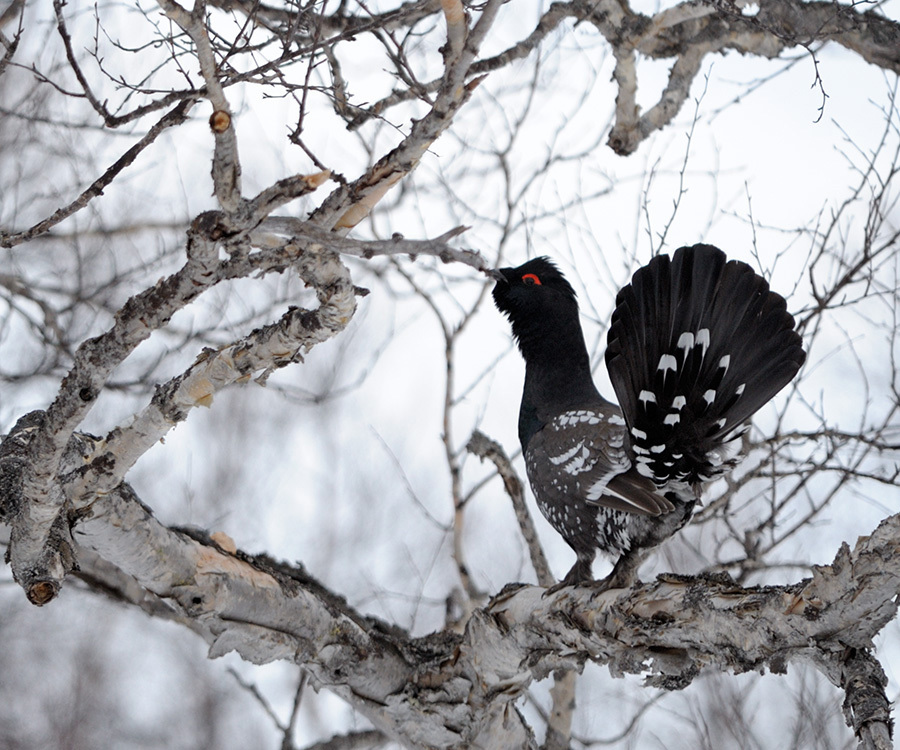
A male black-billed capercaillie has an average length of about 89–97 cm (35–38 in) and weighs 3.4–4.6 kg (7.5–10.1 lb), with females measuring around 69–75 cm (27–30 in) and weighing 1.7–2.2 kg (3.7–4.9 lb). Their wingspan stretches approximately 75–115 cm (30–45 in) long. Compared to the western capercaillie, it is slightly smaller in size with a slimmer body profile and longer neck, has a black beak (hence its name) instead of being horn-colored, and a longer, more spatulate tail. The eastern capercaillie has a somewhat glossy bluish-black head and neck down to a metallic turquoise breast. Distinct white markings at the tips of its upper and undertail coverts, as well as the wing coverts and flanks, give this grouse the nickname 'spotted capercaillie'. The female is similar to that of its western counterpart, except that its plumage is grayer overall with more heavily scaled underparts, lacks a solid rufous chest unlike the western capercaillie, and has noticeably larger white spots on its wing and tail coverts.
What it does
In the spring, from dawn until late morning, male capercaillies display by fanning out their tails, puffing their chest feathers out, lowering their wings, and angling their heads upward with an open beak to defend their space from other males and win over the mating rights of females. The size of the males' territories are usually 30 m × 30 m (98 ft × 98 ft), similar to black grouse territories. A group of hens will carefully squat with drooping wings, while the lekking male is present to signal that they are ready for breeding. Their castanets-like call, much louder than the western capercaillie, can be heard up to 1.5 km (0.93 mi) away. It consists of a series of loud repeating clicks ascending in tempo. Other performances used to attract females involve flutter flights. They jump off the ground to heights of 2 m (6 ft 7 in) or to distances of 8–10 m (26–33 ft), rapidly beating their wings during takeoff and landing, generating a thundering flurry that resonates through the dense stands of conifers.
Wikipedia: “Behavior”
Listen
Looking for field recordings…
Where it lives
Recorded sightings
—
geo-referenced records in GBIF, from museums, herbaria and field observers.
Drag the globe to turn it. Dots are where records exist, not a range map; darker means more records.
In the stacks
Searching the stacks…
Every page naming Tetrao urogalloides in the Biodiversity Heritage Library →
This page is assembled live from iNaturalist, GBIF, Wikipedia, the Source Library and the Internet Archive. It is not yet part of the hand-edited codex. iNaturalist taxon 367471.