- Animals
- ›Arthropods
- ›Hexapods
- ›Insects
- ›Winged and Once-winged Insects
- ›Butterflies and Moths
- ›Owlet Moths and Allies
- ›Underwing, Tiger, Tussock, and Allied Moths
- ›Tiger Moths and Allies
- ›Tiger Moths
- ›Callimorphina
- ›Cymbalophora
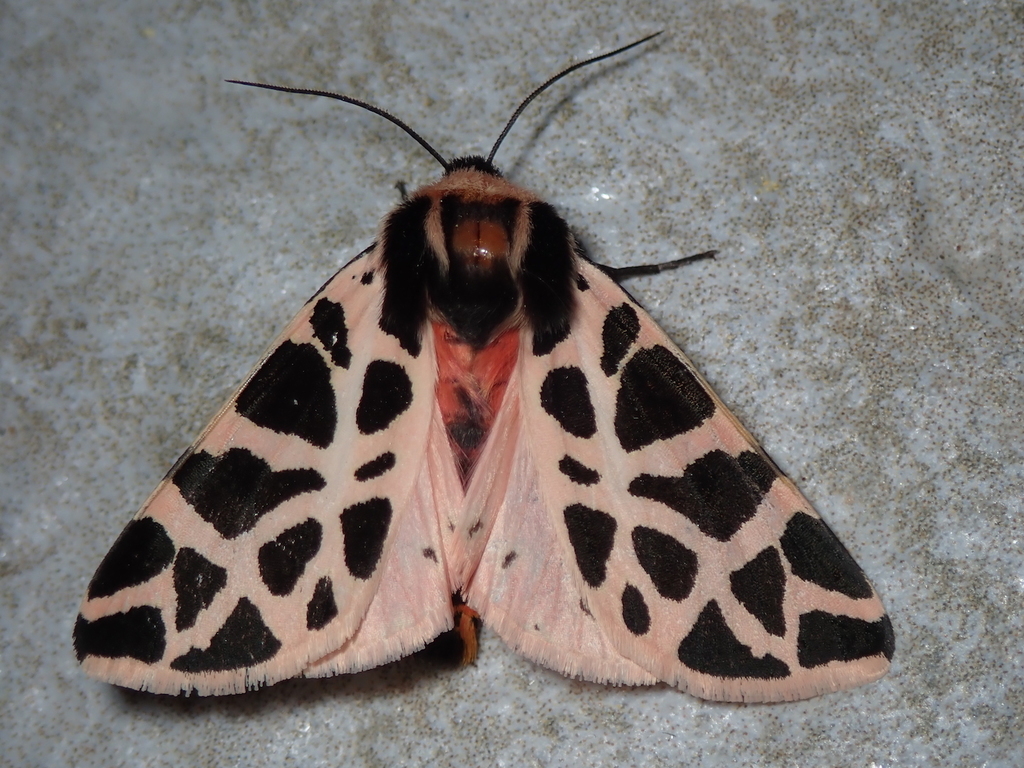
discrete chaperon
Cymbalophora pudica
Cymbalophora pudica, the discrete chaperon, is a moth of the family Erebidae. The species was first described by Eugenius Johann Christoph Esper in 1784.
From the article Cymbalophora pudica on Wikipedia (CC BY-SA), quoted section by section
Description
The wingspan of Cymbalophora pudica is typically 35–42 mm in males and 37–42 mm in females. The background color of the wings and the shape of their markings are rather variable. The external surface of the forewings usually may be milky white or pinkish, with a pattern of black triangular patches. Hindwings vary from white to pinkish with marginal spots. The blackish-haired thorax is characterized by two yellowish longitudinal stripes and by a broad, yellowish cervical spine. The antennae of the males are ciliated (hairy), while those of the females are filiform (thread like). The abdomen is reddish with black spots. The wings may be shaded with yellowish in Cymbalophora f. flaveola Schultz, 1906, in gray in Cymbalophora f. fumosa Oberthür, 1911. Cymbalophora f. Cohaerens Schultz, 1905 shows confluent spots. Very pink forms are called rosina. The caterpillars are gray brown, hairy, and covered with black-brown warts on each segment. Like other species of the genus Cymbalophora ("cymbal bearers"), males are capable of emitting sounds from their wings during flight.
Range & habitat
Cymbalophora pudica can be found in southern Europe from the Iberian Peninsula to Greece and in western North Africa. These moths prefer sunny, rocky areas, grasslands, scrublands and mountain slopes at low to middle elevations.
Wikipedia: “Distribution”
Listen
Looking for field recordings…
Where it lives
Recorded sightings
—
geo-referenced records in GBIF, from museums, herbaria and field observers.
Drag the globe to turn it. Dots are where records exist, not a range map; darker means more records.
In the stacks
Searching the stacks…
Every page naming Cymbalophora pudica in the Biodiversity Heritage Library →
This page is assembled live from iNaturalist, GBIF, Wikipedia, the Source Library and the Internet Archive. It is not yet part of the hand-edited codex. iNaturalist taxon 366885.