- Animals
- ›Chordates
- ›Vertebrates
- ›Reptiles
- ›Snakes and Lizards
- ›Lizards
- ›Iguanas and Allies
- ›Iguanas, Anoles, and Allies
- ›Anoles
- ›Anolis
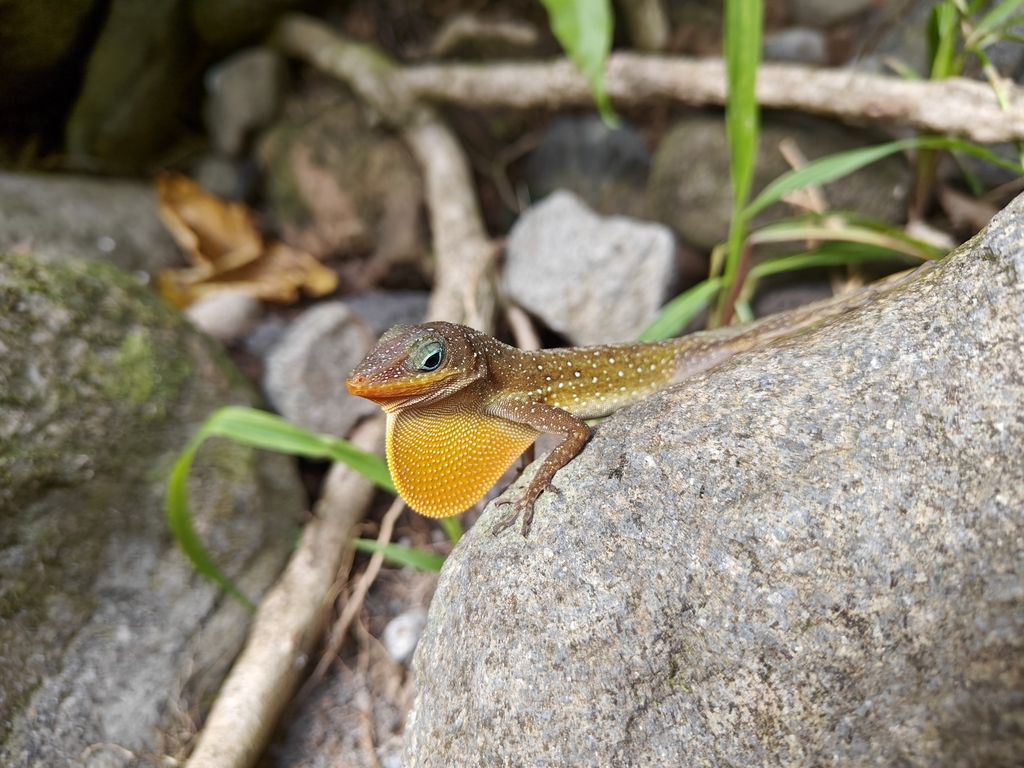
Dominican Anole
Anolis oculatus
Anolis oculatus, the Dominica anole, Dominican anole, eyed anole or zandoli, is a species of anole lizard. It is endemic to the Caribbean island of Dominica, where it is found in most environments. The species is found in a diverse range of color forms, which one herpetologist once classified as four subspecies, which most other scientists did not recognise because the forms gradually inter-grade with one another. Two later researchers have instead promoted the "ecotypes" concept, hypothesizing the color forms are maintained by the ecological conditions of the surrounding environment, despite being genetically indistinguishable. The morphology of some traits is subject to clinal variation, gradually changing from one side of the island to the other, or from sea level to the hilltops. The ground color ranges from pale tan or yellow to deep green or brown. It also has patterned markings that range from light-colored speckling to complex marbled patterns, and some populations also have large black-ringed "eye" spots on their flanks.
The Dominican anole spends much of the time in trees but mainly hunts on the ground. Small insects make up the bulk of its prey, with soft-bodied invertebrates and small vertebrates hunted less frequently. Long-living and late maturing for anoles, the Dominican anole can usually breed from around two to three months of age. Females lay eggs, and breeding can occur at any time of year. Clutches number one or rarely two eggs and are laid under rocks or leaves on the ground.
From the article Anolis oculatus on Wikipedia (CC BY-SA), quoted section by section
Description
The Dominican anole is medium-sized for anoles, with a maximum snout-vent-length (SVL) in males of 61–98 mm (2.4–3.9 in) depending on the population (with larger sizes correlating with higher altitudes), and tails of at least equal length; females are smaller in all populations. Adult males have a tail crest and a prominent, extensible throat fan that is often a bright yellow or orange. The throat fan is only rudimentary in females, and less brightly colored. Some may have bright blue eyes. Dominican anoles are capable of slight color change, but not as much as some other anoles. Their ground color varies from pale tan or ash gray to deep brown or green. Markings also vary significantly. Adult males in all populations have some combination of white or light-colored spotting distributed over most of their bodies. This manifests in different populations as small, evenly distributed spots; scattered groups of white scales; or streaks that run together in a marbled appearance. Males in some populations additionally have larger lateral spots ringed by irregularly shaped black splotches. Markings on females and juveniles are significantly lighter or less distinct, and black spots are extremely uncommon. Females and juveniles may additionally have lateral streaks or mid-dorsal stripes. The cause of the variability of the anole has been the subject of much study. …
Range & habitat
The Dominican anole is restricted to the island of Dominica, one of the few islands in the Lesser Antilles to have retained its original reptile and amphibian fauna over the last 200 years. It is one of two lizard species endemic to Dominica, the other being the Dominican ground lizard. It is the only native anole species on Dominica. It is present in all habitats and areas of the island up to around 900 m elevation and is generally abundant, though it is tending towards extirpation from the southwestern coastal region due to an invasive anole species (see Conservation). The coastal woodlands of Dominica have been particularly noted as unusually favorable for reptiles, with a biomass among the highest recorded for terrestrial reptile populations; Dominican anoles have been estimated to occur in that environment at a mean density of 2148 per hectare.
Wikipedia: “Distribution and habitat”
What it does
Dominican anoles are semi-arboreal, and mainly forage on the ground for food. Its diet mainly consists of insects, but varies by habitat and season based on the available food, and with the size of the individual. It may also eat fruit and even small vertebrates. In xeric woodland habitats on Dominica's Caribbean coast, it mainly feeds on tiny ants, termites, springtails and barklice. Montane populations, which reach larger sizes, rely more on larger prey such as Oligochaeta (earthworms) and Orthoptera (crickets and grasshoppers), although smaller adults and juveniles in rainforest environments will also mainly feed on ants. The main predators of Dominican anoles are Alsophis antillensis, a species of "racer" snake, and birds including the mangrove cuckoo, thrashers, and kingbirds, all of which are mainly found in coastal regions.
Wikipedia: “Ecology”
In human culture
The Dominican anole is locally known as the zandoli, or tree lizard. The indigenous Island Caribs considered its presence in their home to be a sign of "good spirits" according to Honychurch. According to Malhotra and Thorpe the American paleontologist and herpetologist Edward Drinker Cope gave a cursory description of Anolis alliaceus in 1864, which now seen as a synonym of the species A. marmoratus from another island, on the basis of sixteen specimens at the British Museum that lacked locality data. He later separately described Xiphosurus oculatus in 1879, from thirteen specimens in the U.S. National Museum (now the Smithsonian); the name oculatus (Latin, "eyed") refers to its distinctive lateral spots. The two taxa were synonymised in 1888 by the German-British zoologist Albert Günther. Because of the variation in colour there was some question as to whether the Dominican anole comprised multiple species or only one. The American herpetologist James D. Lazell, Jr. attempted to explain this variation in a 1962 publication. In 1959 he had travelled on foot or on horseback throughout the island, collecting over 500 specimens from thirty localities on Dominica. From this, he concluded that it was a single species, and accounted for its variation by classifying the spectrum of different color forms as four subspecies organised by region: A. o. …
Wikipedia: “History and taxonomy”
Where it lives
Recorded sightings
—
geo-referenced records in GBIF, from museums, herbaria and field observers.
Drag the globe to turn it. Dots are where records exist, not a range map; darker means more records.
In the stacks
Searching the stacks…
Every page naming Anolis oculatus in the Biodiversity Heritage Library →
This page is assembled live from iNaturalist, GBIF, Wikipedia, the Source Library and the Internet Archive. It is not yet part of the hand-edited codex. iNaturalist taxon 36672.