On eBird ↗
Passenger Pigeon
Live sightings near you, the range map, bar charts of when it is seen, and Macaulay Library photos and recordings.
Passenger Pigeon
Ectopistes migratorius
The passenger pigeon or wild pigeon (Ectopistes migratorius) is an extinct species of pigeon that was endemic to North America. Its common name is derived from the French word passager, meaning "passing by", due to the migratory habits of the species. The scientific name also refers to its migratory characteristics. The morphologically similar mourning dove (Zenaida macroura) was long thought to be its closest relative, and the two were at times confused, but genetic analysis has shown that the genus Patagioenas is more closely related to it than the Zenaida doves.
The passenger pigeon was sexually dimorphic in size and coloration. The male was 390 to 410 mm (15.4 to 16.1 in) in length, mainly gray on the upperparts, lighter on the underparts, with iridescent bronze feathers on the neck, and black spots on the wings. The female was 380 to 400 mm (15.0 to 15.7 in), and was duller and browner than the male overall. The juvenile was similar to the female, but without iridescence. It mainly inhabited the deciduous forests of eastern North America and was also recorded elsewhere, but bred primarily around the Great Lakes. The pigeon migrated in enormous flocks, constantly searching for food, shelter, and breeding grounds, and was once the most abundant bird in North America, numbering around 3 billion, and possibly up to 5 billion. A very fast flyer, the passenger pigeon could reach a speed of 100 km/h (62 mph). The bird fed mainly on mast, and also fruits and invertebrates.
From the article Passenger pigeon on Wikipedia (CC BY-SA), quoted section by section
Description
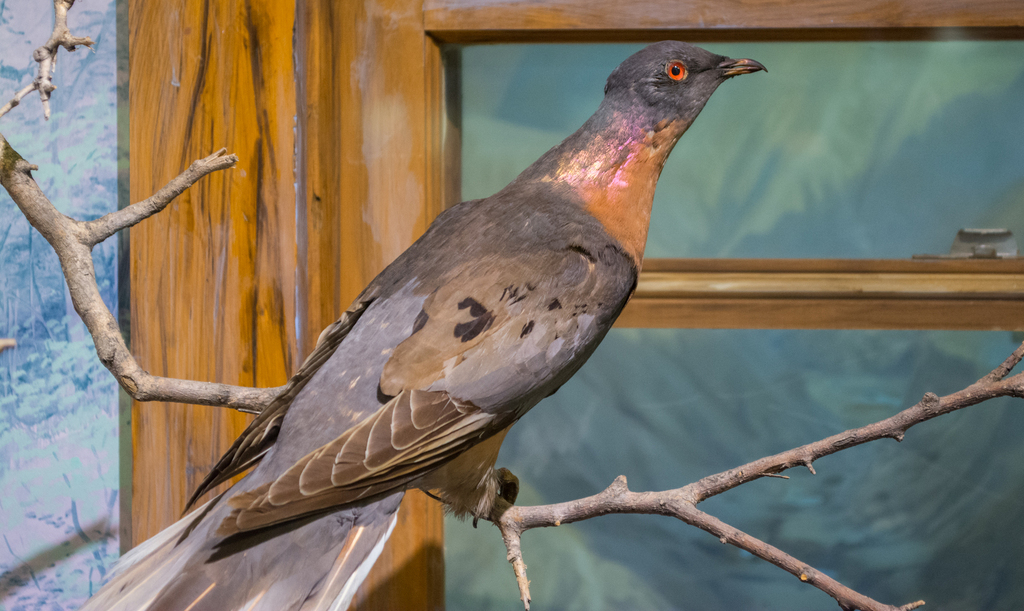
The passenger pigeon was sexually dimorphic in size and coloration. It weighed between 260 and 340 g (9.2 and 12.0 oz). The adult male was about 390 to 410 mm (15.4 to 16.1 in) in length. It had a bluish-gray head, nape, and hindneck. On the sides of the neck and the upper mantle were iridescent display feathers that have variously been described as being a bright bronze, violet, or golden-green, depending on the angle of the light. The upper back and wings were a pale or slate gray tinged with olive brown, that turned into grayish-brown on the lower wings. The lower back and rump were a dark blue-gray that became grayish-brown on the upper tail-covert feathers. The greater and median wing-covert feathers were pale gray, with a small number of irregular black spots near the end. The primary and secondary feathers of the wing were a blackish-brown with a narrow white edge on the outer side of the secondaries. The two central tail feathers were brownish gray, and the rest were white. The tail pattern was distinctive as it had white outer edges with blackish spots that were prominently displayed in flight. The lower throat and breast were richly pinkish-rufous, grading into a paler pink further down, and into white on the abdomen and undertail covert feathers. The undertail coverts also had a few black spots. The bill was black, while the feet and legs were a bright coral red. …
Range & habitat
The passenger pigeon was found across most of North America east of the Rocky Mountains, from the Great Plains to the Atlantic coast in the east, to the south of Canada in the north, and the north of Mississippi in the southern United States, coinciding with its primary habitat, the eastern deciduous forests. Within this range, it constantly migrated in search of food and shelter. It is unclear if the birds favored particular trees and terrain, but they were possibly not restricted to one type, as long as their numbers could be supported. It originally bred from the southern parts of eastern and central Canada south to eastern Kansas, Oklahoma, Mississippi, and Georgia in the United States, but the primary breeding range was in southern Ontario and the Great Lakes states south through states north of the Appalachian Mountains. Though the western forests were ecologically similar to those in the east, these were occupied by band-tailed pigeons, which may have kept out the passenger pigeons through competitive exclusion. The passenger pigeon wintered from Arkansas, Tennessee, and North Carolina south to Texas, the Gulf Coast, and northern Florida, though flocks occasionally wintered as far north as southern Pennsylvania and Connecticut. …
Wikipedia: “Distribution and habitat”
What it does
A skilled flyer, the passenger pigeon is estimated to have averaged 100 km/h (62 mph) during migration. It flew with quick, repeated flaps that increased the bird's velocity the closer the wings got to the body. It was equally adept and quick flying through a forest as through open space. When landing, the pigeon flapped its wings repeatedly before raising them at the moment of landing. The pigeon was awkward when on the ground, and moved around with jerky, alert steps. If the pigeon became alert, it would often stretch out its head and neck in line with its body and tail, then nod its head in a circular pattern. When aggravated by another pigeon, it raised its wings threateningly, but passenger pigeons almost never actually fought. The pigeon bathed in shallow water, and afterwards lay on each side in turn and raised the opposite wing to dry it. The passenger pigeon drank at least once a day, typically at dawn, by fully inserting its bill into lakes, small ponds, and streams. Pigeons were seen perching on top of each other to access water, and if necessary, the species could alight on open water to drink. One of the primary causes of natural mortality was the weather, and every spring many individuals froze to death after migrating north too early. …
Wikipedia: “Behavior and ecology”
At the table
The main reasons for the extinction of the passenger pigeon were the massive scale of hunting, the rapid loss of habitat, and the extremely social lifestyle of the bird, which made it highly vulnerable to the former factors. Deforestation was driven by the development of land for agriculture, expanding towns, and lumber harvesting. About 728,000 km2 (180 million acres) were cleared for farming between 1850 and 1910. Though there are still large woodland areas in eastern North America, which support a variety of wildlife, it was not enough to support the vast number of passenger pigeons needed to sustain the population. In contrast, very small populations of nearly extinct birds, such as the kākāpō (Strigops habroptilus) and the takahē (Porphyrio hochstetteri), have been enough to keep those species extant to the present. The combined effects of intense hunting and deforestation has been referred to as a "Blitzkrieg" against the passenger pigeon, and it has been labeled one of the greatest and most senseless human-induced extinctions in history. …
Wikipedia: “Extinction causes”
In human culture
The genus name, Ectopistes, translates as "moving about" or "wandering", while the specific name, migratorius, indicates its migratory habits. The full binomial can thus be translated as "migratory wanderer". The English common name "passenger pigeon" derives from the French word passager, which means "to pass by" in a fleeting manner. While the pigeon was extant, the name "passenger pigeon" was used interchangeably with "wild pigeon". The bird also gained some less-frequently used names, including blue pigeon, merne rouck pigeon, wandering long-tailed dove, and wood pigeon. In the 18th century, the passenger pigeon was known as tourte in New France (in modern Canada), but to the French in Europe it was known as tourtre. In modern French, the bird is known as tourte voyageuse or pigeon migrateur, among other names. In the Native American Algonquian languages, the pigeon was called amimi by the Lenape, omiimii by the Ojibwe, and mimia by the Kaskaskia Illinois. Other names in indigenous American languages include ori'te in Mohawk, tsahgó:wa:ˀ in Cayuga, dzä́:hgo:wa:’ in Seneca, and putchee nashoba, or "lost dove", in Choctaw. The Seneca people called the pigeon jahgowa, meaning "big bread", as it was a source of food for their tribes. …
Wikipedia: “Etymology”
Listen
Looking for field recordings…
Where it lives
Recorded sightings
—
geo-referenced records in GBIF, from museums, herbaria and field observers.
Drag the globe to turn it. Dots are where records exist, not a range map; darker means more records.
In the old herbals & bestiaries

In the stacks
Searching the stacks…
Every page naming Ectopistes migratorius in the Biodiversity Heritage Library →
This page is assembled live from iNaturalist, GBIF, Wikipedia, the Source Library and the Internet Archive. It is not yet part of the hand-edited codex. iNaturalist taxon 3665.