- Animals
- ›Chordates
- ›Vertebrates
- ›Reptiles
- ›Snakes and Lizards
- ›Lizards
- ›Iguanas and Allies
- ›Iguanas, Anoles, and Allies
- ›Anoles
- ›Anolis
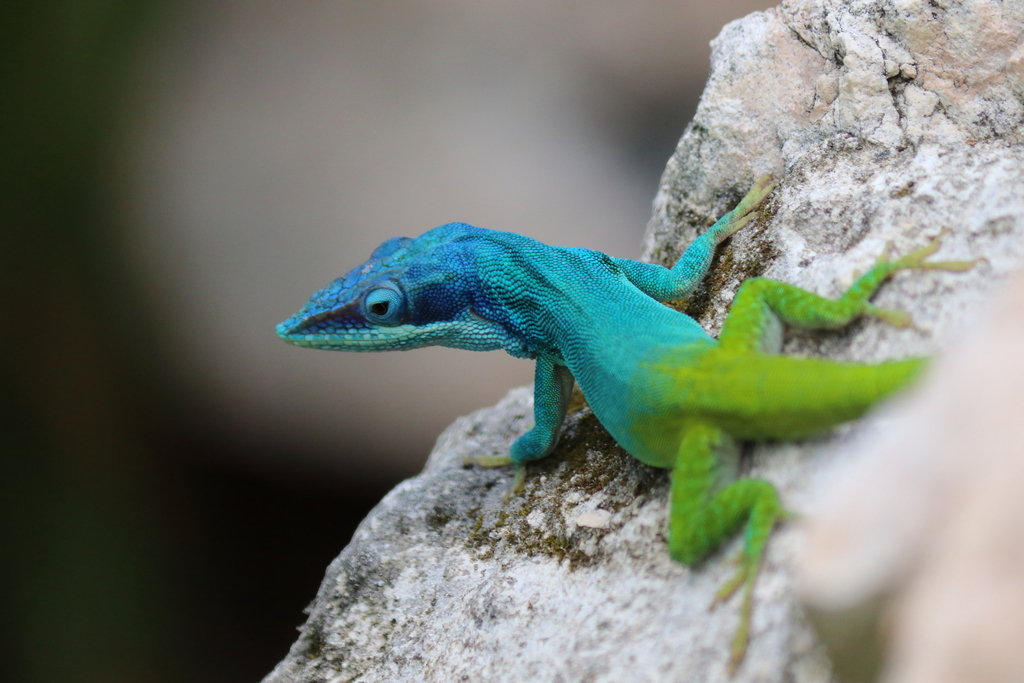
Allison's Anole
Anolis allisoni
Anolis allisoni, also known commonly as Allison's anole or Cuban blue anole is a species of lizard in the family Dactyloidae. The species is endemic to Cuba (except the west and the far southeast), the Bay Islands and Cayos Cochinos off the mainland of Honduras, and Half Moon Caye off the mainland of Belize. There is also a single doubtful record from Cozumel, Mexico. Recently, the species has been documented in southern Florida. This diurnal species is commonly seen on palm trunks, and it feeds on invertebrates. It is among the relatively few anole species in which females may lay their eggs together, forming a communal nest.
From the article Anolis allisoni on Wikipedia (CC BY-SA), quoted section by section
Description
In terms of colour and morphology, Allison's anole is superficially similar to the better-known American green anole. While females are overall green with paler underparts, similar to the green anole, males have a reddish-pink dewlap, and typically have bright blue heads, forelegs, and frontal half of the body (in males from Honduras, only parts of the head are blue with the remaining green). In all individuals the throat is usually white. Both sexes are able to rapidly change their colour to brown. Females reach about 7.5 cm (3 in) in snout-vent length and males about 10 cm (4 in). It is one of the larger species in the carolinensis species group. Allison's anole is a typical trunk-crown anole. Like other anoles in the carolinensis group, it has a large, conspicuously triangular-shaped head, and males have a prominent nuchal crest. This lizard has large subdigital toepads, which help facilitate climbing and clinging to vertical surfaces.
Range & habitat
A. allisoni is believed to have originated on Cuba but has since spread to Honduras and Half Moon Caye. This migration is believed to have occurred long ago as the different populations on these three locations display sufficient phenotypical and genetic differentiation to be considered for subspecies status. Few specimens have been identified in Mexican Banco Chinchorro island . A. allisoni has been documented in several neighborhoods within southern Florida, surviving and apparently breeding in both small parks and residential housing. This population is likely of Cuban origin and was brought to Florida as eggs accidentally ferried with plants.
Wikipedia: “Distribution”
In human culture
The specific name, allisoni, is in honor of American philanthropist Mr. Allison Vincent Armour.
Wikipedia: “Etymology”
Where it lives
Recorded sightings
—
geo-referenced records in GBIF, from museums, herbaria and field observers.
Drag the globe to turn it. Dots are where records exist, not a range map; darker means more records.
In the stacks
Searching the stacks…
Every page naming Anolis allisoni in the Biodiversity Heritage Library →
This page is assembled live from iNaturalist, GBIF, Wikipedia, the Source Library and the Internet Archive. It is not yet part of the hand-edited codex. iNaturalist taxon 36570.