- Animals
- ›Chordates
- ›Vertebrates
- ›Reptiles
- ›Snakes and Lizards
- ›Lizards
- ›Iguanas and Allies
- ›Iguanas, Anoles, and Allies
- ›Anoles
- ›Anolis
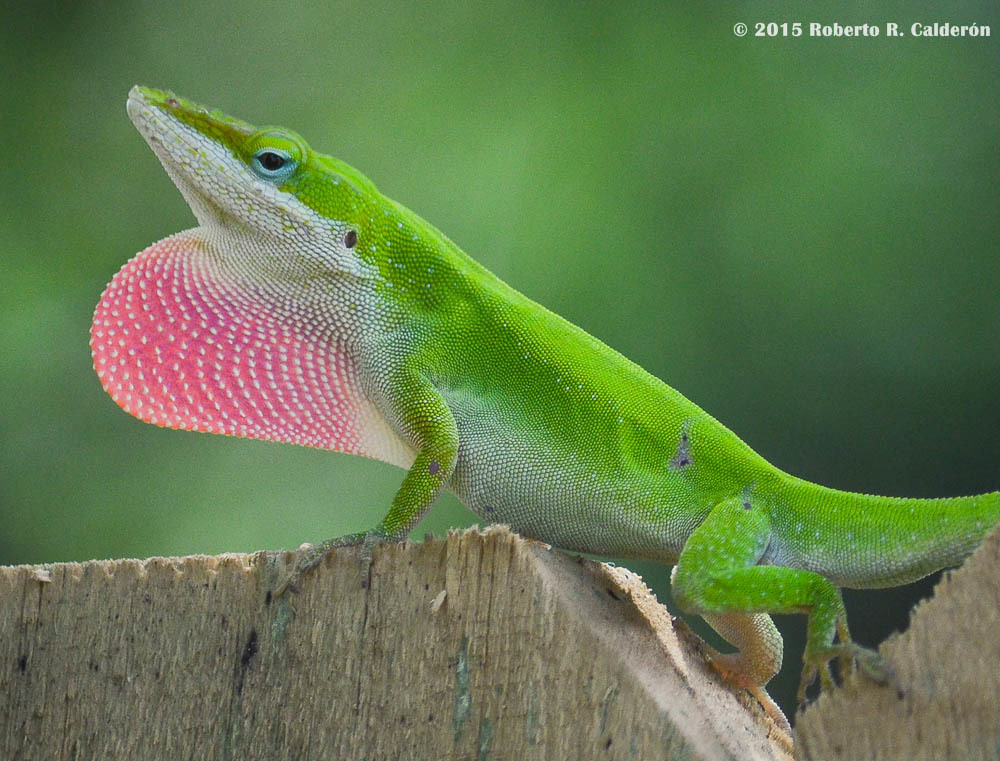
Green Anole
Anolis carolinensis
Anolis carolinensis or green anole (US: ) (among other names below) is a tree-dwelling species of anole lizard native to the southeastern United States and introduced to islands in the Pacific and Caribbean. A small to medium-sized lizard, the green anole is a trunk-crown ecomorph and can change its color to several shades from brown to green.
Other names include the Carolina anole, Carolina green anole, American anole, American green anole, North American green anole and red-throated anole. It is commonly called chameleon in the southeastern United States and sometimes referred to as the American chameleon (typically in the pet trade) due to its color-changing ability; however, it is not a true chameleon.
From the article Anolis carolinensis on Wikipedia (CC BY-SA), quoted section by section
Description
The anole is a small to medium-sized lizard, with a slender body. Males of this species are slightly larger than females. The head is long and pointed with ridges between the eyes and nostrils, and smaller ones on the top of the head. The toes have adhesive pads to facilitate climbing. Green anoles use jumping for their primary means of locomotion. They exhibit sexual dimorphism, the males being fifteen percent larger. Adult males within a population can be classified within a heavyweight and a lightweight morph. The male dewlap (throat fan) is three times the size of the female's and bright orange to red, whereas that of the female is lighter in color. The dewlap is usually pink for Anolis carolinensis (more orange-red in A. sagrei) and is very rarely present in females. The color of the dewlap is variable and different from the lizard eye to the human eye. Green anoles are thought to be capable of seeing a larger range of the UV spectrum, and that the dewlap reflects ultraviolet light to attract mates. Female anoles do, however, often have a dorsal line down their back. Extension of the dewlap from the throat is used for communication. Males can form a pronounced dorsal ridge behind the head when displaying or when under stress. …
Range & habitat
This species is native to North America, where it is found mainly in the subtropical southeastern parts of the continent. They also inhabit grasslands, forests, and temperate zones. Anoles are the most abundant on the Atlantic Coastal Plains in North Carolina, South Carolina, Georgia and Florida, and on the Gulf Coast in Alabama, Mississippi, Louisiana, and Texas, where they extend inland as far as Texas Hill Country and the DFW Metroplex; they have also been recorded in Tamaulipas, Mexico, but it is mostly likely an introduction. In the Carolinas, they are found on the coastal plains as far north as False Cape in Virginia, and in the southern piedmont of North Carolina, but throughout South Carolina, while in Georgia they are widespread except in the Blue Ridge region. The species has been introduced into various locales in the Pacific and the Caribbean: Hawaii, the Ogasawara Islands, the Northern Mariana Islands, the Bahamas, Anguilla, Palau, and Saint Vincent and the Grenadines, as well as the Canary Islands. In 2005 they were recognized and listed as an invasive alien species in the Ogasawara Islands of Japan for causing insect population collapse. Green anoles have also been considered successful invaders as they have made their way into parts of Europe. …
Wikipedia: “Distribution and habitat”
What it does
Male anoles are strongly territorial creatures. Some have even been witnessed fighting their own reflections in mirrored glass. The male will fight other males to defend his territory. These larger territories encompass multiple smaller areas of females so males can maintain exclusive reproductive access.On sighting another male, the anole will compress his body, extend the dewlap, inflate a dorsal ridge, bob his head and attempt to chase the rival away. If the rival male continues to approach, anoles will fight by biting and scratching each other. Studies have also shown that there is a positive correlation between bite-force and the size of the individual's dewlap.
Adult male anoles have two different morphs: heavyweight and lightweight. Heavyweight males are shown to have larger bodies and heads as well as a high bite force, while lightweight males have smaller heads and a lower bite force. One study showed that heavyweights had 50% higher testosterone concentrations than lightweights during the breeding season. It seems that disproportionately larger heads and dewlaps may be correlated to higher bite forces of heavyweights. Those with darker colorations will choose lower perch sites compared to their lighter conspecifics. …
Wikipedia: “Behavior”
Where it lives
Recorded sightings
—
geo-referenced records in GBIF, from museums, herbaria and field observers.
Drag the globe to turn it. Dots are where records exist, not a range map; darker means more records.
In the old herbals & bestiaries


In the stacks
Searching the stacks…
Every page naming Anolis carolinensis in the Biodiversity Heritage Library →
This page is assembled live from iNaturalist, GBIF, Wikipedia, the Source Library and the Internet Archive. It is not yet part of the hand-edited codex. iNaturalist taxon 36514.