On eBird ↗
Nicobar Pigeon
Live sightings near you, the range map, bar charts of when it is seen, and Macaulay Library photos and recordings.
Nicobar Pigeon
Caloenas nicobarica
The Nicobar pigeon or Nicobar dove (Caloenas nicobarica, Car: ma-kūö-kö) is a bird found on small islands and in coastal regions from the Andaman and Nicobar Islands, India, east through the Indonesian Archipelago, to the Solomons and Palau. It is the only living member of the genus Caloenas alongside the extinct spotted green pigeon and Kanaka pigeon, and is the closest living relative of the extinct dodo and Rodrigues solitaire.
From the article Nicobar pigeon on Wikipedia (CC BY-SA), quoted section by section
Description
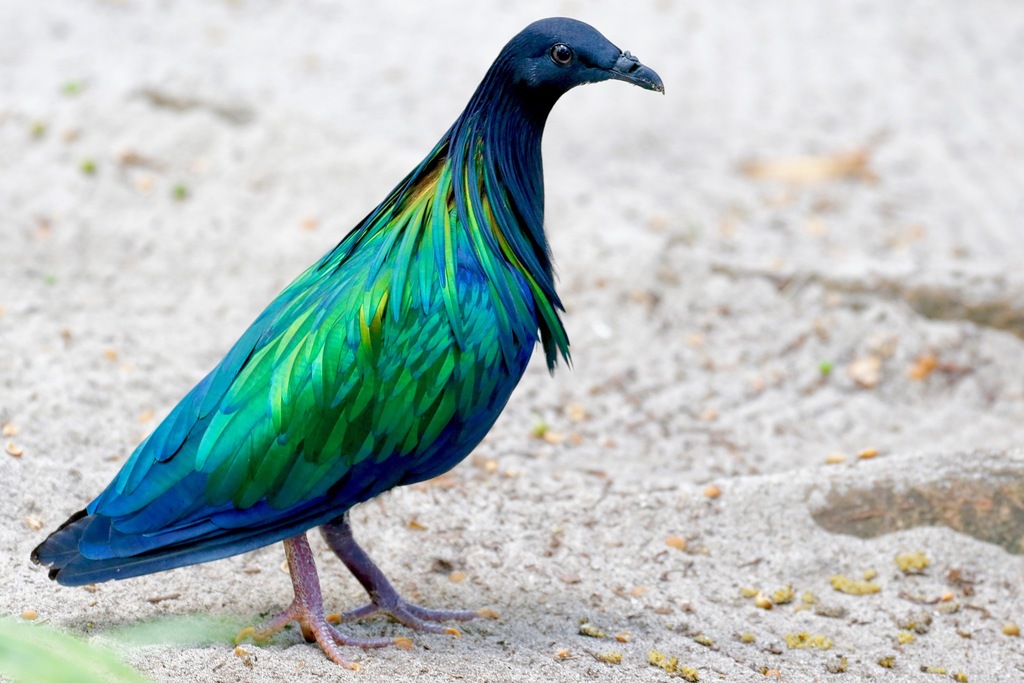
It is a large pigeon, measuring 32–35 cm (13–14 in) in length. The head is grey, like the upper neck plumage, which turns into green and copper hackles. The tail is short and pure white. The rest of its plumage is metallic green, appearing black in dull light. The cere of the dark bill forms a small blackish knob; the strong legs and feet are dull red. The irises are dark. Females, weighing 490–600 g (17–21 oz), are on average slightly larger than the 460–525 g (16.2–18.5 oz) males, but with much overlap; they have a smaller bill knob, shorter hackles and browner underparts. Immature birds have a black tail and lack almost all iridescence. There is hardly any variation across the birds' wide range. Even the Palau subspecies C. n. pelewensis merely has shorter neck hackles, but is otherwise almost identical. It is a very vocal species, giving a low-pitched repetitive call.
Range & habitat
On the Nicobar Islands (which are referred to in its common and scientific names), the most significant colony of Nicobar pigeons in modern times was found on Batti Malv, a remote wildlife sanctuary between Car Nicobar and Teressa. The 2004 Indian Ocean tsunami caused massive damage on the Nicobar Islands, and to what extent Batti Malv was affected is still not clear. But while everything on some islets in the Great Nicobar Biosphere Reserve was destroyed, Batti Malv lighthouse – a skeletal tower a dozen metres high, standing a few metres ASL at the highest point of the low-lying island – was little-damaged and put back in operation by the survey ship INS Sandhayak less than one month after the disaster. An April 2007 survey by the Indian Coast Guard vessel ICGS Vikram found the lighthouse tower "totally covered" in vines, indicating rampant regeneration of vegetation – but perhaps also that damage to the island's forest was severe, as a cover of creeping plants is typical of early succession stages, while a photo of the lighthouse taken before the tsunami shows rather mature forest.
Found in Australia. A Nicobar pigeon was found by the Bardi Jawi Indigenous rangers on the Dampier Peninsula in the western Kimberley region of Australia in May 2017. …
Wikipedia: “Distribution and habitat”
What it does
The Nicobar pigeon's breeding range encompasses the Andaman and Nicobar Islands of India, the Mergui Archipelago of Myanmar, offshore islands of south-western Thailand, Peninsular Malaysia, southern Cambodia and Vietnam, and many of the small islands between Sumatra, the Philippines and the Solomon Islands. On Palau, the only distinct subspecies C. n. pelewensis is found. The Nicobar pigeon roams in flocks from island to island, usually sleeping on offshore islets where no predators occur and spends the day in areas with better food availability, not shying away from areas inhabited by humans. Its diet consists of seeds, fruit, and buds, and it is attracted to areas where grain is available. A gizzard stone helps to grind up hard food items. Its flight is quick, with regular beats and an occasional sharp flicks of the wings, as is characteristic of pigeons in general. Unlike other pigeons, groups tend to fly in columns or single file, not in a loose flock. The prominent white tail, visible in flight from behind, may serve as a sort of "taillight", helping keep flocks together when crossing the sea at dawn or dusk. …
Wikipedia: “Behaviour and ecology”
Listen
Looking for field recordings…
Where it lives
Recorded sightings
—
geo-referenced records in GBIF, from museums, herbaria and field observers.
Drag the globe to turn it. Dots are where records exist, not a range map; darker means more records.
In the stacks
Searching the stacks…
Every page naming Caloenas nicobarica in the Biodiversity Heritage Library →
This page is assembled live from iNaturalist, GBIF, Wikipedia, the Source Library and the Internet Archive. It is not yet part of the hand-edited codex. iNaturalist taxon 3643.