- Animals
- ›Chordates
- ›Vertebrates
- ›Reptiles
- ›Snakes and Lizards
- ›Lizards
- ›Iguanas and Allies
- ›Iguanas, Anoles, and Allies
- ›Phrynosomatid Lizards
- ›Phrynosomatine Lizards
- ›Phrynosoma
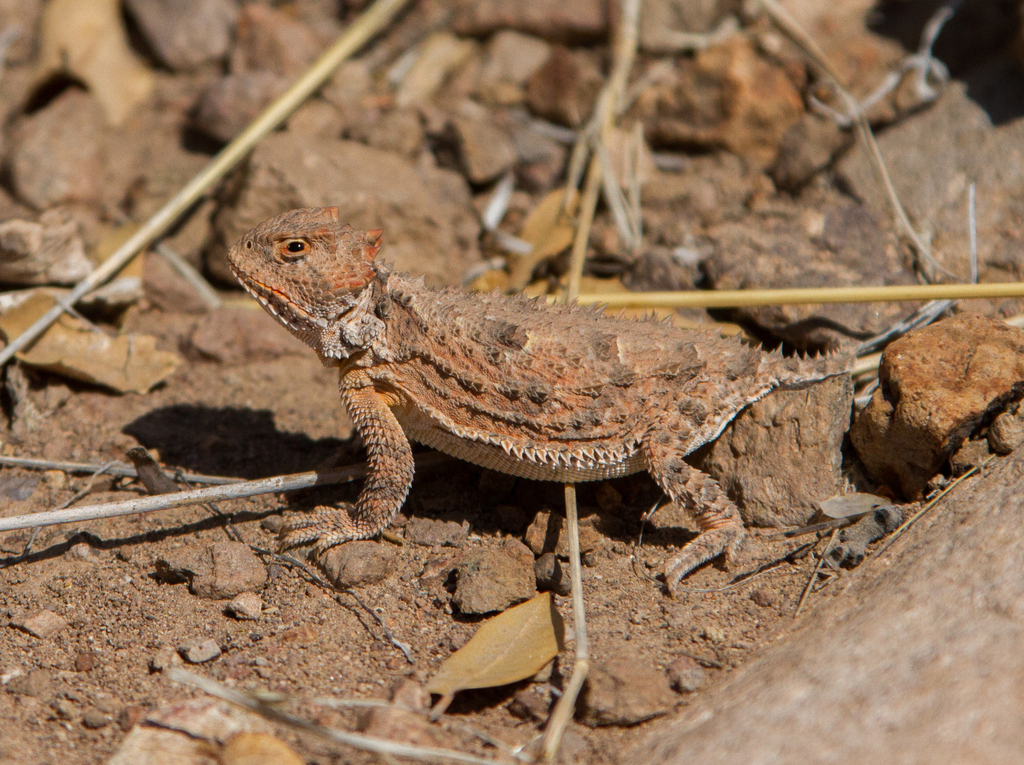
Greater Short-horned Lizard
Phrynosoma hernandesi
The greater short-horned lizard (Phrynosoma hernandesi), also commonly known as the mountain short-horned lizard or Hernández's short-horned lizard, is a species of lizard in the family Phrynosomatidae. The species is endemic to western North America. Like other horned lizards, it is often called a "horned toad" or "horny toad", but it is not a toad at all. It is a reptile, not an amphibian. It is one of five native species of lizards in Canada.
From the article Greater short-horned lizard on Wikipedia (CC BY-SA), quoted section by section
Description
The greater short-horned lizard is often mistaken for its close relative the pygmy short-horned lizard (Phrynosoma douglasii), which has the same basic body type consisting of small pointed scales around the head and back. Until recent mitochondrial DNA evidence, P. hernandesi was considered to be the same species as P. douglasii. They are now considered distinct species with the pygmy short-horned lizard (P. douglasii) occupying the northwest portion of the United States and extreme southern British Columbia. When placed together the two are easily distinguished at full size, the pygmy short-horned lizard being much smaller. P. hernandesi is a highly variable species with different geographic populations exhibiting differences in color, pattern and size with some authorities describing five subspecies. The greater short-horned lizard ranges in size from 2 to 5 inches (5.1 to 12.7 cm) in snout-to-vent length (SVL) and is a flat-bodied, squat lizard with scales around the top of the head, normally called a "crown". It has a snub-nosed profile and short legs. The trunk is fringed by one row of pointed scales, while the belly scales are smooth. The color is gray, yellowish, or reddish-brown, and there are two rows of large dark spots on the back. …
Range & habitat
The greater short-horned lizard is the most widely distributed horned lizard in North America and occurs in the widest range of habitats: West into central Nevada, east into North and South Dakota, north to southern Saskatchewan and Alberta, and then south into eastern New Mexico to central Mexico, with a few pockets in Trans-Pecos Texas. This species of lizard is mostly an arid mountain dweller living in the range of 900–11,300 feet (170–3440 m). It is the only member of its genus in Wyoming, which counts Phrynosoma as its state reptile. It is also considered an endangered species in Saskatchewan and Alberta.
Wikipedia: “Distribution”
What it does
The greater short-horned lizard is a "sit-and-wait" predator. It feeds primarily on ants, but also takes an occasional grasshopper or beetle. Often, it can be found sitting in the vicinity of a nest or trails. It is a diurnal creature, being most active during the evening and burrowing at night. It relies extensively on camouflage to avoid predators. Horned lizards have been shown to darken their skin when threatened or to regulate temperature.
Defenses. Typically, greater short-horned lizards will remain as still as possible when a predator is nearby, attempting to blend in with the environment. However, if provoked, some species of horned lizards can build up blood pressure in regions behind their eyes and accurately squirt their blood at attacking predators, which will deter canids from continuing their attack. It is rare for horned lizards to squirt blood at humans however, reserving this unique defense primarily for canids (i.e. foxes, coyotes, dogs) and felines, which have a strong reaction of distaste to the blood. Squirting blood has been observed in the greater short-horned lizard, but has not been observed in the pygmy short-horned lizard.
Wikipedia: “Behavior”
In human culture
The genus Phrynosoma, means toad-bodied. The specific name, hernandesi, honors Francisco Hernández (1514–1587), a Spanish physician who wrote an early account of a horned lizard, which was published in 1615.
Wikipedia: “Etymology”
Where it lives
Recorded sightings
—
geo-referenced records in GBIF, from museums, herbaria and field observers.
Drag the globe to turn it. Dots are where records exist, not a range map; darker means more records.
In the stacks
Searching the stacks…
Every page naming Phrynosoma hernandesi in the Biodiversity Heritage Library →
This page is assembled live from iNaturalist, GBIF, Wikipedia, the Source Library and the Internet Archive. It is not yet part of the hand-edited codex. iNaturalist taxon 36315.