- Animals
- ›Arthropods
- ›Hexapods
- ›Insects
- ›Winged and Once-winged Insects
- ›Butterflies and Moths
- ›Flannel, Slug Caterpillar, Leaf Skeletonizer, and Allied Moths
- ›Burnet Moths
- ›Zygaeninae
- ›Zygaena
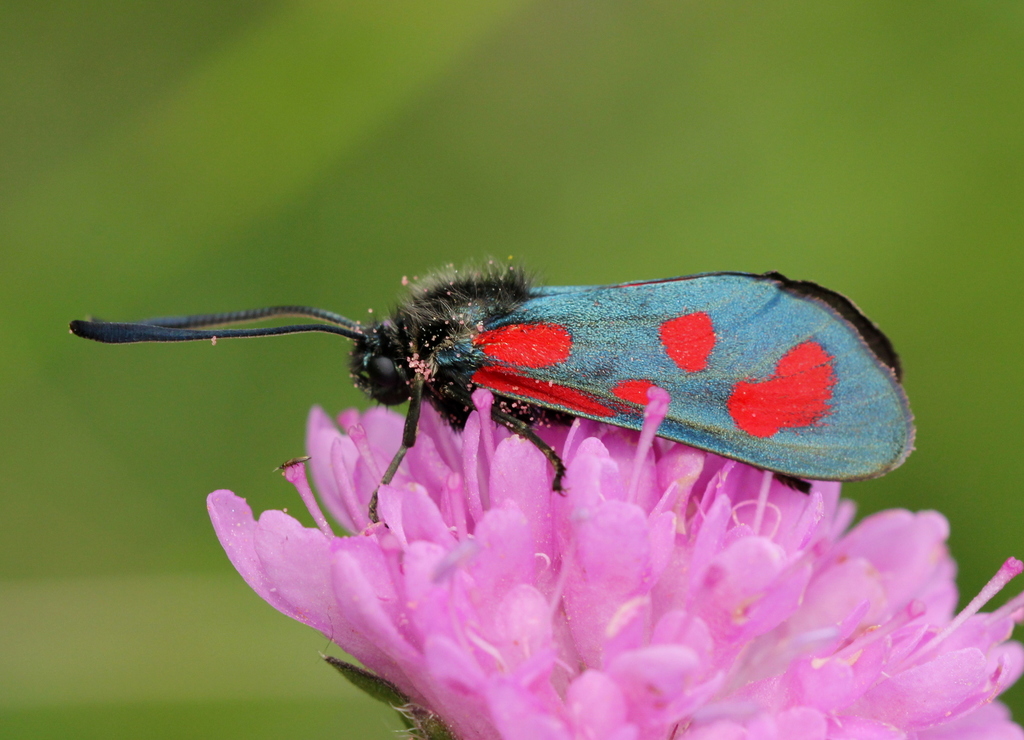
Slender Scotch Burnet
Zygaena loti
Zygaena loti, the slender Scotch burnet, is a moth of the family Zygaenidae. It is a diurnal moth characterized by a black body, light colored legs, and red spots on its wings. The caterpillars are a yellow-green color and usually molt out of dormancy in late February to early March. The larvae feed on plants from the family Fabaceae until they enter their pupal stage and mature into adults in May to early June. For mating, Zygaenidae exhibit a dual-partner finding strategy, where females use pheromones while assuming a calling position, and males exhibit a patrolling behavior where they utilize both vision and the olfactory receptors in their antennae to locate a potential mate.
Although regionally endangered as their population is declining, Z. loti is found all across Europe, inhabiting areas rich in their desired food plants: lime-rich, and characterized by a hot and dry climate. The decreases in their population are likely due to factors such as habitat loss and fragmentation brought on by commercial agriculture and urbanization, as well as global climate change. There are few conservation programs currently focusing on Zygaena loti.
From the article Zygaena loti on Wikipedia (CC BY-SA), quoted section by section
Description
Zygaena loti, also called the slender Scotch burnet moth, is a member of the butterfly and moth order Lepidoptera and the family Zygaenidae. While most moths are categorized as nocturnal, Zygaenidae moths are unique in that they are day-flying or diurnal moths. The Z. loti has also been described as highly sedentary. With a wingspan of 25-35mm, the slender Scotch burnet moth can be identified as having a relatively small black body, light colored legs, and a pair of black or light brown colored, rounded wings with red spots. This moth in particular displays a sexual dimorphism, in which the wings of females are scaled much lighter than their male conspecifics and they possess a double white ruff. Frontwings are grayish-blue in the males, yellow-gray in the females, with six red spots which partly flow together. The kidney-shaped spot at the tip of the forewings consists in fact of the fifth and sixth spots, which have grown together. The hindwings are red and have a black border.
This species is rather similar to Zygaena exulans, Zygaena filipendulae and Zygaena lonicerae. The caterpillars can reach a length of about 20 millimetres (0.79 in). They are olive-green or yellow-green, with two yellow and two black dots on each segment and short white hairs.
Range & habitat
The geographic distribution of Zygaena loti is well documented, but not uniform across research studies. Some documentation cites Zygaena loti to be mainly in western Scotland and solely confined to the Isles Mull and Ulva. The research that claims this however is only looks at the subspecies scotica. The animals in the family Zygaenidae are actually widespread across the European continent. More specifically, Zygaena loti is found in most of Europe, except Ireland, the Netherlands, Portugal, Fennoscandia, Denmark, Estonia and Latvia. This species has been spotted in Spain on the Iberian peninsula, across central and southern Europe, and to Siberia. While it is not very common in northern Europe, there is an isolated population in Scotland. They used to be widely distributed, creating a network of interconnected communities, but due to habitat loss as a likely result of an increase use of land for agriculture, most Z. loti and Zygaenidae populations have become fragmented and isolated from each other. The isolation that these moths are subjected to has led to high levels of genetic differentiation between populations. The current status of the moth's total distribution range since the 1970s is declining. Although fairly widespread, Z. …
Wikipedia: “Geographic range and habitat”
What it does
The life cycle of Zygaena loti has not been well observed, but from the available literature the following likely life cycle can be constructed. The moth is characterized as an early burnet with caterpillars molting out of diapause in late February to early March. The caterpillars hide during the day in moss layers or herbage containing small, short plants less than 6 cm tall. There they also construct or spin their cocoons (oval-shaped, dull dirty whitish color) to enter their pupal stage. later mature into adult moths in May to early June. As adults, their flight time is somewhere from late May to early August depending on eclosion. Since they are diurnal, they only fly during the day. After mating, females will lay their eggs on larval food plants, such as the ones listed below, and the resulting larvae will feed from approximately August to early May, overwintering once and sometimes twice in their larval diapaused state.
Food resources. For larvae, there are some contrasting findings, but all observed food plants that Z. loti caterpillars have been found on are from the family Fabaceae, such as Hippocrepis comosa, Lotus corniculatus, Securigera varia, and Onobrychis vicilfolia. For adult moths, even less has been recorded about their diets. …
Wikipedia: “Life cycle”
Listen
Looking for field recordings…
Where it lives
Recorded sightings
—
geo-referenced records in GBIF, from museums, herbaria and field observers.
Drag the globe to turn it. Dots are where records exist, not a range map; darker means more records.
In the stacks
Searching the stacks…
Every page naming Zygaena loti in the Biodiversity Heritage Library →
This page is assembled live from iNaturalist, GBIF, Wikipedia, the Source Library and the Internet Archive. It is not yet part of the hand-edited codex. iNaturalist taxon 362863.