- Animals
- ›Arthropods
- ›Hexapods
- ›Insects
- ›Winged and Once-winged Insects
- ›Butterflies and Moths
- ›Butterflies
- ›Gossamer-winged Butterflies
- ›Hairstreaks
- ›Theclini
- ›Thecla
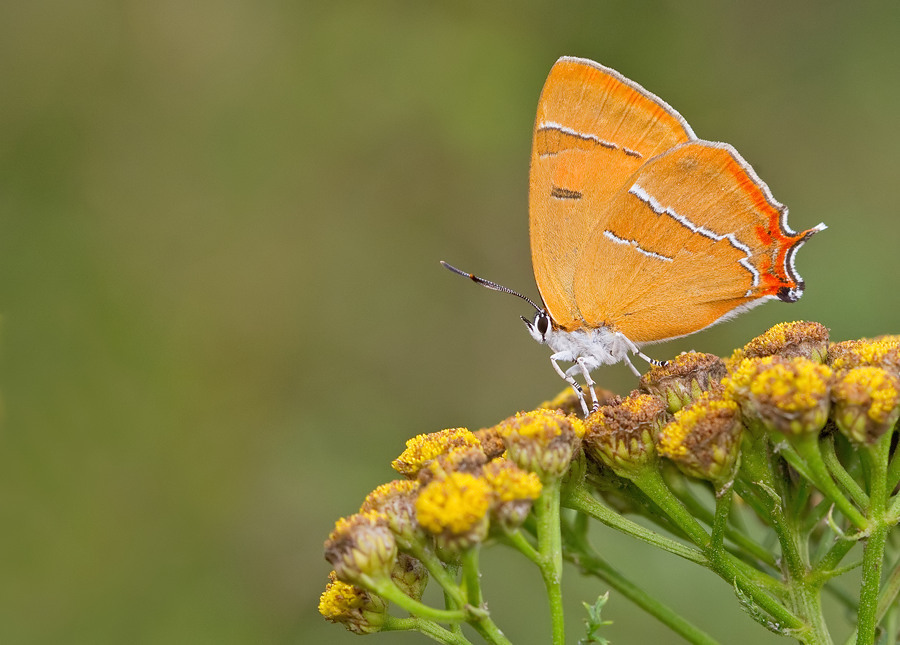
Brown Hairstreak
Thecla betulae
The brown hairstreak (Thecla betulae) is a butterfly in the family Lycaenidae. The range includes most of the Palaearctic.
From the article Brown hairstreak on Wikipedia (CC BY-SA), quoted section by section
Description
The following description of this butterfly was written by Adalbert Seitz in 1909:
Z. betulae L. Black-brown; male with a pale diffuse patch, female with a broad orange band beyond the crossveins. Underside ochreous, with dark-edged white lines. In North and Central Europe und Northern Asia eastward to the Pacific. Tutt name males without the pale diffuse patch beyond the crossveins ab. unicolor, while this patch is nearly white in ab. pallida Tutt. In ab. spinosae Gerh. there appear beyond the apex of the cell small orange-spots, which may be paler yellow than the discal spots of the female. The orange discal band of the female is sometimes narrow: ab. restricta Tutt, and sometimes broad (= ab. lata). females in which the band is pale ochreous instead of orange are ab. fisoni Wheeler, while the band is separated into several spots by the heavily black veins in ab. lineata Tutt. A very remarkable form is ab. cuneata Tutt, which bears a broad orange submarginal band on the hindwing. On the underside the white lines are sometimes more or less obsolete, or distorted (= ab. nucilinea). Or they may be strongly developed and modified into a kind of white-edged dark band in consequence of the interspace between the white lines being dark; this is ab. virgata Tutt. — Of the geographical races ongodai Tutt is the one nearest to the European form. …
What it does
A little butterfly that is found along hedges, scrub, and wood edges but is often overlooked since it spends much of its time high in the tree canopy. Like the purple emperor this butterfly uses 'master trees', usually European ash (Fraxinus excelsior). Males and unmated females congregate at the tops of isolated trees. Once mated the female descends to lower levels to begin laying her eggs. Males rarely descend and both feed mainly on honeydew. Both sexes are dark brown on the upperside with orange tails. The female also has a bright orange band across both forewings. The undersides are similar in both sexes and are bright orange with two white streaks.
Wikipedia: “Appearance and behaviour”
At the table
In Europe the female lays her eggs on blackthorn (Prunus spinosa) in late August which overwinter, hatching the following spring when the buds are breaking. It has been found that the best way to find breeding sites for this species is to look for the conspicuous white eggs in the winter. The larvae are extremely well camouflaged and feed only at night, remaining motionless during the day. Pupation takes place in leaf litter on the ground in late June or early July and are attractive to ants who will bury them in shallow cells.
Wikipedia: “Life cycle and food plants”
Listen
Looking for field recordings…
Where it lives
Recorded sightings
—
geo-referenced records in GBIF, from museums, herbaria and field observers.
Drag the globe to turn it. Dots are where records exist, not a range map; darker means more records.
In the stacks
Searching the stacks…
Every page naming Thecla betulae in the Biodiversity Heritage Library →
This page is assembled live from iNaturalist, GBIF, Wikipedia, the Source Library and the Internet Archive. It is not yet part of the hand-edited codex. iNaturalist taxon 362091.