- Animals
- ›Chordates
- ›Vertebrates
- ›Reptiles
- ›Snakes and Lizards
- ›Lizards
- ›Iguanas and Allies
- ›Iguanas, Anoles, and Allies
- ›Phrynosomatid Lizards
- ›Sceloporine Lizards
- ›Sceloporus
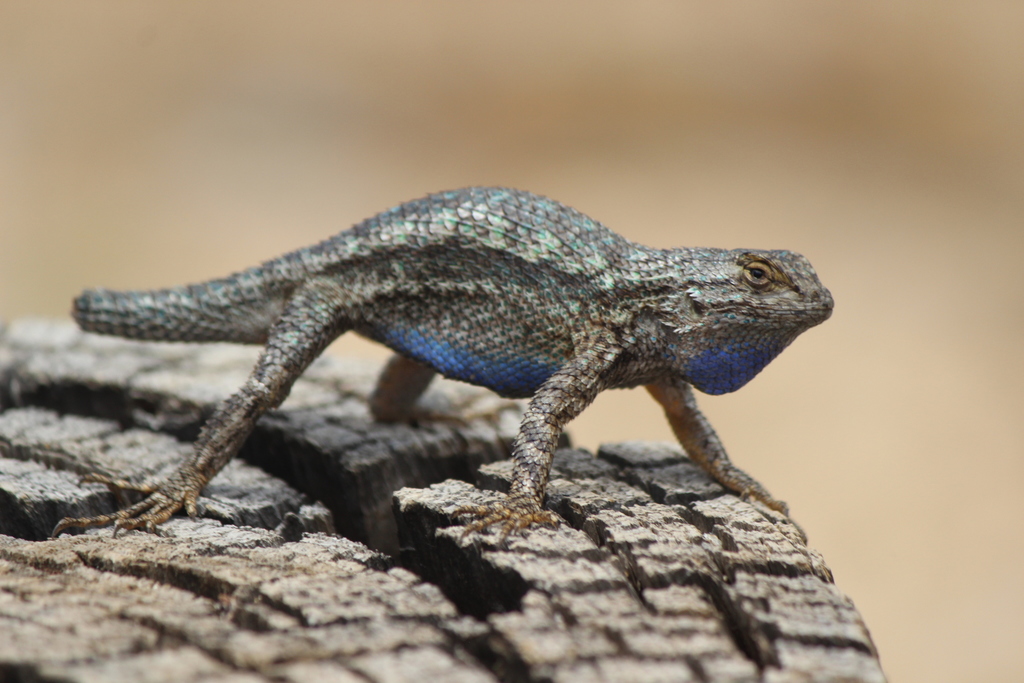
Western Fence Lizard
Sceloporus occidentalis
The western fence lizard (Sceloporus occidentalis) is a species of lizard native to Arizona, New Mexico, and California, as well as Idaho, Nevada, Oregon, Utah, Washington, and Northern Mexico. The species is widely found in its native range and is considered common, often being seen in yards, or as the name implies, on fences. As the ventral abdomen of an adult is characteristically blue, it is also known as the blue-belly. Two western fence lizards have been reported with duplicated or forked tails, presumably following an autotomy.
From the article Western fence lizard on Wikipedia (CC BY-SA), quoted section by section
Range & habitat
Although California is the heart of the range of this lizard, it is also found in eastern and southwestern Oregon (some populations are found even north of Seattle, Washington), as well as in the Columbia River Gorge, southwestern Idaho, Nevada, western Utah, northwestern Baja California, New Mexico, Arizona, and some of the islands off the coast of both California and Baja California. There is also an isolated population in the Northwestern Tualatin Valley, around Henry Hagg Lake. The western fence lizard occupies a variety of habitats. It is found in grassland, broken chaparral, sagebrush, woodland, coniferous forest, and farmland, and occupies elevations from sea level to 10,800 ft. They generally avoid the harsh desert and are often found near water. In California, the western fence lizard is found in most territories apart from deserts or densely forested locations. According to predictions by the California Department of Fish and Wildlife, most of California except for the San Joaquin Valley and South Eastern California are suitable habitats for the western fence lizard. In the habitats, the western fence lizard functions as an important food source for many vertebrates including snakes and predatory birds. As of now, the western fence lizard is listed as unprotected, and no conservation restrictions apply.
Wikipedia: “Distribution and habitat”
What it does
These lizards are diurnal, and are commonly seen basking on paths, rocks, and fence posts, and other suitable sunny locations. Some nocturnal activities are noted during warm periods, the length of which varies geographically but mostly falls in spring and summer. They can change color from light grey or tan to nearly jet black for the purpose of thermoregulation while basking. S. occidentalis goes through a period of brumation during the winter. The length of time and when they emerge varies depending on climate. During mating seasons, adult males will defend a home that ranges up to 7.5 meters in radius through posturing and combat, displaying for both females and rival males with their distinctive "push-ups". On occasion, they can be seen fighting. The western fence lizard feeds almost exclusively on terrestrial invertebrates. The main source of food is insects, and the western fence lizard is less frequently observed to feed on spiders, isopods, centipedes, ticks, scorpions, and sometimes even other western fence lizards. The sagebrush lizard has a similar geological distribution compared with the western fence lizard, and some competition for food may occur between the two species. However, the two species can co-occur without reducing each other’s population size since they have different food sources and avoid each other on a local scale.
Wikipedia: “Behavior”
Where it lives
Recorded sightings
—
geo-referenced records in GBIF, from museums, herbaria and field observers.
Drag the globe to turn it. Dots are where records exist, not a range map; darker means more records.
In the stacks
Searching the stacks…
Every page naming Sceloporus occidentalis in the Biodiversity Heritage Library →
This page is assembled live from iNaturalist, GBIF, Wikipedia, the Source Library and the Internet Archive. It is not yet part of the hand-edited codex. iNaturalist taxon 36204.