- Animals
- ›Chordates
- ›Vertebrates
- ›Reptiles
- ›Snakes and Lizards
- ›Lizards
- ›Iguanas and Allies
- ›Iguanas, Anoles, and Allies
- ›Phrynosomatid Lizards
- ›Sceloporine Lizards
- ›Sceloporus
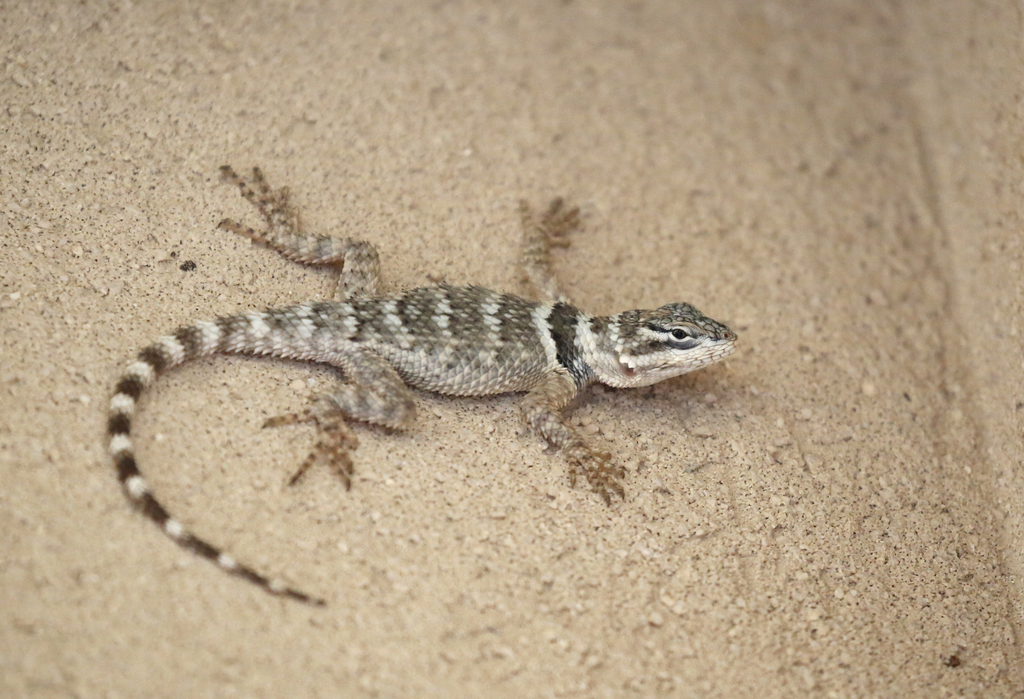
Crevice Spiny Lizard
Sceloporus poinsettii
The crevice spiny lizard (Sceloporus poinsettii ) is a species of small, phrynosomatid lizard.
From the article Sceloporus poinsettii on Wikipedia (CC BY-SA), quoted section by section
Description
The crevice spiny lizard is typically grey in color, but sometimes can have a ruddy red-brown appearance with a black and white collar around the neck region. The underside is typically light grey, but males often have blue patches on either side of their bellies. The tail typically has black banding. Their scales have a distinctly spiny texture. They can grow to 11.8 cm (4.6 in) snout-to-vent length, and 31.1 cm (12.2 inches) total length.
Range & habitat
In the United States, Sceloporus poinsettii occurs in the Chihuahua Desert and Edwards Plateau regions of Texas and New Mexico. In Mexico it occurs in the border states from the Sierra Madre Occidental of Sonora, eastward through Chihuahua, Coahuila, and Nuevo Leon. Southward its distribution is less well established, although it is known to occur throughout of the state of Durango, parts of Zacatecas, with additional records from San Luis Potosi in the southeast, and the Pacific slopes of the Sierra Madre Occidental of northern Jalisco in the southwest.
Wikipedia: “Geographic range”
What it does
Crevice spiny lizards are typically shy and nervous, fleeing up a rock face or into a crevice if approached. They prefer semi-arid habitats, often of limestone rock, where there are numerous holes and easily accessible cracks.
Wikipedia: “Behavior”
In human culture
The epithet, poinsettii, is in honor of American physician, botanist, and statesman, Joel Roberts Poinsett.
Wikipedia: “Etymology”
Where it lives
Recorded sightings
—
geo-referenced records in GBIF, from museums, herbaria and field observers.
Drag the globe to turn it. Dots are where records exist, not a range map; darker means more records.
In the stacks
Searching the stacks…
Every page naming Sceloporus poinsettii in the Biodiversity Heritage Library →
This page is assembled live from iNaturalist, GBIF, Wikipedia, the Source Library and the Internet Archive. It is not yet part of the hand-edited codex. iNaturalist taxon 36189.