- Animals
- ›Chordates
- ›Vertebrates
- ›Reptiles
- ›Snakes and Lizards
- ›Lizards
- ›Iguanas and Allies
- ›Iguanas, Anoles, and Allies
- ›Phrynosomatid Lizards
- ›Sceloporine Lizards
- ›Sceloporus
- ›Sceloporus undulatus
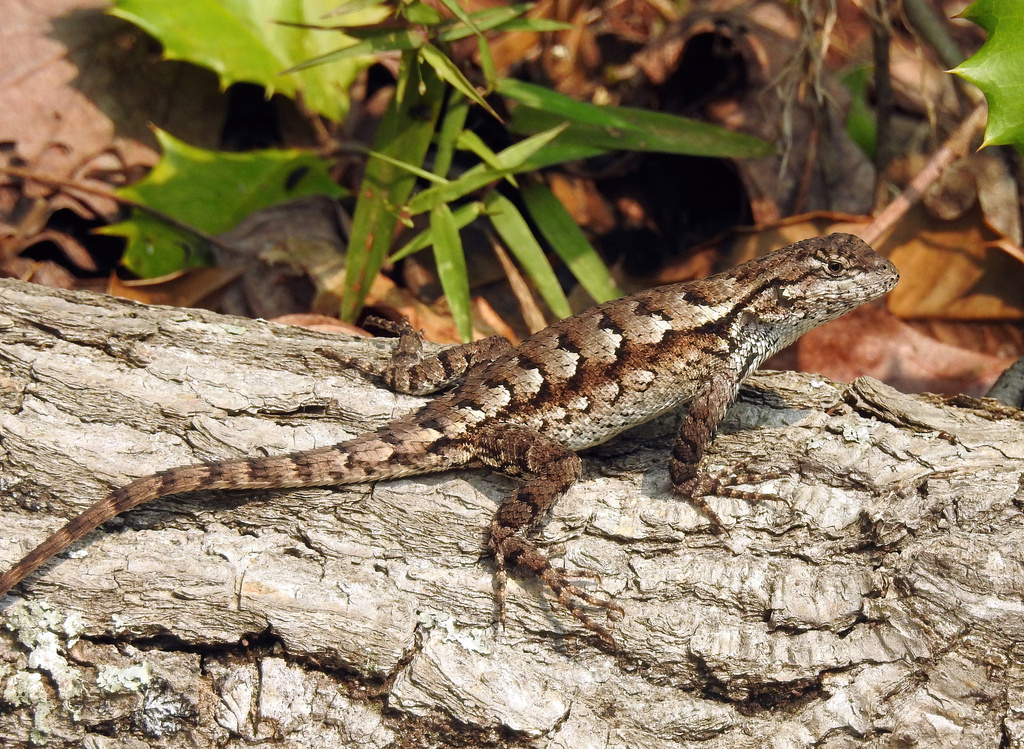
Eastern Fence Lizard
Sceloporus undulatus
The eastern fence lizard (Sceloporus undulatus) is a medium-sized species of lizard in the family Phrynosomatidae. The species is found along forest edges, rock piles, and rotting logs or stumps in the eastern United States. It is sometimes referred to as the fence swift, gray lizard, gravid lizard, northern fence lizard or pine lizard. It is also referred to colloquially as the horn-billed lizard. One of its most notable behaviors is that of its escape behavior when encountering fire ants, which have been known to invade and negatively affect many of their populations.
From the article Eastern fence lizard on Wikipedia (CC BY-SA), quoted section by section
Description
The eastern fence lizard can grow from 4.0 to 7.5 inches (10 to 19 cm) in total length (including tail). This species is a sexually size dimorphic lizard, where the females are larger than the males. It is typically colored in shades of gray or brown, and has keeled scales, with a dark line running along the rear of the thigh. A female is usually gray and has a series of dark, wavy lines across her back. The belly is white with black flecks, with some pale blue on the throat and belly. The male is usually brown, and during the summer, has a more greenish-blue and black coloration on the sides of the belly and throat than the female. The young look like the females, but are darker and duller. Both sexes have keeled scales. The lizards mostly inhabit sparsely wooded areas with ample sunlight, such as pine barrens with sandy or loose soil. They can be found basking atop of both natural and artificial structures including coarse woody debris, tree stumps, rock piles, sandy hills, dead logs, and fence posts. They are most active in the early morning sun when the ground has not been fully warmed up yet. They seek refuge under structures such as woodpiles, logs, and rocks for coverage and protection when it gets too hot and at night.
Sexual dichromatism. This species has sexual dichromatism, which is a difference in coloration between the sexes. …
Range & habitat
The eastern fence lizard is found in Mississippi, Alabama, Georgia, Kentucky, Tennessee, North Carolina, South Carolina, West Virginia, Virginia, Maryland, southeastern Indiana, southern Ohio, southern Pennsylvania, southern New Jersey, western Delaware, and northwestern Florida. It prefers open woodland and the edges of forests. This species is known to enjoy pine trees, and is often dubbed "pine lizard". Adults and juveniles prefer habitats with a high amount of rocks and coarse woody debris while hatchlings prefer sites with high temperatures (23 degrees Celsius) and low amounts of litter. There are some introduced populations of eastern fence lizards, the most well known in Staten Island, New York. In 1942, Carl Kauffeld released 29 of the lizards near Rossville where they still persist today in post oak-blackjack oak barrens. This introduction was done so Kauffeld could have an easy source of food for the lizard-eating snakes at the Staten Island Zoo, as he would otherwise have to drive to the Pine Barrens to collect the lizards for the snakes. There have also been sightings of the fence lizards in northern Pennsylvania and southern New York (in the Hudson Valley and Long Island), suggesting that their range may be expanding north. Despite its broad geographic distribution, these lizards tend to prefer temperatures that optimize their digestive performance. …
Wikipedia: “Habitat and distribution”
What it does
When climate conditions are stable, fence lizards prefer to sleep in the same site over short periods of time. The site selected is within the lizard's home range or territory. When climate conditions are not stable, it has been found that some eastern fence lizards have been able to survive small frozen periods, and then return to normal after the period is over.
Locomotion. The running speed of these lizards is not limited by their mechanical power output. As the slope of the terrain increases, running speed and stamina of lizards decreases. Eastern fence lizards run faster uphill than downhill at a fixed degree of incline or decline. Lizards with higher running speeds also have higher stamina in regard to time and distance.
Territoriality and conflict. Male eastern fence lizards will establish a territory in the early spring, doing push-ups to flash their blue scales and deter other males. Males will flash the blue coloration on their bellies to claim territory. Males will headbob more at males with smaller ventral patches, but aggressiveness is not affected by male patches. The size of a male's territory (home range area) is directly correlated with his body size. The territory of smaller males in their first breeding season tends to be smaller. Territories may overlap; about half of any given male's territory is shared by another male. …
Wikipedia: “Behavior and ecology”
Where it lives
Recorded sightings
—
geo-referenced records in GBIF, from museums, herbaria and field observers.
Drag the globe to turn it. Dots are where records exist, not a range map; darker means more records.
In the stacks
Searching the stacks…
Every page naming Sceloporus undulatus in the Biodiversity Heritage Library →
This page is assembled live from iNaturalist, GBIF, Wikipedia, the Source Library and the Internet Archive. It is not yet part of the hand-edited codex. iNaturalist taxon 36142.