- Animals
- ›Arthropods
- ›Hexapods
- ›Insects
- ›Winged and Once-winged Insects
- ›Ants, Bees, Wasps, and Sawflies
- ›Narrow-waisted Wasps, Ants, and Bees
- ›Ants, Bees, and Stinging Wasps
- ›Vespoid Wasps
- ›Hornets, Paper Wasps, Potter Wasps, and Allies
- ›Paper Wasps
- ›Polistini
- ›Polistes
- ›Aphanilopterus
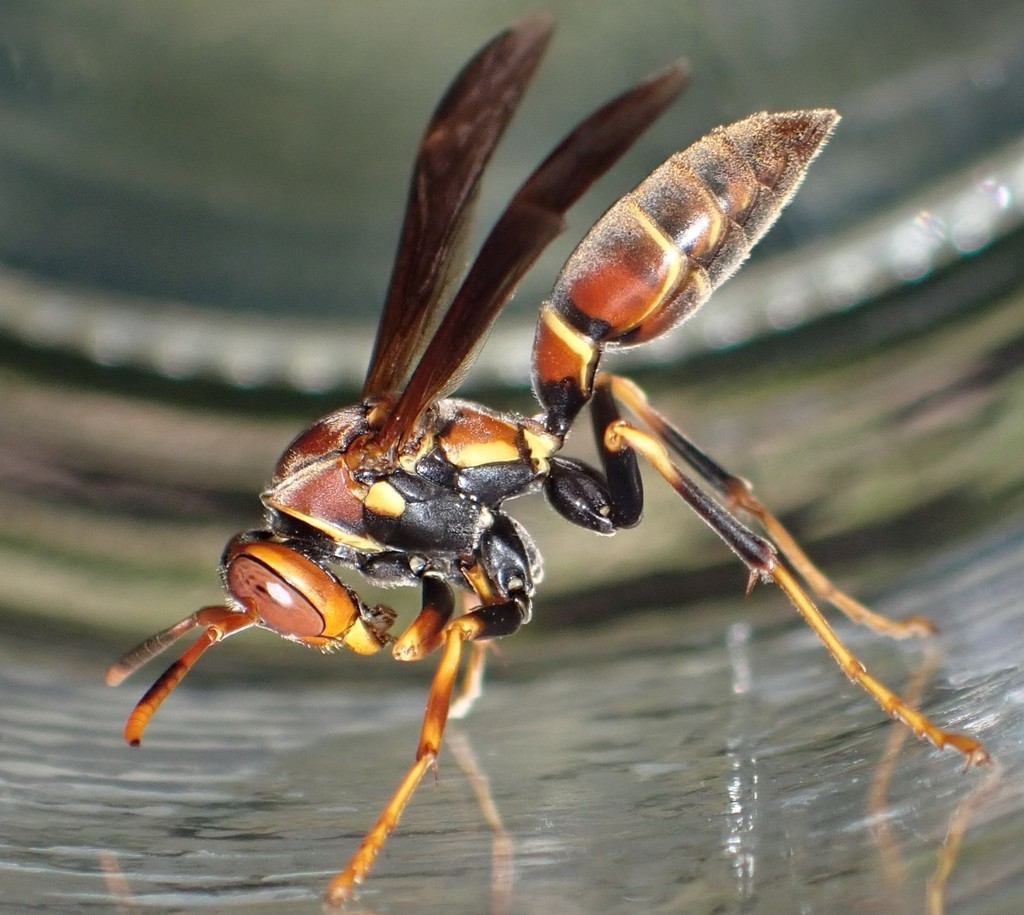
Bahamian Paper Wasp
Polistes bahamensis
Polistes bahamensis is a large species of colourful paper wasp in the genus Polistes of the family Vespidae which occurs in the Bahamas, Florida and Louisiana. It is also said to occur in Georgia.
From the article Polistes bahamensis on Wikipedia (CC BY-SA), quoted section by section
Description
The identification of this species has always been very difficult. When Bequaert first examined the first three specimens from New Orleans around 1940, he at first thought them to be perhaps P. crinitus or P. versicolor introduced from the Caribbean. Snelling examined the same population and classified it as P. exclamans var. exclamans in 1955. It has also been seen as very similar to P. annularis, with which it shares a slender first metasomal segment. It can be distinguished from this species by the yellow spot on the mesopleuron, and almost always having a yellow apical band on the posterior (back) margin of the tergites and more developed yellow markings on the mesosoma.
Range & habitat
The known range has expanded as certain populations of wasps were determined to be this species, and with the collection of more specimens.
Bahamas. The first specimens were first collected on New Providence Island in 1909. Bequaert and Salt described the species in 1931 from specimens collected on Acklins, Andros Island, Cat Island, Crooked Island, Eleuthera, Long Island, Mariguana, New Providence Island, Rum Cay and Watlings Island. Specimens were first collected on Mayaguana in 1996, and the reported range was extended further to Great Inagua in 2011, with the species now believed to occur on all the major islands of the Bahamas,
United States. Snelling first extended the range of this species to southern Florida when he identified a group of specimens of wasps collected there since the late 1930s as belonging to this species in a 1955 article. The louisianus colour form described by Bequaert in 1940, considered a synonym of the nominate taxon of P. exclamans by Snelling at the time, was initially only known from New Orleans, but Snelling also described having seen a single individual in a nest of P. exclamans in Kansas. The taxon is included in the 1979 Catalog of Hymenoptera in America north of Mexico, which for some reason does not include endemic varieties found in the Bahamas as found in America north of Mexico, as a subspecies of P. exclamans. …
Wikipedia: “Distribution”
What it does
It has usually been recorded nesting under eaves of roofs of buildings and sometimes under palm fronds. The nest is suspended from an attachment stalk known as a petiole. As of 2017, no Strepsipteran parasites are reported for P. bahamensis.
Wikipedia: “Ecology”
In human culture
The etymology of the specific epithet bahamensis is from the place 'the Bahamas', combined with the Latin suffix -ensis, meaning 'of, or from, (a place)' or 'pertaining to', together forming an adjective with the meaning: 'of the Bahamas'.
Wikipedia: “Etymology”
Listen
Looking for field recordings…
Where it lives
Recorded sightings
—
geo-referenced records in GBIF, from museums, herbaria and field observers.
Drag the globe to turn it. Dots are where records exist, not a range map; darker means more records.
In the stacks
Searching the stacks…
Every page naming Polistes bahamensis in the Biodiversity Heritage Library →
This page is assembled live from iNaturalist, GBIF, Wikipedia, the Source Library and the Internet Archive. It is not yet part of the hand-edited codex. iNaturalist taxon 361296.