- Animals
- ›Chordates
- ›Vertebrates
- ›Reptiles
- ›Snakes and Lizards
- ›Lizards
- ›Iguanas and Allies
- ›Iguanas, Anoles, and Allies
- ›Phrynosomatid Lizards
- ›Sceloporine Lizards
- ›Urosaurus
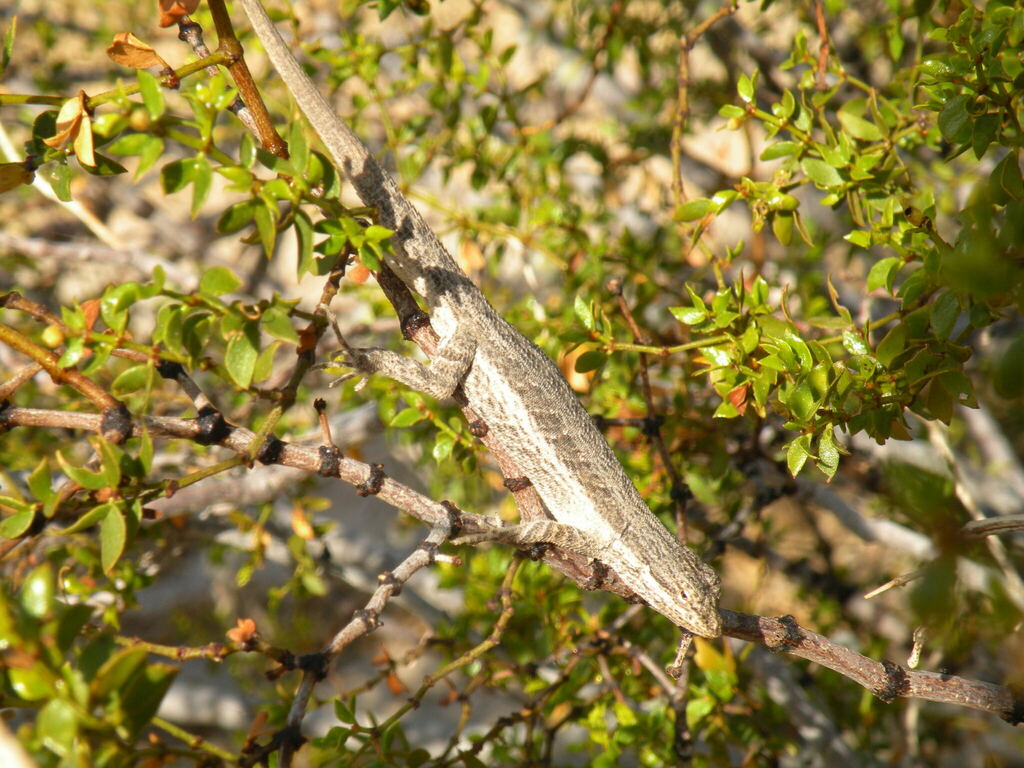
Long-tailed Brush Lizard
Urosaurus graciosus
The long-tailed brush lizard, Urosaurus graciosus, occurs in the Mojave and northwestern Sonoran Deserts in the states of California, Arizona, Nevada, Sonora, and Baja California. This species received its common name due to its tail, which is more than twice the body length, and since it is almost always encountered on a tree or shrub. Its gray or tan coloration keep it well camouflaged against branches while it waits for insects. Unlike most other phrynosomatid lizards,...
From the article Urosaurus graciosus on Wikipedia (CC BY-SA), quoted section by section
Range & habitat
U. graciosus occurs in the Mojave Desert and the northwestern Sonoran Desert in the U.S. states of California, Arizona and Nevada, and in the Mexican states of Baja California and Sonora.
Wikipedia: “Habitat and geographic range”
What it does
The long-tailed brush lizard's gray or tan coloration keeps it well camouflaged against branches while it waits for insects. Unlike most other phrynosomatid lizards, which bury in the sand at night during warm weather, U. graciosus spends the night on the tips of branches.
Wikipedia: “Behavior”
In human culture
The subspecific name, shannoni, is in honor of American herpetologist Frederick Albert Shannon.
Wikipedia: “Etymology”
Where it lives
Recorded sightings
—
geo-referenced records in GBIF, from museums, herbaria and field observers.
Drag the globe to turn it. Dots are where records exist, not a range map; darker means more records.
In the stacks
Searching the stacks…
Every page naming Urosaurus graciosus in the Biodiversity Heritage Library →
This page is assembled live from iNaturalist, GBIF, Wikipedia, the Source Library and the Internet Archive. It is not yet part of the hand-edited codex. iNaturalist taxon 36121.