- Animals
- ›Chordates
- ›Vertebrates
- ›Ray-finned Fishes
- ›Carps, Characins, Catfishes and Allies
- ›Minnows, Suckers, Carps, and Loaches
- ›Carps and Minnows
- ›Cyprinids
- ›Typical Carps
- ›Carassius
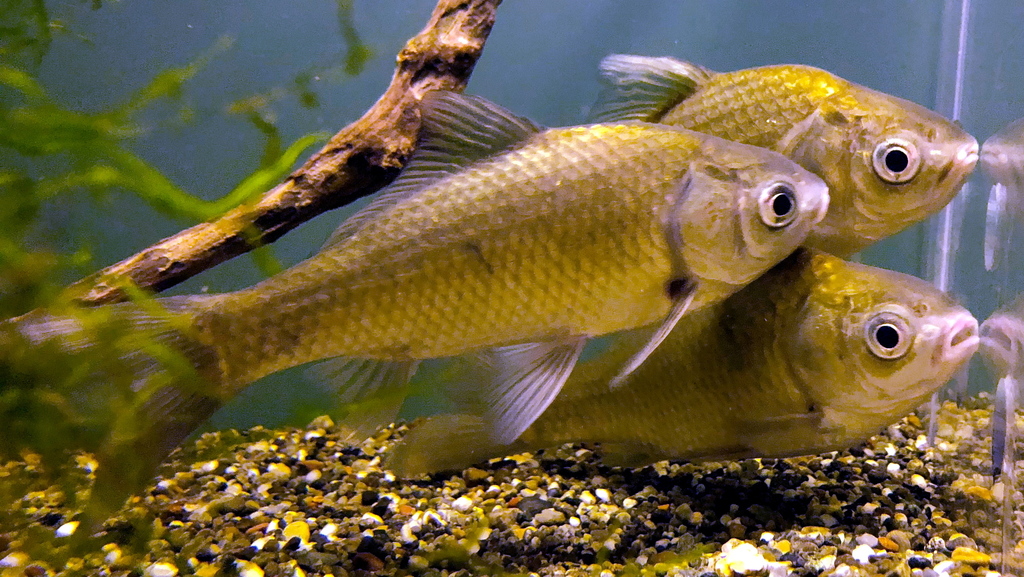
Japanese White Crucian Carp
Carassius cuvieri
The Japanese white crucian carp, also known as Japanese carp, white crucian carp, or gengoro-buna (Carassius cuvieri), is a species of freshwater fish in the carp family (family Cyprinidae). It is found in Japan and, as an introduced species, in several other countries in Asia. This fish is closely related to the commonly known goldfish.
From the article Japanese white crucian carp on Wikipedia (CC BY-SA), quoted section by section
Description
This is a medium-sized fish, growing up to 50 cm, with a broad head and a blunt snout. The lips are fleshy, and lacking barbels. The body is deep and laterally compressed, with a distinctly humped back. The scales are large and cycloid in shape, with a complete lateral line. Serration is present on the last ray of the dorsal and anal fins, and the caudal fin is forked.
Range & habitat
Historically, the Japanese white crucian carp was endemic to Lake Biwa, as well as the connected Yodo River system, in Japan. However, it has been introduced to Taiwan and Korea. In South Korea initial introductions were the result of stocking by government agencies. Subsequently, the species has also been spread through the Buddhist practice of "life releasing", in which animals destined for slaughter are instead released into the wild. Possession of this species without a permit is prohibited in the state of Vermont. It is a freshwater fish, preferring still or slow moving waters, and occurs at depths up to 20 meters. Typical habitats include lakes, canals, and backwaters.
Wikipedia: “Distribution and habitat”
What it does
An omnivorous species, Japanese white crucian carp feed on a variety foods, including algae, phytoplankton, macrophytes, and invertebrates, such as insects and crustaceans. During the larval stage, zooplankton comprise the primary food source. Upon reaching 1.8 cm the young fish form schools and move offshore to feed on phytoplankton. Phytoplankton remains the primary food source through adulthood. This is reflected in the unique structure of their pharyngeal teeth, which are specialized to feed on phytoplankton.
Wikipedia: “Feeding, diet, and related information”
Where it lives
Recorded sightings
—
geo-referenced records in GBIF, from museums, herbaria and field observers.
Drag the globe to turn it. Dots are where records exist, not a range map; darker means more records.
In the stacks
Searching the stacks…
Every page naming Carassius cuvieri in the Biodiversity Heritage Library →
This page is assembled live from iNaturalist, GBIF, Wikipedia, the Source Library and the Internet Archive. It is not yet part of the hand-edited codex. iNaturalist taxon 360787.