- Animals
- ›Chordates
- ›Vertebrates
- ›Reptiles
- ›Snakes and Lizards
- ›Lizards
- ›Iguanas and Allies
- ›Iguanas, Anoles, and Allies
- ›Phrynosomatid Lizards
- ›Phrynosomatine Lizards
- ›Cophosaurus
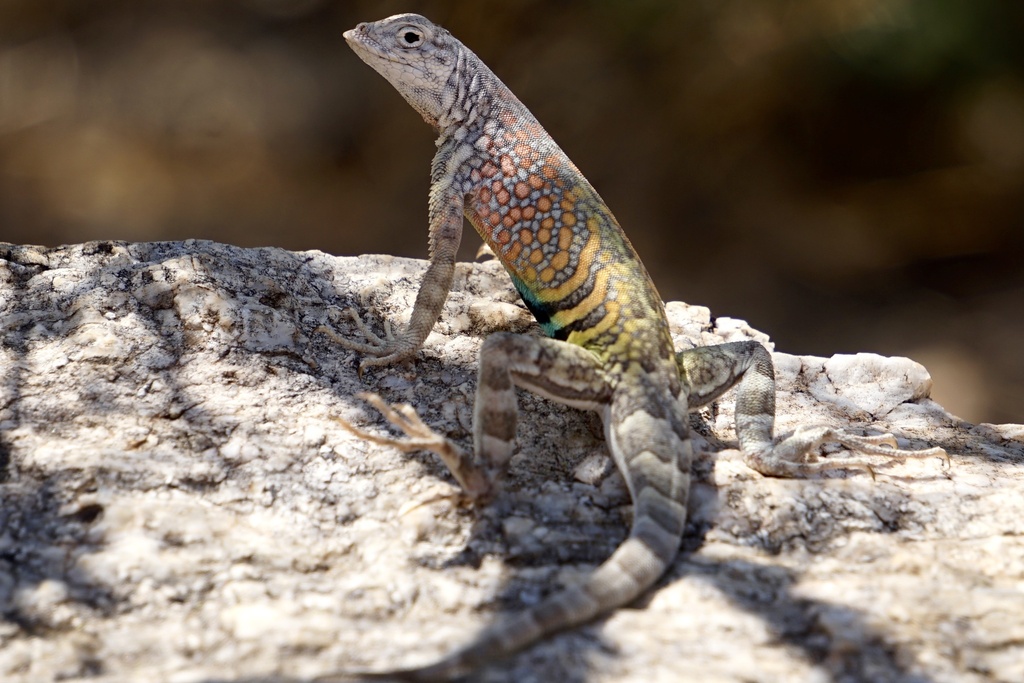
Greater Earless Lizard
Cophosaurus texanus
The greater earless lizard (Cophosaurus texanus) is the only species in the monotypic genus Cophosaurus. It is closely related to the smaller, lesser earless lizards and other species in the genus Holbrookia, and in fact was placed in that genus and referred to Holbrookia texana from 1852 into the 1970s. Earless lizards lack external ear openings, an adaptation to burrowing in the sand, as are the recessed lower jaw and flared upper labial scales. Greater earless lizards are sexually dimorphic, males grow larger and are more colorful than females, exhibiting pink and green colors that are particularly bright in the breeding season. Two bold black bars mark the lateral region of males but are greatly reduced and vague, or occasionally entirely absent in females.
The greater earless lizard is native to the Chihuahua Desert and other arid and semi-arid regions of Southwestern United States and northern Mexico, where they most often occupy moderately open areas of sparse vegetation with rocks, gravel, and sand. The overall color of individual lizards frequently match the colors of the rocks and soils of the local area they inhabit. They will often rely on camouflage and their speed to elude threats and predators before retreating into rock crevices. They are primarily insectivores, preying on wide variety of crickets, grasshoppers, caterpillars, ants, flies, beetles, and bugs. Spiders and small lizards are occasionally eaten as well. Cophosaurus are oviparous.
From the article Greater earless lizard on Wikipedia (CC BY-SA), quoted section by section
Description
The greater earless lizard is a medium-sized lizard (relative to other species in its range) and the largest of the earless lizards. A range of sizes have been reported by various authors: Texas greater earless lizard (C. t. texanus), males 8.3–18.1 cm (3.3–7.1 in), females 7–14.3 cm (2.8–5.6 in); Chihuahuan greater earless lizard (C. t. scitulus), males 9–18.4 cm (3.5–7.2 in), females 6.7–13.5 cm (2.6–5.3 in) in total lengths are representative of the species.
Greater earless lizards do not have external ear openings. The scales on the body are small and granular, with the dorsal scales slightly smaller than the ventral scales. Their legs, particularly the hind legs, are relatively long. The tail is slightly flattened and longer than head and body combined. The underside of the tail is white with 5 to 9 (usually 6 or 7) bold, contrasting black bands (excluding individuals with regenerated tails). The base color can be various shades of grays, browns, tans, or reddish brown and generally close to the prevailing colors of the local substrate. Cophosaurus texanus is a sexually dimorphic species, in addition to size differences, males and females differ in some aspects of colors and markings. …
Range & habitat
The greater earless lizard occurs in the southwestern United States (Arizona, New Mexico, and Texas) and northern Mexico (Chihuahua, Coahuila, Durango, Nuevo León, San Luis Potosí, Sonora, Tamaulipas, and Zacatecas). Elevations ranging from 127 to 2100 meters have been reported.
The Texas greater earless lizard (C. t. texanus) occurs on the Edwards Plateau of Central Texas and northward to the state border with Oklahoma and southeastern areas of the Texas panhandle. It ranges southward into the Tamaulipan mezquital ecoregion, and along the Rio Grande into northeast Coahuila and north-central Nuevo León, Mexico. In south-central Tamaulipas, its occurrence becomes increasingly spotty and localized, with records just across the southern state line in eastern San Luis Potosí. Several accounts have commented on the problematic and poorly defined zone of integration between the subspecies C. t. texanus and C. t. scitulu. The Chihuahuan greater earless lizard (C. t. scitulus) occurs throughout much of the Chihuahuan Desert, including much of the Trans-Pecos region of West Texas, the southern third of New Mexico (following the Pecos and Rio Grande river basins northward), and southeastern Arizona (east of the Sonora Desert), following a zone of semi-arid habitats around the northeastern margins of the Sonoran Desert almost to the California border. …
Wikipedia: “Distribution”
What it does
The longevity of the greater earless lizard is typically 3 years, but records of individuals surviving five reproductive seasons in the wild have been documented. Both males and females reach adult size in a year, attaining maturity and mating before their second winter. Mating occurs from April to August, peaking between late April and early July. Gravid females often exhibit pink, orange or yellow colors on their throats and sides. In one study, gravid females were only found in May and June. Multiple clutches, up to four a year, are scattered over a wide area, with clutch size ranging from 2 to 9 eggs (average 3-5); more mature females produce larger clutches than younger females. One study reported finding single eggs buried in the sand on three occasions, but never locating a clutch. The incubation period is about 50 days. The hatchlings emerge from June to October, with reports of sizes varying from 20 to 25 mm. to 26–31 mm. snout–vent length.
Wikipedia: “Reproduction”
In human culture
The generic name Cophosaurus is derived from the Greek words copho (κουφός), meaning "deaf", and saurus, meaning "lizard", in reference to the animal's absent external ear openings. The trivial name, or specific epithet texanus, is a toponym in reference to the state of Texas, the original location where the specimens used in the lizard's description were collected. The subspecific names are both Latin, reticulatus, meaning "reticulated" or a "net-like" pattern, and scitulus, meaning "handsome" or "pretty".
Wikipedia: “Etymology”
Where it lives
Recorded sightings
—
geo-referenced records in GBIF, from museums, herbaria and field observers.
Drag the globe to turn it. Dots are where records exist, not a range map; darker means more records.
In the stacks
Searching the stacks…
Every page naming Cophosaurus texanus in the Biodiversity Heritage Library →
This page is assembled live from iNaturalist, GBIF, Wikipedia, the Source Library and the Internet Archive. It is not yet part of the hand-edited codex. iNaturalist taxon 36076.