- Animals
- ›Arthropods
- ›Hexapods
- ›Insects
- ›Winged and Once-winged Insects
- ›Beetles
- ›Water, Rove, Scarab, Long-horned, Leaf, and Snout Beetles
- ›Scarabaeiform Beetles
- ›Scarabs, Stag Beetles, and Allies
- ›Scarabs
- ›Fruit and Flower Chafers
- ›Bee Beetles and Flower Scarabs
- ›Trichiina
- ›Gnorimus
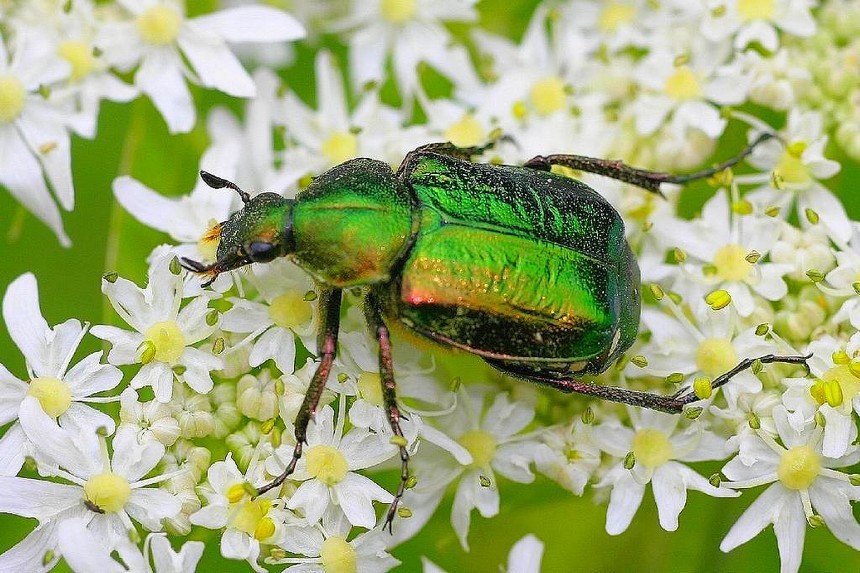
Noble Chafer
Gnorimus nobilis
The noble chafer (Gnorimus nobilis) is a green beetle with a metallic sheen. It spends most of its life as a grub, living in the rotting wood of aging fruit trees. It reaches adulthood in its second summer, and comes out to breed and feed on flowers such as common hogweed, before dying in the early autumn. The adult tends to be found high up in the trees, in old pruned wood or woodpecker holes.
From the article Noble chafer on Wikipedia (CC BY-SA), quoted section by section
Description
Gnorimus nobilis can reach approximately a body length of 15–19 millimetres (0.59–0.75 in). These beetles have the pronotum and head covered with dense medium-sized dots. Elytra are covered with dense, coarse wrinkles and small, small dots. They have a green metallic-green body speckled with white. They show a brilliant iridescence that can vary from gold to copper or violet. The sides of the abdomen and the pygidium are also gold-green with large white spots. The bottom side varies from bright coppery to black. The related species Gnorimus variabilis is easily distinguishable. In this species the elytra are not green metallic, but black, with white spots. In addition, the shape of the pronotum side edge is laterally weakly s-shaped, while in Gnorimus nobilis it is simply rounded. Gnorimus nobilis is also rather similar to the more common Cetonia aurata, but in the latter the middle and hind legs are toothed, whereas they are smooth in the Gnorinus nobilis. Moreover in the noble chafer the scutellum forms an equilateral triangle.
Range & habitat
This species is widespread in most of Europe (Albania, Austria, Belarus, Belgium, Bosnia and Herzegovina, Bulgaria, Croatia, Czech Republic, Denmark, Estonia, France, Germany, Greece, Hungary, Italy, Latvia, Liechtenstein, Luxembourg, Montenegro, Netherlands, North Macedonia, Norway, Poland, Portugal, Romania, Russia, Serbia, Slovakia, Slovenia, Spain, Sweden, Switzerland, Turkey, Ukraine and United Kingdom). It seems to be declining over much of its European range. In Britain this beetle has been losing its habitat, and its populations shrinking, for more than a century. The beetle has been recently seen at a handful of sites in the old English fruit-growing regions of Gloucestershire, Herefordshire and Worcestershire.
Wikipedia: “Distribution”
In human culture
The genus name Gnorimus derives from the ancient Greek γνώριμος, gnōrimos meaning 'famous'. The species name nobilis (Latin) means noble.
Wikipedia: “Etymology”
Listen
Looking for field recordings…
Where it lives
Recorded sightings
—
geo-referenced records in GBIF, from museums, herbaria and field observers.
Drag the globe to turn it. Dots are where records exist, not a range map; darker means more records.
In the stacks
Searching the stacks…
Every page naming Gnorimus nobilis in the Biodiversity Heritage Library →
This page is assembled live from iNaturalist, GBIF, Wikipedia, the Source Library and the Internet Archive. It is not yet part of the hand-edited codex. iNaturalist taxon 360026.