- Animals
- ›Arthropods
- ›Hexapods
- ›Insects
- ›Winged and Once-winged Insects
- ›Beetles
- ›Water, Rove, Scarab, Long-horned, Leaf, and Snout Beetles
- ›Scarabaeiform Beetles
- ›Scarabs, Stag Beetles, and Allies
- ›Scarabs
- ›Fruit and Flower Chafers
- ›Rose Chafers
- ›Cetoniina
- ›Protaetia
- ›Potosia
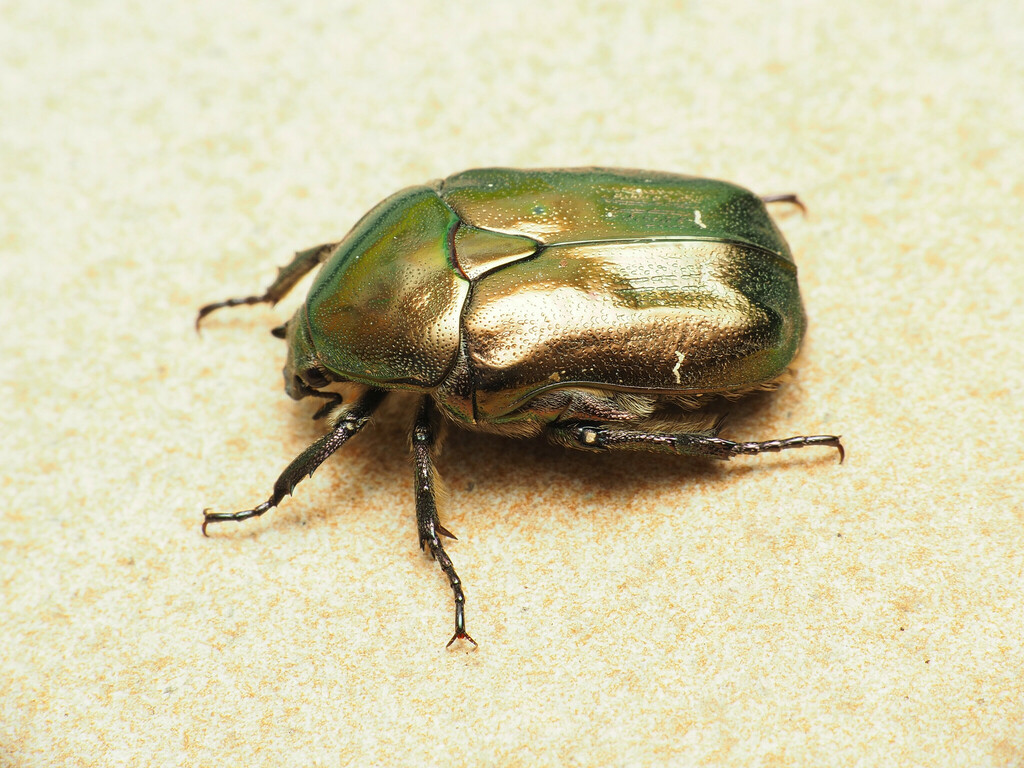
Copper Chafer
Protaetia cuprea
Protaetia cuprea, also known as the copper chafer, is a species of chafer in the family Scarabaeidae. This species is also known as the rose chafer and has a wide geographic distribution, extending from Canary Islands, Portugal, and Spain to the east towards Vladivostok in the Russian Far East, Mongolia, and North China. This species forages for pollen from flowers and fruits, such as apples, from trees. However, since fruit is scarce in the spring and winter, they only transition from a diet of pollen to a diet of fruits in the summer. Since pollen is richer in proteins and lipids than carbohydrates, while fruit is richer in carbohydrates, they are able to travel longer when on a fruit diet; this is due to their increased aerobic performance when fueled by high-carbohydrate content.
This beetle is well-known for its flight ability, a skill that supports its foraging behavior. It has swift maneuvering ability and strong precision when landing on flowers and plants; it is able to do this due to the elasticity and mechanisms this beetle's wings possess.
From the article Protaetia cuprea on Wikipedia (CC BY-SA), quoted section by section
Description
The Protaetia cuprea species complex exhibits high morphological variability. The chromosome number across the genus Protaetia, including P. cuprea, is consistently 2n = 20. Despite this genetic stability, minor variances in X-chromosome morphology have been observed among some subspecies.
The extensive morphological variability does not align with the phylogenetic insights from mitochondrial DNA studies. Morphological features traditionally used for taxonomical classification, such as coloration, body structure, and reproductive organ shapes, show significant variation that does not neatly correlate with genetic relationships. Traits like the elytra's distal sculpture and white "knee" markings emerged as clade-specific, yet their taxonomic significance remains ambiguous. Geometric morphometry has highlighted that variations in certain morphological traits are more gradual than discrete across the complex, further complicating the relationship between morphology and genetic data. The observed high color variation within the species complex also does not mirror mitochondrial DNA (mtDNA) structures. This suggests that color polymorphism might be influenced by factors beyond genetics, such as environmental conditions and biotic interactions, including mimicry and aposematism. This implies a multifaceted regulation of morphological diversity in the P. …
Wikipedia: “Morphology”
Range & habitat
The beetle species P. cuprea has an extensive geographic distribution across various regions, showcasing its adaptability and diverse habitat preferences. P. cuprea is found all over Europe and Asia. From the Canary Islands, Portugal, and Spain, the beetle's range extends eastward to Vladivostok in the Russian Far East and further encompasses Mongolia and North China. Its presence in the Middle East is notable, with populations in Turkey, the Levant, northern Egypt, and Iran. Further, the species is also documented in South Asia, specifically in Pakistan and Nepal.
The diversity of subspecies within P. cuprea highlights its evolutionary complexity and geographical spread. The subspecies Protaetia cuprea obscura is notably absent in Germany but is found across Central and Eastern Europe, including the Czech Republic, Slovakia, Austria (lowlands), Hungary, Italy (near Venezia), Bosnia and Herzegovina, Croatia, Romania, Bulgaria, and Greece. This subspecies is known to hybridize with P. cuprea metallica in Slovakia and Romania, indicating a rich interspecies interaction. The distribution of P. cuprea bourgini, as well as closely related P. cuprea brancoi, in Spain, separated by the natural barrier of the Pyrenees Mountains, showcases the influence of geographic features on species distribution. The subspecies P. …
Wikipedia: “Geographic range”
What it does
The life cycle of Protaetia cuprea is typically one year. However, under certain conditions, this beetle can develop more rapidly, growing into adults within the same year the eggs were laid by the parental generation. In their larval stage, P. cuprea is primarily sapro-xylophagous. They have a particular affinity for deciduous trees, with oaks (Quercus spp.) being a favored habitat. Despite this preference, the larvae can also transition to pure saprophagy, evidenced by reports of larvae developing in compost heaps or forming associations with ant colonies.
Wikipedia: “Life cycle”
At the table
Research indicates that P. cuprea primarily feeds on decaying organic matter, such as fruits, flowers, and plant debris. Studies investigating the feeding habits of larvae revealed that they predominantly consume rotting wood and plant material. Additionally, adult beetles are known to feed on ripe fruits and sap exudates from damaged trees. Furthermore, P. cuprea has been observed to exhibit opportunistic feeding behavior, consuming a wide range of organic materials depending on its availability in their habitat. This adaptability in food preference suggests a generalist feeding strategy, which may contribute to its ecological success in diverse habitats.
Wikipedia: “Food resources”
How it is grown
The study by Babarabie et al. (2018) highlights the possible agricultural benefits of utilizing P. cuprea larvae in composting organic materials, including kitchen waste and various types of leaves. Specifically, it examines how compost produced by P. cuprea larvae compares with traditional vermicompost in terms of nutrient content and physical properties. The findings reveal that compost derived from kitchen waste processed by these larvae contained higher levels of essential nutrients such as nitrogen, potassium, and phosphorus. Compost from lawn clippings also showed improved pH levels and uniformity, which is crucial for agricultural use. This indicates the potential of P. cuprea larvae to improve compost quality and usability, thereby supporting more sustainable agricultural practices.
Wikipedia: “Agricultural use”
Listen
Looking for field recordings…
Where it lives
Recorded sightings
—
geo-referenced records in GBIF, from museums, herbaria and field observers.
Drag the globe to turn it. Dots are where records exist, not a range map; darker means more records.
In the stacks
Searching the stacks…
Every page naming Protaetia cuprea in the Biodiversity Heritage Library →
This page is assembled live from iNaturalist, GBIF, Wikipedia, the Source Library and the Internet Archive. It is not yet part of the hand-edited codex. iNaturalist taxon 360024.