On eBird ↗
Pheasant Pigeon
Live sightings near you, the range map, bar charts of when it is seen, and Macaulay Library photos and recordings.
Pheasant Pigeon
Otidiphaps nobilis
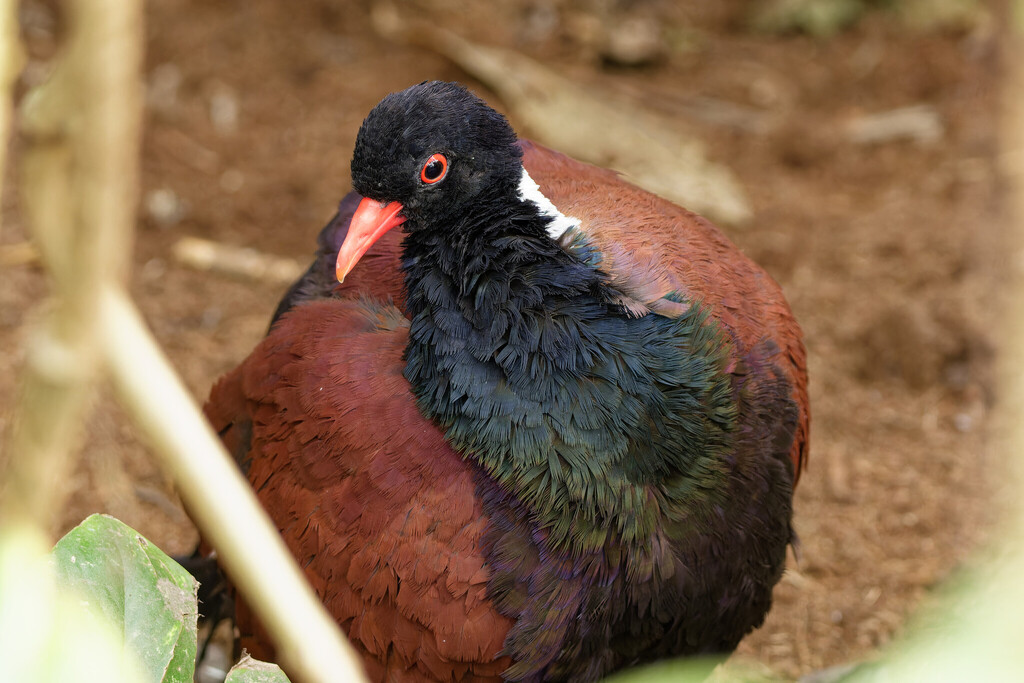
The pheasant pigeon (Otidiphaps nobilis) is a species of large terrestrial pigeon. It is the only species of the monotypic genus Otidiphaps. The pheasant pigeon is found in the primary rainforests of New Guinea and nearby islands. It ranges primarily over hilly and lower mountain areas, but can also be found in lowlands.
From the article Pheasant pigeon on Wikipedia (CC BY-SA), quoted section by section
Description
The pheasant pigeon resembles a pheasant in external morphology, particularly in its laterally compressed tail and rounded wings. They have glossy black heads, undersides, rears and lower backs, and short rounded brown wings, and a white, green, grey, or black nape depending on the subspecies. The pheasant pigeon has filled the ecological niche of a partridge or small pheasant (while the larger Goura crowned pigeons have a lifestyle similar to larger pheasants, grouse or turkeys). It is a highly secretive species, feeding on seeds and fallen fruits. It inhabits hill and montane areas, however, it is also known to inhabit lower altitudes. It nests on the ground below trees and bushes, laying one egg that it incubates for around four weeks. Both adults incubate and look after the young, feeding regurgitated crop milk to their young (a common practice for most pigeons). They have a range of calls including a drilling-like sound, a typical pigeon cooing call and a loud "wu-huwoooooa" call that rises and falls in pitch before trailing off at the end. They are found in rainforest habitats, eating fallen fruits and seeds, in the Aru Islands. As they avoid human settlements, the little that is known about their behavior comes from observation at zoos.
Listen
Looking for field recordings…
Where it lives
Recorded sightings
—
geo-referenced records in GBIF, from museums, herbaria and field observers.
Drag the globe to turn it. Dots are where records exist, not a range map; darker means more records.
In the stacks
Searching the stacks…
Every page naming Otidiphaps nobilis in the Biodiversity Heritage Library →
This page is assembled live from iNaturalist, GBIF, Wikipedia, the Source Library and the Internet Archive. It is not yet part of the hand-edited codex. iNaturalist taxon 3597.