On eBird ↗
Victoria Crowned-Pigeon
Live sightings near you, the range map, bar charts of when it is seen, and Macaulay Library photos and recordings.
Victoria Crowned-Pigeon
Goura victoria
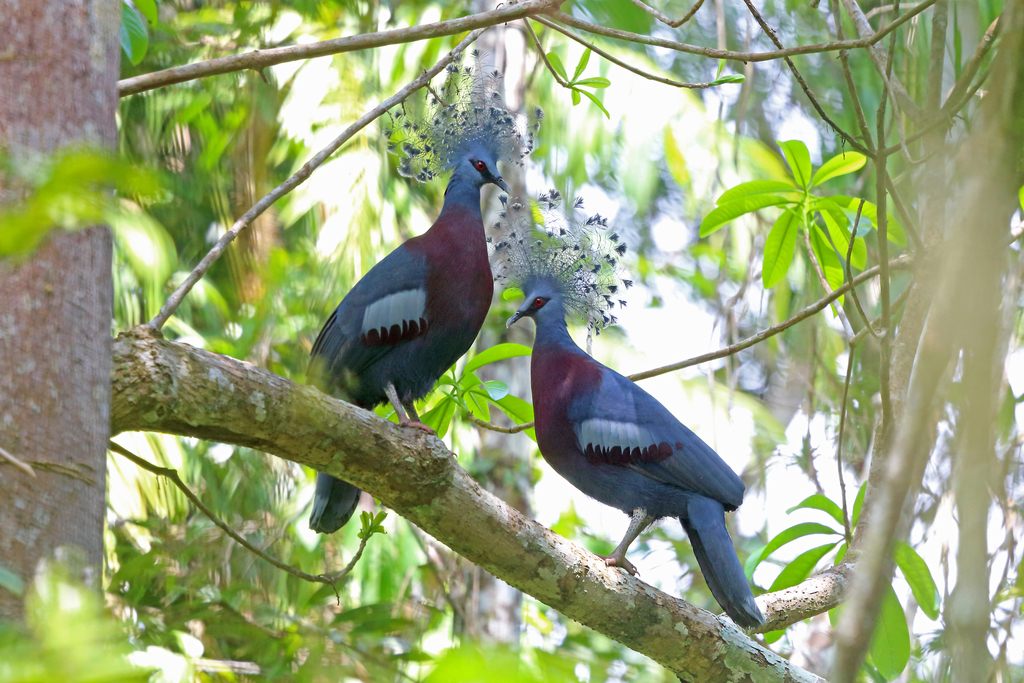
The Victoria crowned pigeon (Goura victoria) is a large, bluish-grey pigeon with elegant blue lace-like crests, maroon breast and red irises. It is part of a genus (Goura) of four unique, very large, ground-dwelling pigeons native to the New Guinea region, with the Victoria crowned pigeon measuring as the largest extant species of pigeon. The bird may be easily recognized by the unique white tips on its crests and by its deep 'whooping' sounds made while calling. Its name commemorates the British monarch, Queen Victoria.
From the article Victoria crowned pigeon on Wikipedia (CC BY-SA), quoted section by section
Description
The Victoria crowned pigeon is a deep blue-grey colour with a small, black mask. Its feather crest (the signature feature of crowned pigeons other than their size) is conspicuously white-tipped. On the wing coverts is a row of feathers that are a paler blue-gray with maroon tips. These form a distinct wing bar. The chest is a deep purple-maroon color. As in all crowned pigeons, melanism has been observed. The other two crowned pigeons are somewhat superficially similar, but only the western crowned pigeon overlaps in range with the Victoria species. The Scheepmaker's crowned pigeon does not. In the western species, the crown is more scraggly and hair-like, the chest is a uniform blue-gray and not maroon, and a less distinct wing-bar is present. Both sexes are similar. This species is typically 73 to 75 cm (29 to 30 in) long. Some specimens may exceed a length of 80 cm (31 in) and a weight of 3.5 kg (7.7 lb). It is marginally larger than the two other crowned pigeons on average, at a mean of 2.39 kg (5.3 lb) in adult body mass, thus is considered the largest surviving species of pigeon on Earth. …
Range & habitat
The Victoria crowned pigeon is distributed in the lowland and swamp forests of northern New Guinea and surrounding islands. It usually occurs on areas that were former alluvial plains, including sago forests. Though typically found at or near sea level, occasionally birds of this species may venture up in the hills to an elevation up to about 3,000 feet.
Wikipedia: “Habitat”
What it does
Like other crowned pigeons, the Victoria crowned pigeon is a gregarious species. They usually travel in pairs or small parties as they search for food. They walk with an unhurried gait along the forest floor. Their food typically consists of fallen fruit. Birds of this species in captivity are particularly fond of eating figs. Seeds and invertebrates may occasionally supplement the diet. When disturbed, these birds fly straight up into the canopy or a large horizontal branch of a large forest tree. After being disturbed, they may remain on their perch for a considerable time engaging in contact calls and flicking their tails. In the wild, this species tends to be shier than the western crowned pigeon, but can still occasionally be quietly approached. The males regularly engage in aggressive displays to establish dominance. In these interactions, the pigeons puff up their chests and repeatedly raise their wings as if preparing to strike their opponent. They also make short dashes at each other and may actually hit one another, but rarely make contact and can be completely peaceful towards other males outside of the early mating season.
Wikipedia: “Behavior”
Listen
Looking for field recordings…
Where it lives
Recorded sightings
—
geo-referenced records in GBIF, from museums, herbaria and field observers.
Drag the globe to turn it. Dots are where records exist, not a range map; darker means more records.
In the stacks
Searching the stacks…
Every page naming Goura victoria in the Biodiversity Heritage Library →
This page is assembled live from iNaturalist, GBIF, Wikipedia, the Source Library and the Internet Archive. It is not yet part of the hand-edited codex. iNaturalist taxon 3593.