- Animals
- ›Chordates
- ›Vertebrates
- ›Reptiles
- ›Snakes and Lizards
- ›Lizards
- ›Wall lizards, amphisbaenians, and allies
- ›Wall Lizards
- ›Lacertinae
- ›Podarcis
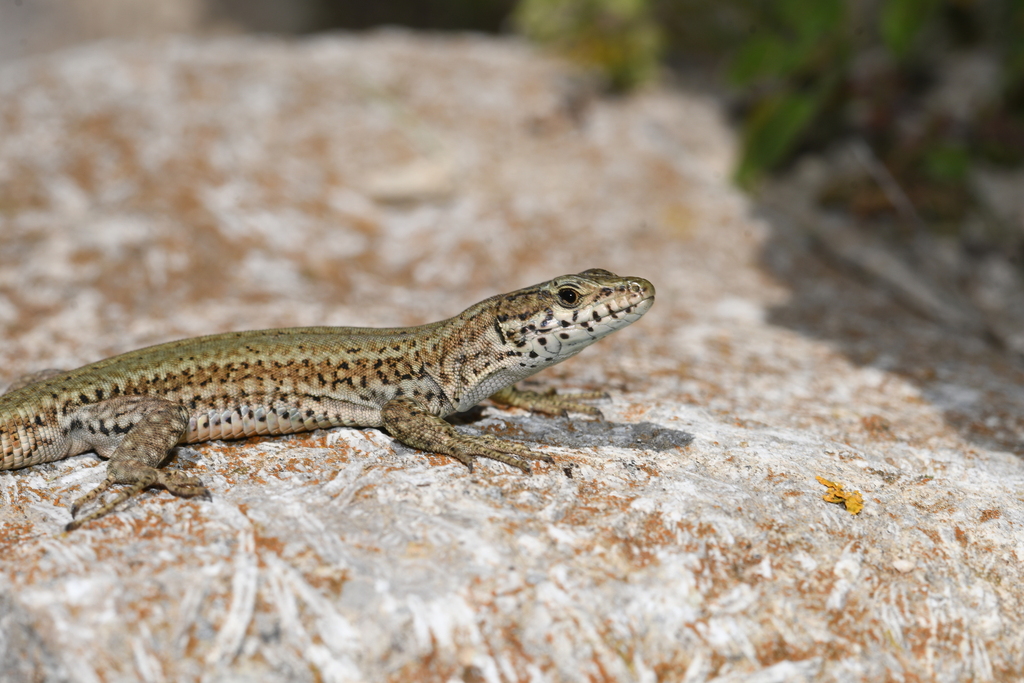
Catalonian Wall Lizard
Podarcis liolepis
Podarcis liolepis, the Columbretes wall lizard or Catalan wall lizard, is very similar to the other lizards in the genus Podarcis. This species was formerly described as a subspecies of the Iberian wall lizard, but has now been elevated to species status. These are slender lizards with long tails, narrow tapered heads and long thin toes, and stout legs. Colours are variable, although generally grey-brown. Often very subtle spots and stripes along the back and flanks can be seen and these can be more distinguished in the female. The underside is a much lighter cream or beige with sometimes a reddish tint. Adults grow 15–20 cm in length from the nose to tip of the tail. Body length can be a little as one third of the total body length, the tail making up the other two thirds.
From the article Podarcis liolepis on Wikipedia (CC BY-SA), quoted section by section
Range & habitat
They are found in the north-east of the Iberian peninsula, including southern France in parts of the Pyrenees. They are not found above 3400m elevation.
== References ==
Wikipedia: “Distribution”
What it does
Lifespan around 4–5 years. Sexual maturity is reached in their second year. Breeding takes place in spring after they wake from winter hibernation. 1-5 eggs are laid, each around 5x9mm, in cracks in rocks or under stones. During development the eggs swell and after 8 weeks when ready to hatch they can be 8x15mm in size. They hatch out around early July.
Wikipedia: “Life cycle”
Where it lives
Recorded sightings
—
geo-referenced records in GBIF, from museums, herbaria and field observers.
Drag the globe to turn it. Dots are where records exist, not a range map; darker means more records.
In the stacks
Searching the stacks…
Every page naming Podarcis liolepis in the Biodiversity Heritage Library →
This page is assembled live from iNaturalist, GBIF, Wikipedia, the Source Library and the Internet Archive. It is not yet part of the hand-edited codex. iNaturalist taxon 35666.