- Animals
- ›Chordates
- ›Vertebrates
- ›Reptiles
- ›Snakes and Lizards
- ›Lizards
- ›Wall lizards, amphisbaenians, and allies
- ›Wall Lizards
- ›Lacertinae
- ›Podarcis
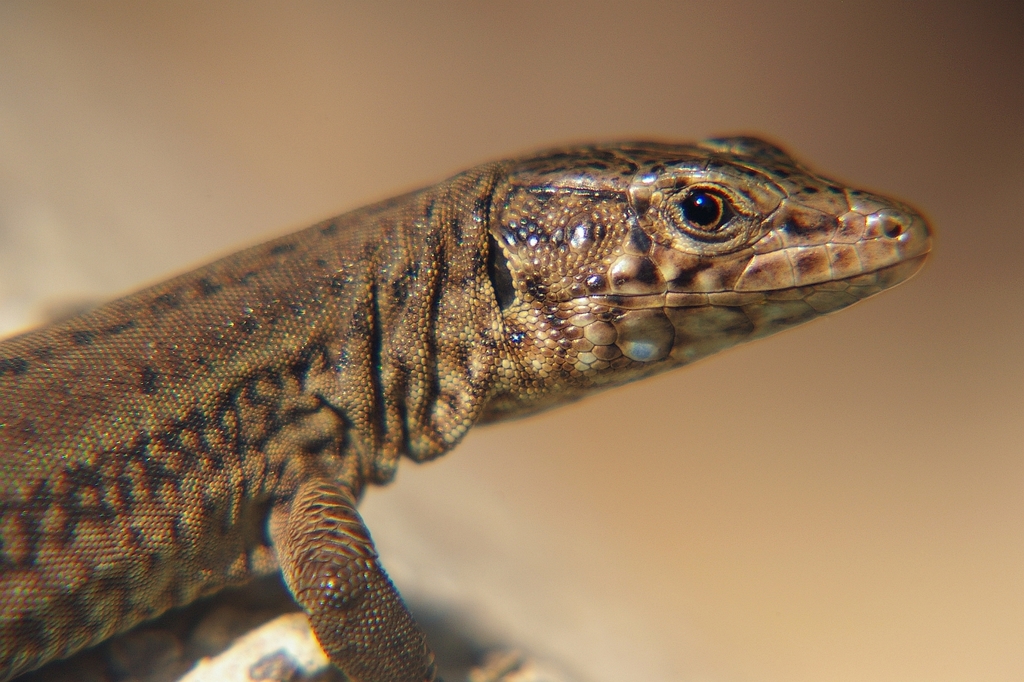
Lilford's Wall Lizard
Podarcis lilfordi
Lilford's wall lizard (Podarcis lilfordi) is a species of lizard in the family Lacertidae. The species is endemic to the Gymnesian Islands, the easternmost of the Balearic Islands, Spain. There are 27 subspecies that are recognized as being valid.
Its natural habitats are temperate Mediterranean-type shrubby vegetation, rocky areas, and rocky shores. Originally distributed throughout the Gymnesians including the main islands of Mallorca and Menorca, the introduction of alien species which started with the Romans has confined the species to the uninhabited islets around the major islands, on almost each of which a local subspecies has evolved. It is threatened by habitat loss.
From the article Lilford's wall lizard on Wikipedia (CC BY-SA), quoted section by section
Description
Lilford's wall lizard grows to a maximum snout-to-vent length (SVL) of 8 cm (3 in), but adults are usually a little smaller than this. The tail is about 1.8 times as long as the body. It is a robust streamlined lizard with a short head and rounded body with smooth, unkeeled scales. The dorsal surface is usually greenish or brownish but varies much between different island subpopulations. There is usually a pale dorso-lateral stripe and there may be several dark streaks or three dark lines running along the spine. The flanks may be slightly reticulated and the underside is white, cream or pinkish. The throat may be blotched with darker colour. Juveniles sometimes have a blue tail.
Range & habitat
Lilford's wall lizard is native to the Gymnesian Islands, including Mallorca, Menorca, the Cabrera Archipelago to the south of Mallorca, and the neighbouring rocky islets, which united into a single landmass during the colder periods of the Pleistocene. In historical times it has been extirpated from the two large islands and is now only present on the islets. It was never found on the Pityusic Islands, west of the Gymnesian Islands.
Wikipedia: “Geographic range”
What it does
Lilford's wall lizard is a relatively tame lizard and easy to approach. It mainly feeds on insects, spiders and other arthropods, snails and some vegetable matter. This includes flowers and fruits, nectar and pollen. Some plants endemic to the Gymnesian Islands depend on this lizard for pollination. Other plants known to be pollinated by it include the mastic tree (Pistacia lentiscus), rock samphire (Crithmum maritimum), wild leek (Allium ampeloprasum), clustered carline thistle (Carlina corymbosa) and the sea daffodil (Pancratium maritimum). It is opportunistic around birds' nests in the use of scraps of food that have been regurgitated by gulls for their chicks. It also sometimes moves to the vicinity of nests of the Eleonora's falcon (Falco eleonorae) and feeds on the remains of its prey and the flies that accumulate around the nesting site. It is sometimes cannibalistic, eating juveniles and the tails of other lizards of its own species.
Wikipedia: “Behaviour”
In human culture
P. lilfordi is named in honour of Thomas Powys, 4th Baron Lilford, a British ornithologist who studied the fauna of the Balearics.
Wikipedia: “Etymology”
Where it lives
Recorded sightings
—
geo-referenced records in GBIF, from museums, herbaria and field observers.
Drag the globe to turn it. Dots are where records exist, not a range map; darker means more records.
In the stacks
Searching the stacks…
Every page naming Podarcis lilfordi in the Biodiversity Heritage Library →
This page is assembled live from iNaturalist, GBIF, Wikipedia, the Source Library and the Internet Archive. It is not yet part of the hand-edited codex. iNaturalist taxon 35637.