- Animals
- ›Chordates
- ›Vertebrates
- ›Reptiles
- ›Snakes and Lizards
- ›Lizards
- ›Iguanas and Allies
- ›Iguanas, Anoles, and Allies
- ›Iguanas and Chuckwallas
- ›Sauromalus
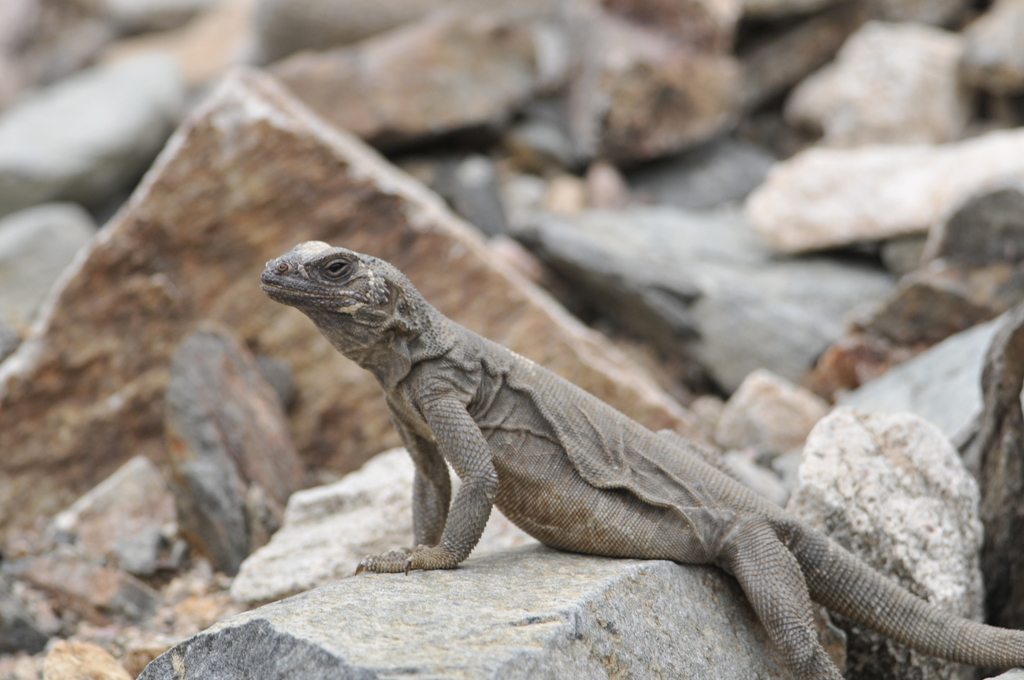
Black Chuckwalla
Sauromalus hispidus
The Angel Island chuckwalla (Sauromalus hispidus), also known as the spiny chuckwalla, is a species of chuckwalla lizard belonging to the family Iguanidae endemic to Isla Ángel de la Guarda (Guardian Angel Island) in the Gulf of California. The species was transported to other islands by a tribe of the Seri as a potential food source.
From the article Angel Island chuckwalla on Wikipedia (CC BY-SA), quoted section by section
Description
The Angel Island chuckwalla is the second-largest species of chuckwalla, reaching 44 cm (17 in) in body length and 64 cm (25 in) overall length, and weighing up to 1.4 kg (3.1 lb). It is considered a gigantic species as it is two to three times the size of its mainland counterparts. Its body color is a dark brown color with transverse black bands which fade into a solid darker brown to black color as the animal ages.
Range & habitat
The Angel Island chuckwalla is endemic to Isla Ángel de la Guarda and 10 smaller islands in the Gulf of California.
Wikipedia: “Distribution and habitat”
What it does
Harmless to humans, these lizards are known to run from potential threats. When disturbed, the chuckwalla inflates its lungs, distends its body, and wedges itself into a tight rock crevice. Males are seasonally and conditionally territorial; an abundance of resources tends to create a hierarchy based on size, with one large male dominating the area's smaller males. Chuckwallas defend their territory and communicate with one another using a combination of color and physical displays, namely "push ups", head-hobbing, and gaping of the mouth. Angel Island chuckwallas are diurnal animals, and as they are exothermic, spend much of their mornings and winter days basking. These lizards are well adapted to desert conditions; they are active at temperatures up to 102 °F (39 °C). Mating occurs from April to July, with five to 16 eggs laid between June and August. The eggs hatch in late September. Chuckwallas may live for 25 years or more.
Wikipedia: “Behavior and reproduction”
In human culture
The generic name, Sauromalus, is said to be a combination of two ancient Greek words: sauros meaning "lizard" and omalus meaning "flat". The proper ancient Greek word for "flat" is however homalos (ὁμαλός) or homalēs (ὁμαλής). Its specific name hispidus is Latin for "coarse" or "thorny" in reference to the spines on the chuckwalla's tail. The common name chuckwalla derives from the Shoshone word tcaxxwal or Cahuilla caxwal, transcribed by Spaniards as chacahuala.
Wikipedia: “Taxonomy and etymology”
Where it lives
Recorded sightings
—
geo-referenced records in GBIF, from museums, herbaria and field observers.
Drag the globe to turn it. Dots are where records exist, not a range map; darker means more records.
In the stacks
Searching the stacks…
Every page naming Sauromalus hispidus in the Biodiversity Heritage Library →
This page is assembled live from iNaturalist, GBIF, Wikipedia, the Source Library and the Internet Archive. It is not yet part of the hand-edited codex. iNaturalist taxon 35340.