- Animals
- ›Chordates
- ›Vertebrates
- ›Reptiles
- ›Snakes and Lizards
- ›Lizards
- ›Iguanas and Allies
- ›Iguanas, Anoles, and Allies
- ›Iguanas and Chuckwallas
- ›Sauromalus
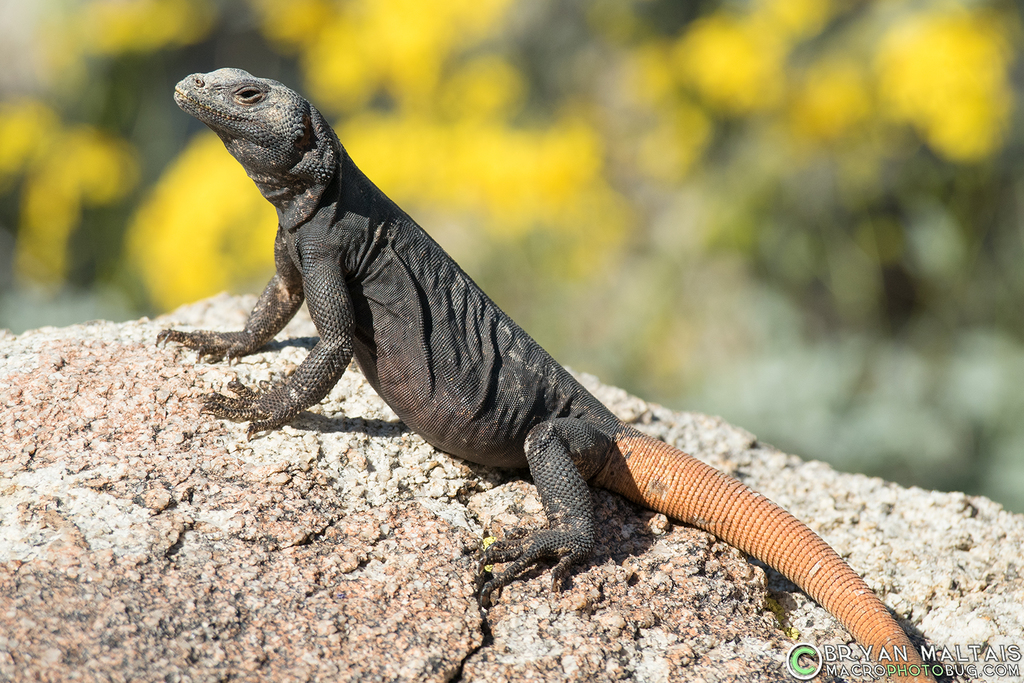
Common Chuckwalla
Sauromalus ater
Sauromalus ater, also known as the common chuckwalla or northern chuckwalla, is a species of lizard in the family Iguanidae. It inhabits the Sonoran and Mojave Deserts of the Southwestern United States and northwestern Mexico. Its range extends from eastern California, Utah, and Nevada south to Baja California and Sonora.
From the article Sauromalus ater on Wikipedia (CC BY-SA), quoted section by section
Description
The common chuckwalla is a large, flat-bodied lizard with a large, rounded belly, and a wide-based, blunt-tipped tail. Reaching a total length of 20 in (51 cm) and a weight of 0.9 kg (2.0 lb). Small scales cover its body, with larger scales protecting the ear openings. The coloration of these lizards varies by location and between juveniles and adults, as well as between males and females. In adult males, the head, shoulder, and pelvic regions are black, while the midbody is light tan speckled with brown. Adult females are brownish in color with a scattering of dark red spots. Young chuckwallas have four or five broad bands across their bodies, and three or four on the tail which are lost in adulthood by males, but retained somewhat by females.
What it does
Harmless to humans, these lizards are known to run from potential threats. When disturbed, the chuckwalla enters crevices between rocks and inflates its lungs using a gular pump. Lung inflation distends its body and wedges the lizard tightly in place. Males are seasonally and conditionally territorial; an abundance of resources tends to create a hierarchy based on size, with one large male dominating the area's smaller males. Chuckwallas use a combination of color and physical displays, namely "push ups", head-bobbing, and gaping of the mouth to communicate and defend their territory. They spend much of their morning basking. They display different basking positions depending on the season. In the spring, they lie inflated on rocks with their stomach pressed to the ground, resting their throat on the rocks. In the summer, this flattened posture is replaced with sitting and stilting. Chuckwallas are diurnal animals, and as they are ectothermic, spend much of their mornings and cooler days basking. These lizards are well adapted to desert conditions; they are active at temperatures up to 102 °F (39 °C). Chuckwallas brumate during cooler months and emerge in February. Mating occurs from April to July, with 5 to 16 eggs laid between June and August. The eggs hatch in late September.
Wikipedia: “Behavior”
Where it lives
Recorded sightings
—
geo-referenced records in GBIF, from museums, herbaria and field observers.
Drag the globe to turn it. Dots are where records exist, not a range map; darker means more records.
In the stacks
Searching the stacks…
Every page naming Sauromalus ater in the Biodiversity Heritage Library →
This page is assembled live from iNaturalist, GBIF, Wikipedia, the Source Library and the Internet Archive. It is not yet part of the hand-edited codex. iNaturalist taxon 35330.