- Animals
- ›Chordates
- ›Vertebrates
- ›Reptiles
- ›Snakes and Lizards
- ›Lizards
- ›Iguanas and Allies
- ›Iguanas, Anoles, and Allies
- ›Iguanas and Chuckwallas
- ›Cyclura
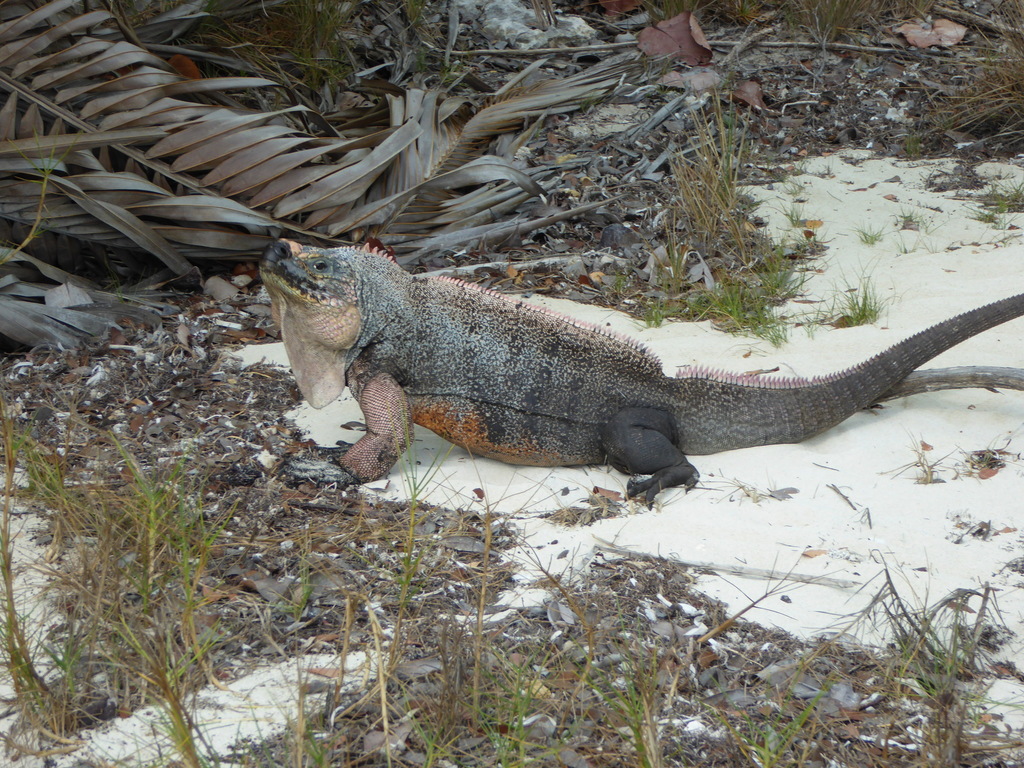
Bahamas Rock Iguana
Cyclura carinata
The Turks and Caicos rock iguana (Cyclura carinata) is a species of lizard endemic to the Turks and Caicos islands. This small iguana can reach 30 in (76 cm) and becomes mature at seven years and may live for twenty. A single clutch of up to nine eggs is laid each year, and these take three months to hatch. This iguana is mostly herbivorous, but supplements this by adding some animal matter to its diet.
At one time numerous, these iguanas have been depleted by introduced predators, mainly cats and dogs. Their habitat is being degraded by overgrazing and trampling of vegetation which reduces the availability of food for the iguanas. They have been wiped out of some islands and cling on precariously in others. The International Union for Conservation of Nature has rated them as endangered. Various conservation efforts are being undertaken, and some iguanas have been relocated to uninhabited islets in an effort to prevent them from becoming extinct.
From the article Turks and Caicos rock iguana on Wikipedia (CC BY-SA), quoted section by section
Description
Measuring less than 770 millimetres (30 in) in length when full grown, the Turks and Caicos Rock iguana is one of the smallest species of Cyclura. The lizard's basic color can range from green to brownish grey, usually patterned by darker markings. The species lacks the large scales on the upper surface of its head, characteristic of other species of cyclura and possesses larger dorsal spines than other species of iguana. Like other members of the genus Cyclura, males of this species are larger than females (in this case twice as large in body mass) and have larger dorsal crests and femoral pores on their thighs making the animals sexually dimorphic.
Wikipedia: “Anatomy and morphology”
Range & habitat
The Turks and Caicos rock iguana inhabits small cays, but has been reduced to less than 5% of its original range largely due to the introduction of predators. 2,000 iguanas are the only land creatures that inhabit Little Water Cay. To promote tourism on Little Water Cay, a boardwalk has been built throughout the island. Tourists can take a tour of the island, along this boardwalk, but are not permitted to step off it. The Turks and Caicos rock iguana dwells in rocky areas and sandy habitats as sand is required for nesting. The Turks and Caicos iguana is diurnal and spends the night in the burrows it has dug or in natural retreats in or under the rocks.
Wikipedia: “Habitat and distribution”
What it does
Like all Cyclura species, the Turks and Caicos rock iguana is primarily herbivorous, consuming leaves, flowers, and fruits from over 58 different plant species. This diet is very rarely supplemented with insects, mollusks, crustaceans, arachnids, lizards, and carrion. It has been noted that in captivity, it eats both animal and plant food. Gerber and Iverson write that the Turks and Caicos rock iguana may live at least 20 years.
Wikipedia: “Diet and longevity”
At the table
Like most Cyclura species the Turks and Caicos rock iguana is in decline. In this species' case it is primarily due to its small body size which makes it vulnerable to introduced predators such as dogs and cats. In the 1970s a population of 15,000 iguanas was completely destroyed within five years by a mere handful of dogs and cats brought to Pine Cay by hotel workers. Competitive grazing with domestic and feral livestock is a secondary factor.
Wikipedia: “Causes of decline”
Where it lives
Recorded sightings
—
geo-referenced records in GBIF, from museums, herbaria and field observers.
Drag the globe to turn it. Dots are where records exist, not a range map; darker means more records.
In the stacks
Searching the stacks…
Every page naming Cyclura carinata in the Biodiversity Heritage Library →
This page is assembled live from iNaturalist, GBIF, Wikipedia, the Source Library and the Internet Archive. It is not yet part of the hand-edited codex. iNaturalist taxon 35299.