- Animals
- ›Chordates
- ›Vertebrates
- ›Reptiles
- ›Snakes and Lizards
- ›Lizards
- ›Iguanas and Allies
- ›Iguanas, Anoles, and Allies
- ›Iguanas and Chuckwallas
- ›Cyclura
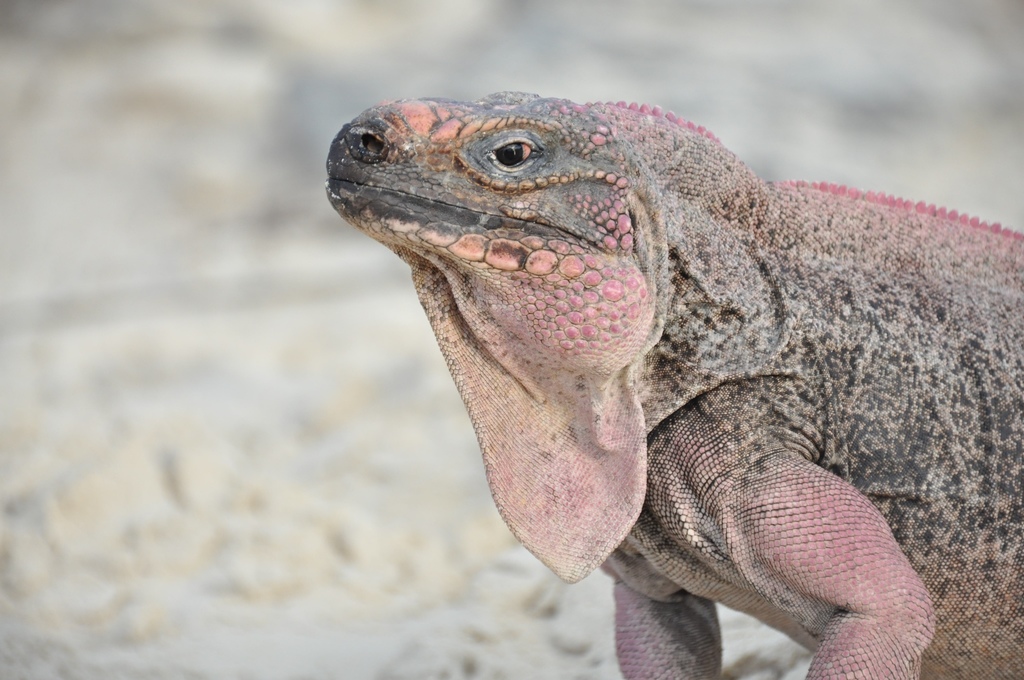
Allen's Island Iguana
Cyclura cychlura
The northern Bahamian rock iguana (Cyclura cychlura) is a species of lizard of the genus Cyclura that is found on Andros Island and the Exuma islands in the Bahamas. Its status on the IUCN Red List is vulnerable, with a wild population of less than 5,000 animals.
From the article Northern Bahamian rock iguana on Wikipedia (CC BY-SA), quoted section by section
Description
This species, like other species of Cyclura, is sexually dimorphic; males are larger than females, and have more prominent femoral pores on their thighs which are used to release pheromones.
Range & habitat
This species only occurs in the southwestern Bahamas. 18,000 years ago during the last ice age and the sea level was much lower, many of the islands of the Bahamas were connected to each other and this species probably existed in an unbroken population, the relict populations now inhabit Andros Island and the Exuma islands.
Wikipedia: “Distribution”
What it does
It lives in tropical dry forest, pine barrens, coastal coppice, mangrove and beach strand habitats. These are found on low islands built from karst limestone plateaus. Like all Cyclura species, the northern Bahamian rock iguana is primarily herbivorous. It is ground-dwelling, although juveniles often climb into branches in the morning to bask and feed.
Wikipedia: “Ecology (habitat)”
At the table
In 2004 the IUCN listed the main threats to this lizard depended on the islands where the different subspecies came from; with the Andros Island population to be threatened by logging, infrastructure development, feral animals and fires set for agricultural or crab-hunting reasons. The populations from the Exumas were imperilled due to feral animals (goats), fires caused by tourists, and rapid private land acquisition (primarily for tourism purposes). Development, fire and feral animals had caused a reduction in area of suitable habitat of at least 20% over the previous 30 years. Feral animals which pose a threat to the iguanas are cats, dogs, hogs and goats. Dogs prey upon juvenile and adult iguanas, hogs eat their eggs. All populations were still occasionally being hunted for meat or for the pet trade according to the IUCN in 2004. A 2002 article in the Miami Herald quoted an officer of the Bahamas' Department of Agriculture who stated iguanas were still sometimes hunted and eaten, albeit rarely.
Wikipedia: “Causes of decline”
Where it lives
Recorded sightings
—
geo-referenced records in GBIF, from museums, herbaria and field observers.
Drag the globe to turn it. Dots are where records exist, not a range map; darker means more records.
In the stacks
Searching the stacks…
Every page naming Cyclura cychlura in the Biodiversity Heritage Library →
This page is assembled live from iNaturalist, GBIF, Wikipedia, the Source Library and the Internet Archive. It is not yet part of the hand-edited codex. iNaturalist taxon 35290.