- Animals
- ›Chordates
- ›Vertebrates
- ›Reptiles
- ›Snakes and Lizards
- ›Lizards
- ›Iguanas and Allies
- ›Iguanas, Anoles, and Allies
- ›Iguanas and Chuckwallas
- ›Cyclura
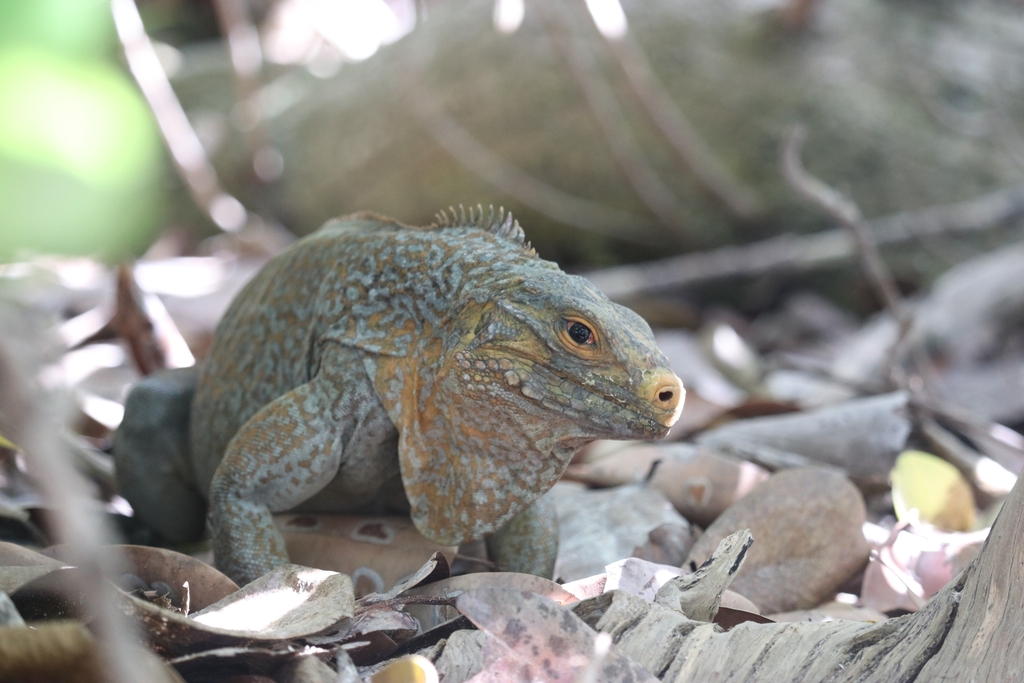
White Cay Ground Iguana
Cyclura rileyi
Cyclura rileyi, commonly known as the Central Bahamian rock iguana or the San Salvador rock iguana, is a critically endangered species of lizard in the family Iguanidae. The species is native to three island groups in the Bahamas, and is in decline due to habitat encroachment from human development and predation by feral dogs and cats. There are three subspecies: the Acklins ground iguana (Cyclura rileyi nuchalis), the White Cay iguana (Cyclura rileyi cristata), and the nominotypical subspecies (Cyclura rileyi rileyi).
From the article Cyclura rileyi on Wikipedia (CC BY-SA), quoted section by section
Description
Measuring 300 to 390 mm (12 to 15 in) in snout-to-vent length (SVL) when full grown, the San Salvador rock iguana is a colorful lizard, the coloration varying between subspecies as well as between individual specimens. The lizard's back color can range from red, orange or yellow, to green, brown or grey, usually patterned by darker markings. The very brightest colors (red, orange, blue, or yellow) are normally only displayed by males and are more pronounced when at warmer body temperatures. Immature iguanas lack these bright colors, being either solid brown or grey with faint slightly darker stripes. This species, like other species of Cyclura, is sexually dimorphic; males are larger than females, and have more prominent dorsal crests as well as larger femoral pores on their thighs, which are used to release pheromones.
Wikipedia: “Anatomy and morphology”
Range & habitat
Once inhabiting all the large islands of the Bahamas, today C. rileyi is confined to six populations in small remote cays of three island groups: San Salvador Island, Acklins, and Exuma. A study in 1995 estimated there were between 426 and 639 specimens left in the wild, and that this number has likely been reduced since much of their habitat was destroyed in 1999 by Hurricane Floyd. The three island groups, each harboring its own subspecies, are on separate banks and were not connected during the last glacial period when water levels were 100 m (330 ft) lower than they are at present.
Wikipedia: “Distribution”
What it does
Like all Cyclura species, the San Salvador rock iguana's diet is primarily herbivorous, 95% of which comes from consuming leaves, flowers and fruits from 7 different plant species such as seaside rock shrub (Rachicallis americana), and erect prickly pear (Opuntia stricta). This diet is very rarely supplemented with insect larvae, crabs, slugs, dead birds and fungi.
Wikipedia: “Diet”
In human culture
The San Salvador rock iguana is an endangered species of lizard of the genus Cyclura in the family Iguanidae. First described by Leonhard Stejneger in 1903, it is known commonly in the Bahamas as simply "iguana". Its specific name, rileyi, is a Latinized form of the surname of American ornithologist Joseph Harvey Riley, who collected the holotype.
Subspecies. As of 1975 two additional subspecific forms have been identified along with the nominal subspecies: the Acklins ground iguana (C. r. nuchalis) and the White Cay iguana (C. r. cristata). Together they are one of the most threatened species of all the West Indian rock iguanas and are described as critically endangered according to the current IUCN Red List.
Wikipedia: “Taxonomy and etymology”
Where it lives
Recorded sightings
—
geo-referenced records in GBIF, from museums, herbaria and field observers.
Drag the globe to turn it. Dots are where records exist, not a range map; darker means more records.
In the stacks
Searching the stacks…
Every page naming Cyclura rileyi in the Biodiversity Heritage Library →
This page is assembled live from iNaturalist, GBIF, Wikipedia, the Source Library and the Internet Archive. It is not yet part of the hand-edited codex. iNaturalist taxon 35280.