On eBird ↗
Long-tailed Ground Dove
Live sightings near you, the range map, bar charts of when it is seen, and Macaulay Library photos and recordings.
Long-tailed Ground-Dove
Uropelia campestris
The long-tailed ground dove (Uropelia campestris) is a species of bird in the dove and pigeon family, Columbidae. It is the only species, within the genus Uropelia. It is found in the cerrado of central and northeast-central Brazil and neighboring Bolivia in the southwest. Its natural habitats are dry savanna and subtropical or tropical seasonally wet or flooded lowland grassland.
From the article Long-tailed ground dove on Wikipedia (CC BY-SA), quoted section by section
Description
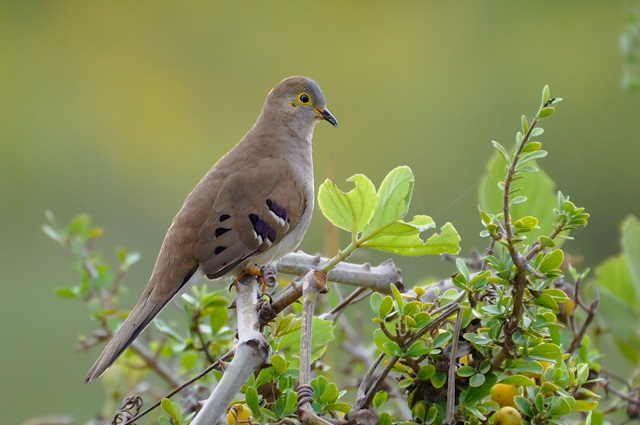
The long-tailed ground dove is 15.7 to 17.7 cm (6.2 to 7.0 in) long. The adult male's forehead and crown are bluish gray. Its upperparts are brown with a pinkish tinge on the hindneck. The folded wing shows two iridescent purple bands and a row of large purplish black spots. The throat and breast are pinkish mauve fading to white on the belly. The long tail's central feathers are brown and the outer ones black with white tips. The eye is gray to blue surrounded by bare yellow to orange skin. The adult female's eye surround is paler than the male's; its underparts are paler pink, its hindneck and shoulders more olive-brown, and the rest of the upperparts an ashier gray. Juveniles are duller and more grayish brown overall, and the bands and spots on the wings are chestnut and buff.
Range & habitat
The long-tailed ground dove is found discontinuously in much of central Brazil and adjoining Bolivia. It inhabits drier (but seasonally wet) grassland, savanna, woodland edges, and scrubby parkland, usually near watercourses. In elevation it ranges from near sea level to 1,100 m (3,600 ft).
Wikipedia: “Distribution and habitat”
What it does
The long-tailed ground dove forages in pairs or small groups, taking a wide variety of seeds from the ground.
Wikipedia: “Feeding”
Listen
Looking for field recordings…
Where it lives
Recorded sightings
—
geo-referenced records in GBIF, from museums, herbaria and field observers.
Drag the globe to turn it. Dots are where records exist, not a range map; darker means more records.
In the stacks
Searching the stacks…
Every page naming Uropelia campestris in the Biodiversity Heritage Library →
This page is assembled live from iNaturalist, GBIF, Wikipedia, the Source Library and the Internet Archive. It is not yet part of the hand-edited codex. iNaturalist taxon 3490.