On eBird ↗
Socorro Dove
Live sightings near you, the range map, bar charts of when it is seen, and Macaulay Library photos and recordings.
Socorro Dove
Zenaida graysoni
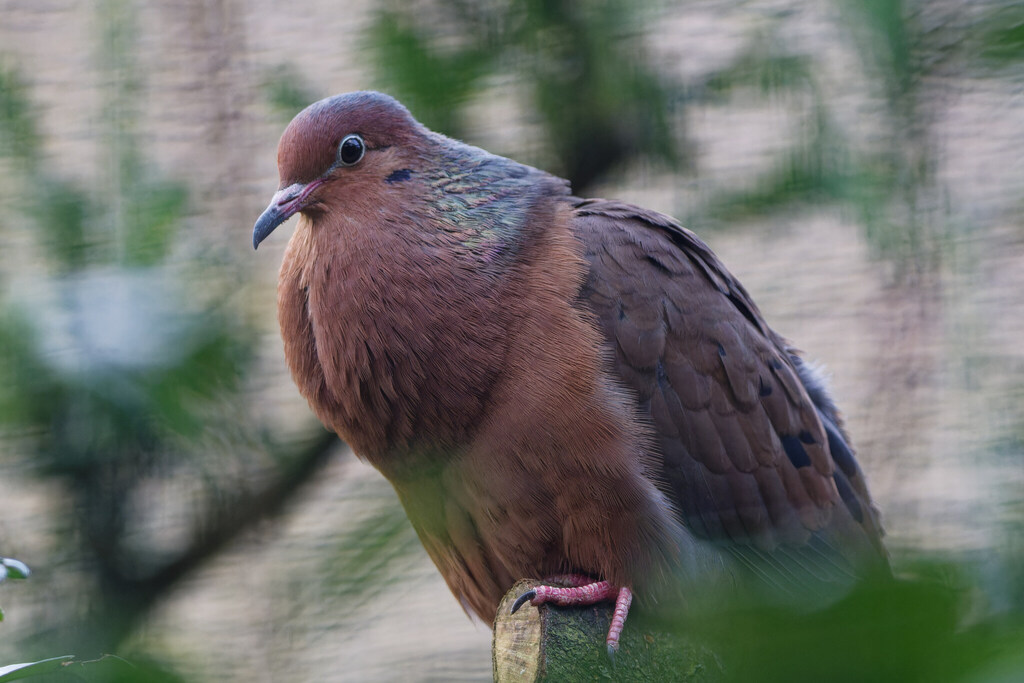
The Socorro dove or Grayson's dove (Zenaida graysoni) is a dove species which is extinct in the wild. It was endemic to Socorro Island in the Revillagigedo Islands off the west coast of Mexico. The last sighting in its natural habitat was in 1972 and it survives only in captivity. A reintroduction program is being prepared.
It is a close relative of the mourning and eared doves, particularly the former, and was at one time considered a subspecies. In captivity, it hybridizes with the former and almost all privately owned birds as well as several of the captive breeding program birds are known or strongly suspected to be hybrids. These are excluded from the reintroduction program as there is evidence of unique adaptations in the Socorro species. The scientific name commemorates Zénaïde Laetitia Julie Bonaparte and the American ornithologist and artist Andrew Jackson Grayson.
From the article Socorro dove on Wikipedia (CC BY-SA), quoted section by section
Description
The Socorro dove is a medium-sized, principally terrestrial dove with long legs for a zenaida dove. It is 26.5–34 cm (10.4–13.4 in) long and weighs 190 g (6.7 oz) on average. In overall color pattern, it agrees with its relatives. It is considered to be a stronger-colored insular representative of the mourning dove. The male is deep cinnamon on its head and underparts, with an ear streak like its relatives. The nape is blue-grey and the neck has an iridescent pink patch, most prominent after moult. The upperparts are rufous brown. Female and juvenile coloration is slightly duller. The most conspicuous differences from the mourning dove, darker coloration and more well-developed feet, were useful amid the dark lava rock and the shady forests of its island home, where native mammalian predators were absent but constant threats from red-tailed hawks and great frigatebirds were present. The advertising call begins with a disyllabic coo, followed by three single calls, and ends with another disyllabic coo: "Coo-oo, OO, OO, OO, Coo-oo". Each of these five elements takes a little less than one second. The arid and fairly barren Clarión Island, some 400 km (250 mi) west of Socorro, has an endemic subspecies of the mourning dove, Zenaida macroura clarionensis. These birds are roughly intermediate in appearance between the Socorro dove and the mainland mourning doves. …
What it does
There is marked behavioral difference to the mourning dove. When Andrew Jackson Grayson discussed the species, he called it the "solitary dove" because he never saw more than one male and one female together. The doves, particularly the adult males, chase away their young as soon as these can fend for their own and the partners split for the time being. This too is believed to be in adaptation to the former dominance of aerial predators, lest local concentrations of birds, let alone young, inexperienced ones, would present easy targets for the hawks. Typical of many birds on islands lacking mammals, Socorro doves also show little fear of humans or introduced predators, including cats, which proved a major factor in its extirpation. The last habitat in which this dove was found is the low seasonally humid forest above 500 m (1,600 ft) ASL. Before the introduction of cats, it seasonally descended into the lowlands where it was "common" in March 1953 for example. It may be that this coincided with the peak of the breeding season, when many birds had dependent young and dispersed widely to gather more varied food. …
Wikipedia: “Ecology”
Listen
Looking for field recordings…
Where it lives
Recorded sightings
—
geo-referenced records in GBIF, from museums, herbaria and field observers.
Drag the globe to turn it. Dots are where records exist, not a range map; darker means more records.
In the stacks
Searching the stacks…
Every page naming Zenaida graysoni in the Biodiversity Heritage Library →
This page is assembled live from iNaturalist, GBIF, Wikipedia, the Source Library and the Internet Archive. It is not yet part of the hand-edited codex. iNaturalist taxon 3464.