- Animals
- ›Arthropods
- ›Hexapods
- ›Insects
- ›Winged and Once-winged Insects
- ›Butterflies and Moths
- ›Owlet Moths and Allies
- ›Cutworm Moths and Allies
- ›Cutworms and Dart Moths
- ›Xylenini
- ›Xylenina
- ›Conistra
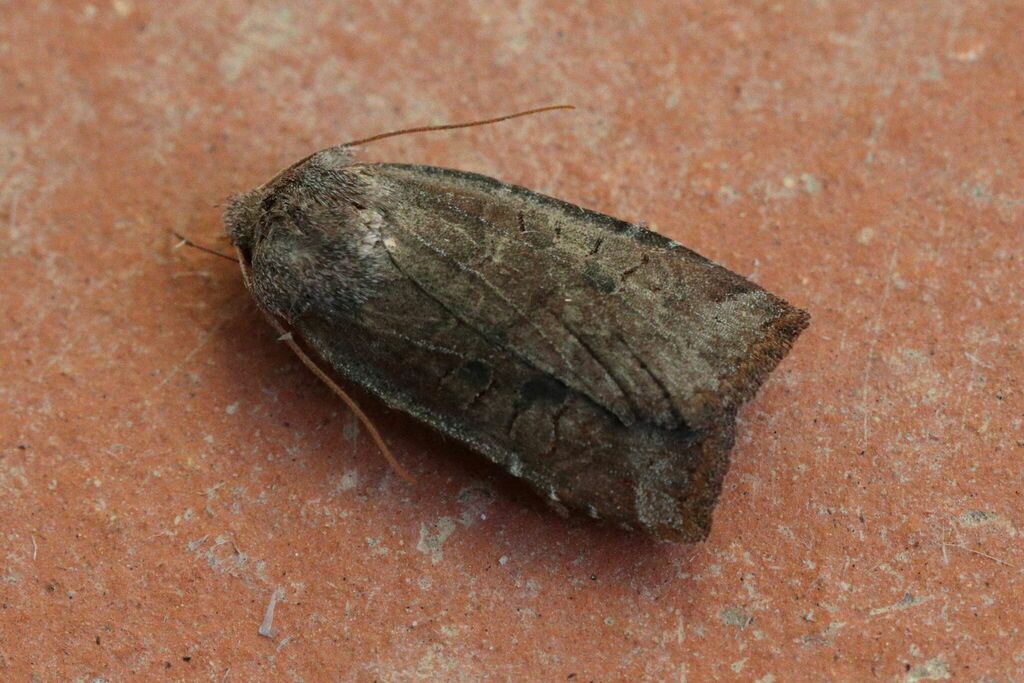
Dark Chestnut
Conistra ligula
Conistra ligula, the dark chestnut, is a moth of the family Noctuidae. The species was first described by Eugenius Johann Christoph Esper in 1791 and it is found in the Palearctic.
From the article Conistra ligula on Wikipedia (CC BY-SA), quoted section by section
Description
The length of the forewings is 13–15 mm. "Forewing deep red brown or purplish brown, darker than vaccinii; a pale submarginal band, grey or brownish grey, on which stand the spots forming the submarginal line; the lines and edges of the stigmata, and often the veins pale; hindwing brownish fuscous." Differential characters: dark brown or red-brown base colour of the forewings. Pale subterminal fascia. brown fuscous hindwings.
Range & habitat
It is found in western, central and southern Europe. In western Europe, it is missing in many parts of Scotland and the western part of Ireland. In central Europe it is missing on the German North Sea coast, in Denmark, the entirety of Fennoscandia wooded, the northern Baltic countries and the central and northern Russia. The species also does not occur on many islands of the Mediterranean. In North Africa, it is found in Morocco. Further east, its range extends into northern Iraq, Turkey and Armenia.
Wikipedia: “Distribution”
Listen
Looking for field recordings…
Where it lives
Recorded sightings
—
geo-referenced records in GBIF, from museums, herbaria and field observers.
Drag the globe to turn it. Dots are where records exist, not a range map; darker means more records.
In the stacks
Searching the stacks…
Every page naming Conistra ligula in the Biodiversity Heritage Library →
This page is assembled live from iNaturalist, GBIF, Wikipedia, the Source Library and the Internet Archive. It is not yet part of the hand-edited codex. iNaturalist taxon 343152.