- Plants
- ›Vascular Plants
- ›flowering plants
- ›monocots
- ›grasses, sedges, cattails, and allies
- ›grasses
- ›Chloridoideae
- ›Cynodonteae
- ›Aeluropodinae
- ›Odyssea
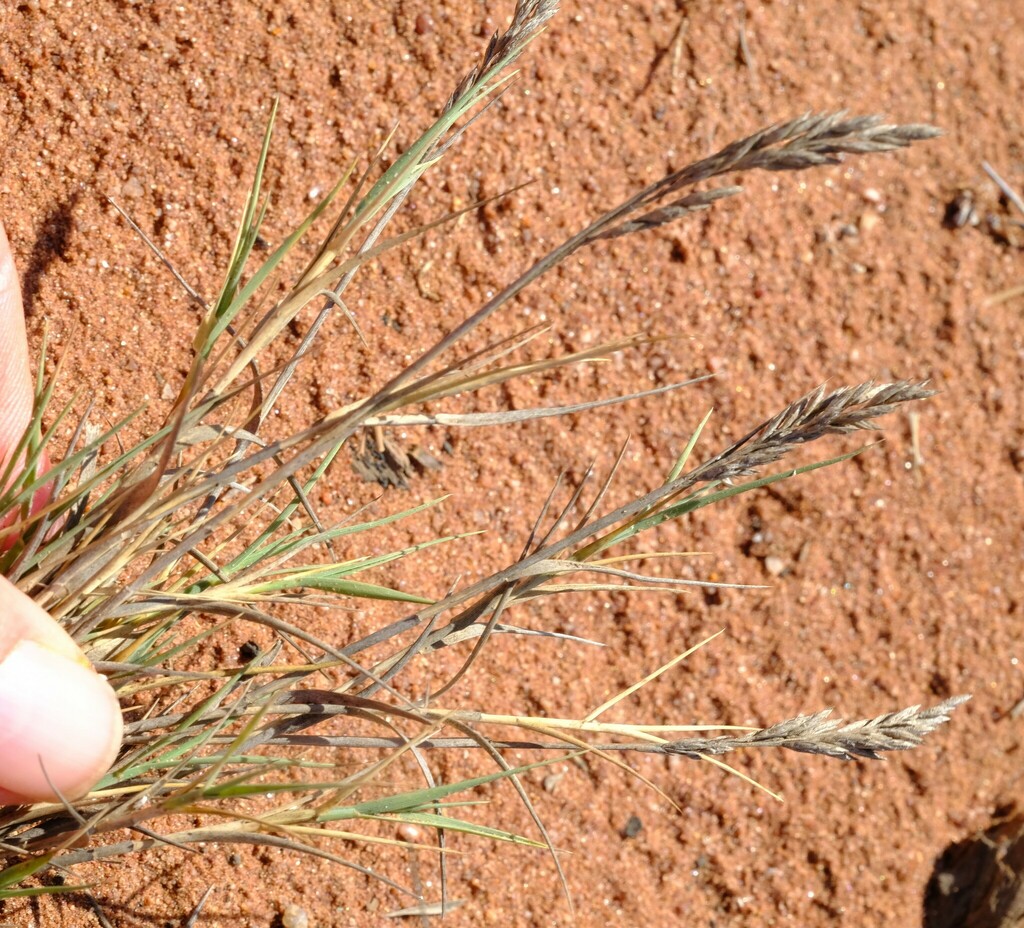
Prickly Brack Grass
Odyssea paucinervis
Odyssea paucinervis is a species of African plants in the grass family. The genus is named after the ancient Greek tale the "Odyssey", in allusion to the long journey the type species has taken through nine genera before settling in this one. The specific name means "few veined".
From the article Odyssea paucinervis on Wikipedia (CC BY-SA), quoted section by section
Description
This grass is a perennial plant with long, stout, rhizomes that penetrate deeply into the ground. The stems branch only at the base, have an L-shaped bend and are up to 30 cm (10 in) in length. They grow in matted tufts and are bluish-green. The ligules are formed from rings of hairs and the leaves are rolled, stiff and tough, and somewhat pungent. The inflorescence is narrowly elliptic or elliptic-oblong and up to 7 cm (3 in) long. It is composed of many spikelets, each with four to nine flowers.
Range & habitat
Odyssea paucinervis is native to Zaire, Somalia, Tanzania, Angola, Zambia, Zimbabwe, Botswana, Cape Province, Namibia, Limpopo and Mpumalanga.
Wikipedia: “Distribution”
At the table
Odyssea paucinervis is a salt-tolerant plant that grows on sand and it is often the only plant in its habitat. The leaves are tough and spiky and are of little use as fodder. The plant has a very deep root system and grows by means of extensive rhizomes. Wind-blown sand builds up around the plants which mat together and form mounds. If planted in dunes this grass can bind the sand and help stabilize the dunes.
== References ==
Wikipedia: “Uses”
Where it lives
Recorded sightings
—
geo-referenced records in GBIF, from museums, herbaria and field observers.
Drag the globe to turn it. Dots are where records exist, not a range map; darker means more records.
In the stacks
Searching the stacks…
Every page naming Odyssea paucinervis in the Biodiversity Heritage Library →
This page is assembled live from iNaturalist, GBIF, Wikipedia, the Source Library and the Internet Archive. It is not yet part of the hand-edited codex. iNaturalist taxon 343078.