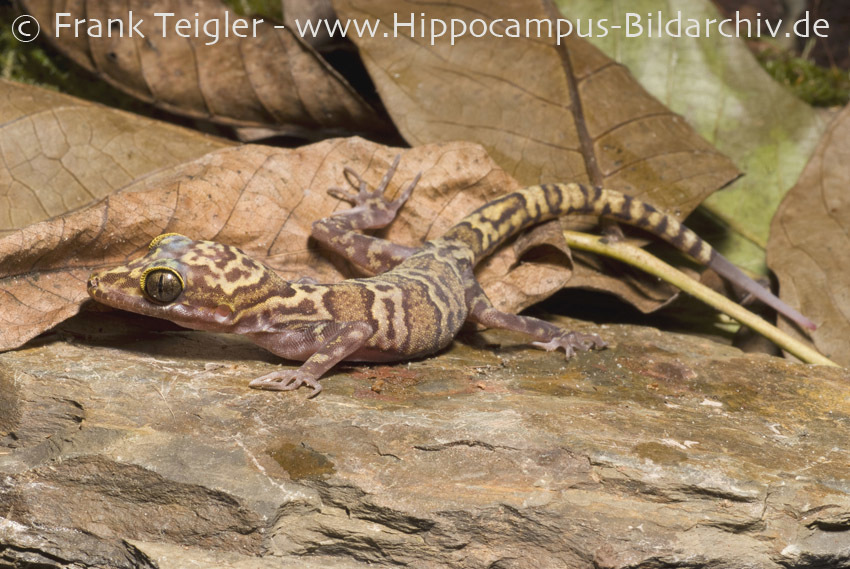
Mocquard's Madagascar Ground Gecko
Paroedura bastardi
Mocquard's Madagascar ground gecko (Paroedura bastardi) is a species of lizard in the family Gekkonidae. It is a moderately-sized reptile reaching just over 7 cm (2.8 in) in snout–vent length. The species is endemic to southeastern Madagascar, where it can be found on the ground or climbing tree trunks.
Although it was formerly thought to be a widespread species throughout much of west and south Madagascar, morphological and genetic analyses have found that this was due to misclassification, and that this definition of the species is actually a species complex comprising several cryptic species. Today, it is known that P. bastardi in the strict sense is actually restricted to the extreme southeast of the country.
From the article Mocquard's Madagascar ground gecko on Wikipedia (CC BY-SA), quoted section by section
Description
The Mocquard's Madagascar ground gecko is a moderately-sized species which may attain a snout-to-vent length (SVL) of approximately 7.1–7.3 cm (2.8–2.9 in). The triangular head is distinctly wider than the neck, and the ear opening is a vertical slit. Like its closest relatives, the dorsal surface of this species has enlarged keeled scales arranged in longitudinal rows. The tail has spiny tubercles, which in juveniles are arranged more regularly than in adults. The limbs are robust, with lamellae-lined toe pads that are wider than the rest of the digit. The body is a tawny brown color with scattered grayish spots and three lighter crossbands. The bands are most prominent in younger individuals, where they may be white with dark borders, whereas in adults they are less distinct. Juveniles also have a distinct pattern on the head which has been described as "butterfly or bat-shaped" that becomes less visible with age. There is no banded patterning on the digits.
Range & habitat
Older sources commonly state that Mocquard's Madagascar ground gecko is found across western and southern Madagascar in dry forests, shrubland, and rocky areas, at altitudes of 40–800 m (130–2,620 ft). However, this is due to the fact that several lineages now known to be distinct were once assigned to this species, and the aforementioned range is actually that of the species complex as a whole. Miralles et al. (2021) found that "true" Paroedura bastardi are only known from the extreme southeast of Madagascar, and that records of this species from elsewhere on the island actually represent other cryptic species including P. rennerae, P. guibeae and P. manongavato. There is some overlap in range among members of the species complex, with P. bastardi and P. guibeae occurring sympatrically in Tranoroa.
Wikipedia: “Distribution and habitat”
What it does
This gecko is a terrestrial species capable of climbing, and can be seen on the ground or on vertical wooden surfaces such as tree trunks. It and other species of the P. bastardi complex have been reported to be quick to bite when handled, likely as a defence mechanism. It is oviparous, laying eggs which the female buries in substrate. While this species is known to coexist with the related Paroedura guibeae in Tranoroa, molecular evidence indicates there is reproductive isolation between the two species.
Wikipedia: “Behaviour”
Where it lives
Recorded sightings
—
geo-referenced records in GBIF, from museums, herbaria and field observers.
Drag the globe to turn it. Dots are where records exist, not a range map; darker means more records.
In the stacks
Searching the stacks…
Every page naming Paroedura bastardi in the Biodiversity Heritage Library →
This page is assembled live from iNaturalist, GBIF, Wikipedia, the Source Library and the Internet Archive. It is not yet part of the hand-edited codex. iNaturalist taxon 34104.