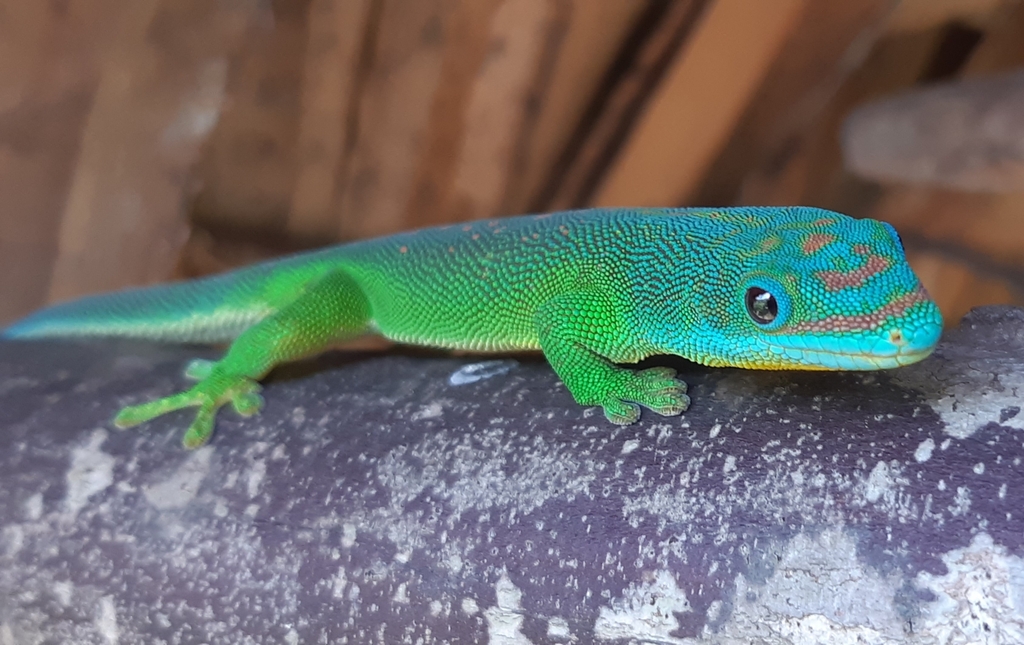
Yellow-throated Day Gecko
Phelsuma flavigularis
The yellow-throated day gecko (Phelsuma flavigularis) is an endangered diurnal species of gecko from eastern Madagascar. It typically inhabits rainforests and dwells on trees. The yellow-throated day gecko feeds on insects and nectar.
From the article Yellow-throated day gecko on Wikipedia (CC BY-SA), quoted section by section
Description
This lizard belongs to the medium-sized day geckos. Males can reach a total length of about 15 cm (5.9 in) while females are often much smaller. The body colour is dark green or bluish green. On the snout there are two red transversal bars. One to three rust-coloured stripes may be present on the neck. On the back there are small brownish or reddish dots and spottings. The throat is light yellow and the ventral side is beige. P. flavigularis has blue eye rings.
Range & habitat
This species has a limited distribution. It is only known from the area around Andasibe on the east coast of Madagascar, about 100 km (62 mi) east of Antananarivo.
Wikipedia: “Distribution”
What it does
These day geckos feed on various insects and other invertebrates. They also like to lick soft, sweet fruit; pollen; and nectar.
Wikipedia: “Diet”
Where it lives
Recorded sightings
—
geo-referenced records in GBIF, from museums, herbaria and field observers.
Drag the globe to turn it. Dots are where records exist, not a range map; darker means more records.
In the stacks
Searching the stacks…
Every page naming Phelsuma flavigularis in the Biodiversity Heritage Library →
This page is assembled live from iNaturalist, GBIF, Wikipedia, the Source Library and the Internet Archive. It is not yet part of the hand-edited codex. iNaturalist taxon 34056.