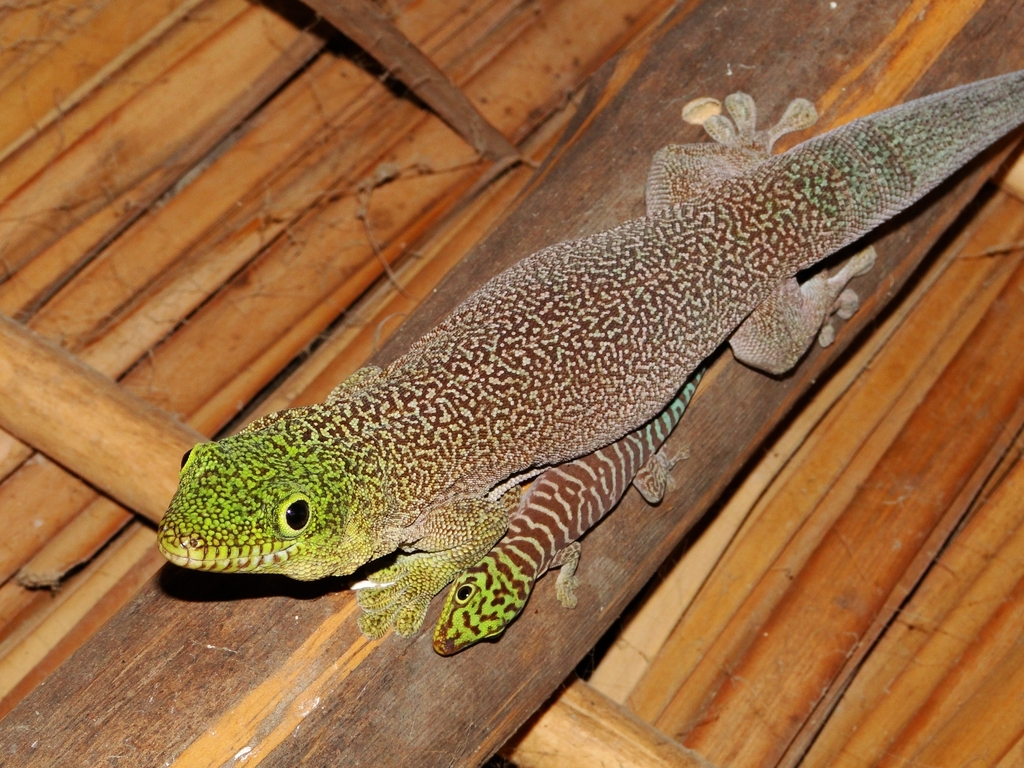
Banded Day Gecko
Phelsuma standingi
Standing's day gecko (Phelsuma standingi) is an arboreal and diurnal species of lizard in the family Gekkonidae. The species is endemic to southwest Madagascar; it is threatened by illegal collection for the international pet trade and habitat loss. It is among the largest living species of day geckos. Standing's day gecko feeds on insects and nectar.
From the article Standing's day gecko on Wikipedia (CC BY-SA), quoted section by section
Description
P. standingi is among the largest extant species of day geckos. It can reach a maximum total length (including tail) of 8-10″ (20-25.4cm), although larger is possible. The body colour can be quite variable, depending on light intensity. It can be brownish grey or bright green or turquoise with grey to blue reticulated markings on its body and head. The head and tail are often turquoise. Hatchlings have a yellowish green head and typical light bands and bars on their backs. It is a sexually dimorphic species. In the males the cloacal area has very pronounced preanal pores and a bulge in the area of hemipenis. In many females two endolymphatic chalk sacs, located on each side of the neck, are well-developed, while in males usually they are just barely visible. These sacs store calcium, which is needed for the formation of egg shells.
Range & habitat
P. standingi is restricted to the arid southwest of Madagascar, specifically the region around Andranolaho, Sakaraha and in the Zombitse-Vohibasia National Park. This area has a unique thorn forest vegetation. The daytime temperature never drops under 20 °C (68 °F) and between January and December, the temperature can be as high as 40 °C (104 °F) in the shade. In July and August, the night temperature can drop to 13 °C (55 °F).
Wikipedia: “Distribution and habitat”
What it does
Standing's day gecko feeds on various insects, invertebrates, and even smaller lizards. It is omnivorous, however, supplementing its prey with soft, sweet fruit, pollen and nectar.
Wikipedia: “Diet”
In human culture
The generic name, Phelsuma, is a Latinized version of the last name of Dutch physician Murk van Phelsum. The specific name, standingi, is in honor of another physician, Doctor Herbert F. Standing of Antananarivo, Madagascar.
Wikipedia: “Etymology”
Where it lives
Recorded sightings
—
geo-referenced records in GBIF, from museums, herbaria and field observers.
Drag the globe to turn it. Dots are where records exist, not a range map; darker means more records.
In the stacks
Searching the stacks…
Every page naming Phelsuma standingi in the Biodiversity Heritage Library →
This page is assembled live from iNaturalist, GBIF, Wikipedia, the Source Library and the Internet Archive. It is not yet part of the hand-edited codex. iNaturalist taxon 34019.